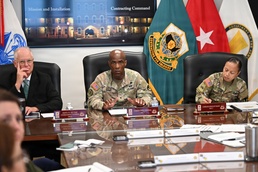
JOINT BASE SAN ANTONIO-FORT SAM HOUSTON, Texas — The Mission and Installation Contracting Command leadership team reinforced its commitment to transparency, communication, the Army’s contracting mission, and organizational transformation during the command’s Fiscal Year 2026 third quarter town hall July 13 at MICC headquarters.
Originally scheduled for June 30, the town hall was hosted by the MICC Command Team, Brig. Gen. Freddy Adams, the MICC commanding general, Clay Cole, the MICC deputy to the commanding general, and Command Sgt. Maj. JennyAnne Bright, the MICC command sergeant major. While approximately 30 senior leaders and headquarters staff joined in person, over 745 Soldiers and Civilians from across the command participated virtually through Microsoft Teams.
“It is great to get together so that we can talk about, not only the progress we have made, but also our path forward for the future,” Adams said, before leading a discussion on the command’s newly launched 2026-2027 Campaign Plan. The plan outlines a refined mission statement, commander’s intent and three strategic lines of effort designed to align the organization with Army priorities.
The MICC’s mission is to deliver decisive contracting solutions that strengthen Army readiness, enable combat capability and improve the quality of life for Soldiers and Families by providing agile, ethical and innovative contracting support wherever the Army serves.
“Really, our mission has not changed,” Adams said. “The MICC is still responsible for delivering those decisive contracting solutions to our Army and to our supported activities.”
Adams explained that while the mission remains constant, the campaign plan’s lines of effort, key tasks and desired effects were refined to better align the command with Army senior leader priorities, higher headquarters guidance and the rapidly evolving contracting environment.
“When I took command about two years ago,” Adams said, “I talked about that [the MICC campaign plan] being a living document. Like anything, you get in an organization, you contend with some of the challenges, you learn and the environment changes—and all of those things have occurred.”
The campaign plan centers on three lines of effort: forging elite talent, delivering contracting solutions at the speed of relevance and innovating through contracting to maintain the Army’s competitive advantage. Together, they represent an evolution and expansion of the command’s previous priorities of people, readiness, execution and transformation.
Adams emphasized that the campaign plan serves as the foundation for the MICC’s ongoing transformation and reflects a continued emphasis on honing the talents within the workforce while improving support to Soldiers, installations and mission partners worldwide.
“I remain deeply convinced of the expertise, dedication and the commitment of the folks within this command—and that has been the constant,” Adams told his workforce, staff and leaders. “I think we have stretched ourselves, we have grown and we have really explored ways of doing things differently—and we need to continue to build on that.”
The campaign plan also outlines Adams’ vision for the MICC to become the Army’s unrivaled contracting arsenal — a trusted, agile and forward-leaning contracting command composed of elite professionals who anticipate mission needs, master their craft and provide an unmatched competitive advantage to every Soldier, unit and installation the command serves.
“An arsenal houses the resources that the nation needs to impose its will and to deliver on both national and strategic outcomes.” Adams explained. “From a contracting perspective, that is what we do—we house those resources that enable our Army across a wide spectrum of operational needs and deliver capability at the time and space it is needed to impose our will and deliver those effects.”
Cole, the command’s senior civilian, praised the workforce for demonstrating agility, speed, capability and flexibility throughout the organization’s continued transformation.
“Flexibility is the key to performance, flexibility is the key to success and you guys have been extremely flexible,” Cole said. “You have got to bend with what is going on at the time, and people are doing that, and they are coming up with innovation solutions.”
Bright reiterated how impressed she is that the command continues to operate at optimal levels, despite the continued challenges of transformation.
“Transformation cannot happen without you, the people that execute it,” Bright said. “Army contracting will remain to be a critical capability in our Army, and I know every single one of our Soldiers and our Civilian workforce understands that.”
Bright also introduced attendees to the inaugural MICC Launch Program, a professional development initiative scheduled for July 28-30 that supports the campaign plan’s Forge Elite Talent line of effort.
“This is essentially an integration program, to let our newest contracting teammates know what the MICC is, who we are, what our purpose is and how we utilize contracting as a warfighting capability,” Bright said.
Developed by Bright, in partnership with the command’s senior noncommissioned officers, the program prepares transitioning 51C Soldiers with the tactical, technical and leadership skills needed to succeed in operational contracting assignments.
Her vision for the course is to “empower our transitioning 51Cs with the localized tools and knowledge necessary to navigate op contracting competently,” Bright said. “As strong sergeants they will translate their foundational training into immediate action, accelerating their contribution to the MICC.”
In anticipation of the program’s success and early feedback from auditors of the course, participation in MICC’s Lauch Program will be mandatory for all newly assigned 51C officers and noncommissioned officers after the July iteration.
During the nearly two-hour town hall event, brigade and field directorate leaders also highlighted stellar performers making a significant impact on the mission and other employees for their milestone years of dedicated federal service. Dean Michalec, deputy chief of staff for personnel, and Patrick Hill, his deputy, also provided updates and answered audience questions on hiring, labor relations and the Army’s telework policy.
The command also addressed more than a half-dozen live and presubmitted questions from employees across the organization. Additional staff briefed attendees on contracting modernization efforts, including Small%20Business%20Innovation%20Research%20and%20Small%20Business%20Technology%20Transfer%20(SBIR%7CSTTR)%20Program (SBIR/STTR) Program, Other Transactions Authority contracting actions and authorized Artificial Intelligence Tools approved to assist in Army contract writing.
Throughout the town hall discussion, each of the leaders encouraged employees to provide candid feedback, participate in frequent two-way discussions and help leaders identify both successes and opportunities for improvement as the organization continues its transformation.
“I will conclude the same way I started, and that is to say thank you,” Adams told attendees in his closing remarks. “I am incredibly honored for the privilege to serve as your commanding general for this organization.”
Since assuming command in June 2024, Adams established recurring town halls as one of several communication forums the command team uses to engage the approximately 1,500 personnel workforce, alongside monthly Golden Sword command videos, command-wide email updates, an anonymous feedback tool and commander’s coffees. Together, those communication efforts reinforce the organization’s commitment to transparent, two-way dialogue as it executes the 2026-2027 Campaign Plan.
About the MICC TheMission and Installation Contracting Commandis a one-star subordinate command of theArmy Contracting Commandand theArmy Materiel Command. MICC Soldiers, Civilians and contractors take pride in their mission to support Soldiers and their families across the theater of operations by delivering decisive contracting solutions across the theater of operations, equipping America’s Soldiers with what they need to dominate on the battlefield, sustaining readiness at home and pioneering the capabilities for the Army of tomorrow. Headquartered atJoint Base San Antonio-Fort Sam Houston, Texas, the MICC comprises nearly 1,500 Soldiers and Civilian employees assigned across the theater of operations. MICC contracts are vital in feeding more than 260,000 Soldiers every day, providing daily base operations support services at installations, preparing more than 100,000 conventional force members annually, facilitating training for more than 100,000 students each year, and maintaining more than 14.4 million acres of land and 170,000 structures.