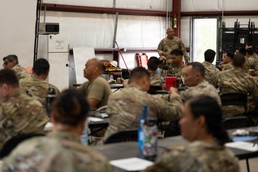
JOINT BASE PEARL HARBOR-HICKAM, Hawaii – The Hawaii Air National Guard conducted Po‘okela - an interisland Readiness Exercise April 28 – May 3. The exercise took place on the islands of Oahu, Hawaii, and Kauai and was used to validate homeland defense capabilities while operating in a degraded, post-hurricane environment. Designed to prepare the 154th Wing for an upcoming Capstone, Po‘okela tested a complex hub-and-spoke operational model. Joint Base Pearl Harbor-Hickam served as the central hub, while units across neighboring islands acted as spokes, challenging Airmen to sustain operations, maintain communications and project combat capability despite disrupted infrastructure.
“My number one priority for the 154th Regional Support Group is combat readiness,” said Col. Mariko Boone, 154th RSG commander, “We ensure mission command Lokahi ‘unity’ readiness and execution by promoting that our people are pono ‘doing the right thing,’ that they’re trained, ready, and resilient. Readiness through individual and collaborative kuleana ‘responsibility’ is a must across the wing to be ready to fight anytime, anywhere.” Centered on the Hawaiian principle of Lokahi, Po‘okela provided a platform for commanders and senior enlisted leaders to exercise mission command while organizing, training, and equipping their units.
As the wing’s most geographically dispersed unit, the 154th Regional Support Group used the exercise to strengthen coordination across the islands. Working alongside the 154th Mission Support Group, the RSG demonstrated that geographically separated units can synchronize operations and function as one cohesive force. The exercise evaluated federal Mission Essential Tasks alongside individual Ready Airmen Training requirements, reinforcing both technical proficiency and interoperability across mission partners.
Po‘okela also supported the The Hawaii National Guard Homeland Defense objectives and complemented larger statewide preparedness efforts, including the State’s Makani Pāhili exercise. The movement between islands wasn't just logistical; it was a test of technical endurance. Beyond moving personnel and equipment between islands, the exercise challenged Airmen to operate in austere conditions by performing Tactical Combat Casualty Care, chemical, biological, radiological and nuclear defense tasks, and establishing field-expedient communications systems to maintain connectivity when traditional networks were unavailable.
“Through Po‘okela we will highlight what we can and cannot do,” said Boone, “The lessons learned that we would glean will pay dividends and will only make us better moving forward.”
Following the exercise, after-action reviews captured key observations and critical lessons to inform future training. Po’okela established a baseline of the Hawaii Air National Guard’s ability to execute homeland defense missions ahead of Vigilant Guard 2027, a national-level exercise scheduled for next summer that will further test the 154th Wing’s ability to integrate with federal, state, and county agencies.