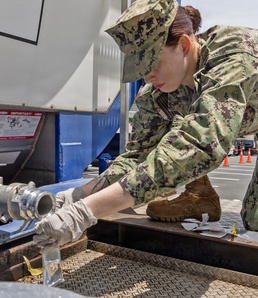
YOKOSUKA, Japan— While most residents aboard Commander, Fleet Activities Yokosuka (CFAY) saw a precautionary boil water advisory during a recent water line repair, public health professionals at U.S. Naval Hospital Yokosuka were working behind the scenes to verify the safety of the installation's drinking water system and help ensure the community remained protected.
CFAY recently completed repairs to a water supply line serving Main Base. As a standard public health precaution, a boil water advisory was implemented while the repaired system was flushed, sampled, and validated through a series of water quality tests.
During the repair and validation period, personnel from USNH Yokosuka's Public Health Directorate collected water samples from multiple locations across the installation, including water trucks, storage tanks, and distribution points. Among those supporting the effort was Hospital Corpsman 3rd Class Casandra Tisdale, a preventive medicine technician who helped gather samples used to assess water quality throughout the process.
For Tisdale and other preventive medicine technicians, the mission began in the field. "Every sample our team collects represents a checkpoint in the process," Tisdale said. "We follow strict collection procedures, use sterile sampling techniques, and carefully document each sample to ensure the results accurately reflect the condition of the water system."
Reliable access to safe drinking water is a critical component of force health protection and mission readiness.
"This was truly a collaborative effort," said Capt. Rebecca Welch, director for Public Health Services at U.S. Naval Hospital Yokosuka. "CFAY Public Works conducted extensive testing and monitoring of the installation's water system, while our Public Health team independently reviewed water quality data, conducted additional sampling, and provided recommendations based on established standards. Together, those efforts helped ensure decisions were based on science, data, and a shared commitment to protecting our community."
Throughout the effort, the Public Health Directorate worked closely with CFAY Public Works, environmental specialists, and host-nation partners. This included detailed preparatory work led by key personnel like Cmdr. Mary Piliwale, the environmental health officer and associate director, and Chief Hospital Corpsman Christopher T. McCarthy, senior enlisted leader for the directorate. Through rigorous testing and international coordination, installation officials verified the water system met or exceeded applicable U.S. and Japanese drinking water standards before normal operations resumed.
Piliwale said the effort demonstrated the directorate's commitment to protecting both community health and operational readiness.
"This is what force health protection looks like in practice," Piliwale said. "Our Hospital Corpsmen and Preventive Medicine Technicians were collecting samples across the installation while other members of the team conducted testing, reviewed data, and coordinated with installation partners. Combined with the efforts of CFAY Public Works, Environmental Management, and other stakeholders, every part of that process was essential to ensuring we had an accurate picture of water quality onboard CFAY."
The Public Health Directorate's role extended well beyond collecting samples. The team conducted risk assessments and helped educate the community on the purpose of the advisory.
"In total, our team conducted 87 water quality tests, sampled 53 water trucks, and surveyed 34 sites across the installation to verify the integrity of the distribution system," McCarthy said. "Once those samples were collected, we evaluated several indicators of water quality, including verifying disinfectant residual levels and conducting Colilert testing for total coliform bacteria and E. coli. Those tests helped us determine the system remained microbiologically safe."
Colilert is a standardized drinking water test used to detect potential contamination. Public health personnel use these results, along with chlorine residual measurements, to assess water quality and determine when normal use can safely resume.
"Many people saw the advisory itself, but they may not have seen the extensive testing and analysis happening behind the scenes," Welch said. "From the work performed by CFAY Public Works to the sampling, testing, and risk assessments conducted by our Public Health team, there were multiple layers of oversight dedicated to protecting the health of everyone who lives and works aboard the installation."
For Welch, the successful completion of the project underscored the importance of expertise and teamwork.
"Protecting the health of our community requires constant vigilance and strong partnerships," Welch said. "This effort demonstrated the dedication of the professionals who work every day to ensure our Sailors, civilians, and families have access to safe, reliable drinking water."