OKINAWA, Japan — In a contested environment, the difference between mission success and failure may depend on more than the availability of ammunition, fuel or personnel. It may come down to whether Marines can repair damaged equipment or manufacture replacement parts before traditional supply chains can deliver them.
To address that challenge, U.S. Marines with Intermediate Repair Company, 3rd Maintenance Battalion, 3rd Marine Logistics Group, partnered with engineers, scientists and industry experts during Valiant Shield 26 to test advanced manufacturing capabilities designed to transform sustainment in the Indo-Pacific.
From June 1 through July 1, Marines participated in Resilient Advanced Manufacturing For Contested Environments, or RAMFORCE, an initiative hosted by the Office of the Under Secretary of Defense for Research and Engineering. The innovative event brought together military personnel, government laboratories and private industry to evaluate how advanced manufacturing technologies could enable expeditionary forces to repair, replace and even produce critical equipment at the point of need.
Working alongside representatives from the U.S. Army Development Command Armaments Center, Naval Surface Warfare Center Carderock, Oak Ridge National Laboratory's Manufacturing Demonstration Facility, RGBSI Aerospace and Defense, nScrypt and Haas Automation, Marines gained hands-on experience with technologies intended to reduce logistical burdens and increase operational flexibility during distributed operations.
While each experiment focused on a different capability, together they demonstrated a larger vision of integrating digital engineering, advanced manufacturing and expeditionary sustainment into a single connected ecosystem.
"As a force we are only largely, and generally, aware of additive and subtractive manufacturing techniques and products, but RAMFORCE is not just about advanced manufacturing — it is about integration," said Maj. Daniel Krake, company commander of Intermediate Repair Company. "On their own, each event is fascinating; combined across commodities they are game changing."
Rather than relying solely on established supply chains, the event explored how Marines could manufacture components, repair electronics, fabricate replacement parts and build unmanned systems while operating from dispersed locations throughout the First Island Chain.
One of the first capabilities Marines learned involved additive manufacturing for electronics using nScrypt's nRugged system, a ruggedized platform capable of repairing damaged circuit boards in austere environments.
Instead of replacing an entire electronic assembly, Marines learned to diagnose faults, restore damaged electrical pathways and replace failed components directly on circuit cards. The system also allowed users to recreate damaged circuitry using existing schematics and fabricate entirely new electrical runs when necessary. "This piece of machinery takes up-close photos of circuit cards," said Staff Sgt. Ryan Grillo, an Intermediate Repair Company Marine and experiment team lead. "It pieces them together into a high-definition photo of the circuit card. Once the circuit card is mounted and catalogued, the nRugged has multiple tool heads capable of replacing components, repairing electrical runs and creating entirely new electrical runs."
The capability represents a significant shift from replacing expensive electronics to repairing them forward, reducing downtime while minimizing dependence on replacement inventories.
Nearby, another team of Marines explored cold spray repair, a process that restores worn or damaged metal components by accelerating powdered metal onto existing surfaces without melting the base material.
"The cold spray machine shoots metal powder at subsonic speeds," explained Staff Sgt. Huffman, experiment team lead with Intermediate Repair Company. "In this case, we are using aluminum and nickel at 375 degrees Celsius. It builds up a layer of new metal higher than the original surface before it's machined back to specification."
Instead of waiting for replacement components to arrive, Marines trained to restore damaged parts already in theater, extending equipment service life while improving operational readiness.
Advanced repair capabilities continued with hybrid manufacturing demonstrations led by Oak Ridge National Laboratory's Manufacturing Demonstration Facility.
Using an additive hybrid machine, participants demonstrated how damaged components could be digitally scanned, recreated and manufactured using additive and subtractive manufacturing processes within a single machine.
Research scientist Blane Fillingim explained that the process begins by creating a precise three-dimensional model of an existing part using advanced optical scanners. Once digitized, the machine deposits metal through wire-fed additive manufacturing before automatically switching to precision machining tools to finish the final component to specification.
The goal, Fillingim said, is to streamline the process so that service members with minimal specialized experience can successfully reproduce critical components using standardized equipment kits deployed alongside expeditionary forces.
The hybrid manufacturing team also collaborated directly with engineers supporting another RAMFORCE experiment, producing specialized components required for ongoing fabrication projects and demonstrating how multiple advanced manufacturing capabilities could support one another in real time.
While some Marines focused on manufacturing physical parts, another team explored how those parts, and the technical data required to build them, could be securely transmitted across distributed operating environments.
The Digital Manufacturing Exchange, or DMX, demonstrated how technical data packages could be securely shared between military units and industry partners, allowing authorized users to manufacture approved components regardless of their physical location.
According to Zach Brandon, director of engineering for RGBSI Aerospace and Defense, the system serves as a secure digital backbone that controls access to technical information while allowing manufacturers to receive approved production requests and supporting documentation. The platform also enables manufacturing operations to continue in disconnected environments before synchronizing information once communications are restored.
For expeditionary forces operating across the vast distances of the Indo-Pacific, the ability to securely transmit manufacturing data may prove just as valuable as transporting physical replacement parts. Krake said that integration remains the true objective behind RAMFORCE.
"We have advanced manufacturing and information systems experts working alongside our Marines to establish new methods for exchanging technical data packages between industry and deployed service members," Krake said. "We have them working with both electronics and mechanical maintenance Marines to reduce equipment downtime, allowing them to collaborate to create flexible, deployable maritime platforms."
Among the most ambitious demonstrations was Manufacturing Attritable Systems at Scale, or MASS, an initiative focused on rapidly producing low-cost maritime platforms using deployable manufacturing equipment and commercially available materials.
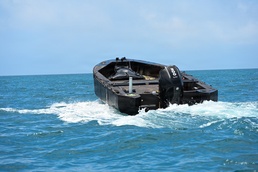
Marines worked side-by-side with engineers from NSWCC to construct a 7-meter foam raiding craft designed to be manufactured entirely in theater. Rather than showcasing a single boat, the project demonstrated a manufacturing process capable of producing a variety of expeditionary platforms close to the point of need.
"The shape of the hull is not the goal," said Marissa Stecko, a mechanical engineer supporting logistics and manufacturing operations with NSWCC. "It's the manufacturing that we're trying to showcase."
Using only three primary pieces of equipment, a computer numerical control router, a large-format polymer 3D printer and a spray foam and coating system, the team produced a modular hull using materials intentionally selected for their worldwide availability.
"The goal would be to modify this manufacturing process to make any platform that would be usable for the Marine Corps, the Navy or whoever needs it," Stecko said. "We do the design work on the back end and push those digital files to the end-user so they can manufacture the platform where it's needed." The approach seeks to reduce one of the greatest logistical challenges facing expeditionary operations: transporting large, expensive systems across thousands of miles of ocean.
Instead of shipping complete platforms into theater, engineers envision shipping compact manufacturing equipment and digital design files, allowing Marines to fabricate equipment using locally sourced materials. Stecko said the team's previous 5-meter prototype hull was manufactured in approximately 16 working hours using roughly $11,000 worth of materials—dramatically reducing both production costs and manufacturing timelines compared with traditional methods.
"We have reason to believe that, once fully scaled, we could manufacture a 5-meter platform every four hours with a team of 12, and a 7-meter platform every six hours," Stecko said. "We're still in the prototyping phase, but there's a tremendous amount of potential."
The vessels themselves are designed to balance affordability with operational capability. While conventional expeditionary platforms often represent significant financial investments, the MASS concept focuses on rapidly producing systems capable of supporting logistics, reconnaissance and other operational missions without relying on traditional acquisition timelines.
Following fabrication, the craft receives a protective polyurea coating before being fitted with an outboard engine. The platform can be operated conventionally or integrated with an autonomy kit allowing operators to transition between manned and unmanned operations.
That capability was demonstrated June 29 during operational testing at White Beach Naval Facility. After being transported from the fabrication site, the completed 7-meter FRC entered the water equipped with a 300-horsepower Mercury outboard engine and an autonomous control system developed by Fort Robotics.
For the demonstration, the vessel completed both manned and unmanned operations, including autonomous waypoint navigation. While remote-control distances were intentionally limited to comply with Japanese regulations, engineers explained that future applications could leverage satellite communications to dramatically extend operational range.
The demonstration also served as the culmination of another RAMFORCE experiment: Print on the Move. Rather than evaluating additive manufacturing in a stationary workshop, Marines tested whether polymer 3D printers could continue producing parts while being transported aboard tactical vehicles and watercraft. The experiment assessed multiple commercially available printers, printing materials and software platforms to determine which combinations could withstand the vibrations and environmental conditions associated with expeditionary operations.
"We are engineers training them on how to operate these printers," said Dr. Cindy Waters, senior science and technology manager with NSWCC. "We specialize in advanced manufacturing, and we're here to support the Marines with whatever they need throughout the week."
Waters said extensive testing conducted before Valiant Shield 26 helped identify systems capable of operating reliably in demanding conditions while remaining practical for deployed service members.
"The printers range from being quite expensive to really affordable," Waters said. "A lot of research went into selecting these printers to ensure they are reliable, repeatable and rugged."
During the final demonstration, one printer continued fabricating a component while being transported to White Beach before being transferred aboard the FRC, where the print continued while the vessel operated on the water.
The successful demonstration highlighted the potential for expeditionary forces to manufacture mission-critical components while moving between operating locations, further reducing delays associated with traditional logistics.
Senior military leaders observed the culmination of RAMFORCE during the White Beach demonstration, including Lt. Gen. Roger Turner, Commanding General of III Marine Expeditionary Force; Japan Ground Self-Defense Force Lt. Gen. Seiji Toriumi, commanding general of Western Army; and Brig. Gen. Christopher Haar, commanding general of 3rd MLG. The leaders rode aboard the newly manufactured craft as engineers demonstrated its capabilities.
NSWCC personnel also showcased the Configurable Budget Autonomous Swarming Submersible, a low-cost unmanned underwater vehicle designed to collect seafloor data while supporting distributed maritime operations.
The event concluded with recognition of several Marines whose contributions supported RAMFORCE experimentation. Turner presented challenge coins to Sgt. Jamaare Brown, a machinist with 9th Engineer Support Battalion, 3rd MLG, and Lance Cpl. Blake Isaacson, a utilities systems technician with Intermediate Repair Company. Navy and Marine Corps Achievement Medals were presented to Cpl. Noah Uhrbrock, a calibration technician with Intermediate Repair Company, and Lance Cpl. Jesse Dendy, an amphibious combat vehicle technician with Intermediate Repair Company.
For leaders overseeing the experimentation, the technologies demonstrated during RAMFORCE represent more than isolated innovations. Together, they form an integrated sustainment ecosystem capable of reducing equipment downtime, strengthening regional partnerships and increasing operational endurance throughout contested environments.
"The power of additive manufacturing is that it is adaptable to whatever that next threat is," said Col. Howard Marotto II, a capabilities analyst with the Secretary of the Navy's Direct Reporting Offices. "I see the future, I see the potential, and it would greatly help if we can drive more funding for these new programs of record."
Krake said RAMFORCE's lasting impact extends beyond the completion of Valiant Shield 26. Equipment, digital technologies and industry partnerships established during the experimentation will remain with Intermediate Repair Company, providing Marines the ability to continue refining expeditionary manufacturing capabilities long after the exercise concludes.
"We will be trained, manned and equipped to deploy these field-ready technologies inside the First Island Chain to improve lethality and operational readiness," Krake said.
As military operations continue evolving across the Indo-Pacific, RAMFORCE demonstrated that the future of sustainment may no longer depend solely on moving replacement parts across oceans. Instead, it may depend on empowering Marines to manufacture, repair and innovate wherever the mission takes them — bringing the industrial base closer to the front lines than ever before.