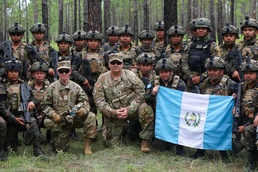
CAMP JOSEPH T. ROBINSON, NORTH LITTLE ROCK, Ark. -- Arkansas National Guardsmen and Guatemalan Army special forces recently joined forces to train together at Fort Polk, La., during Joint Readiness Training Center rotation 26-08.
Arkansas and Guatemala were paired together 24 years ago through the National Guard Bureau’s State Partnership Program. While numerous exchanges occur annually that tackle training, aircraft maintenance, leadership and unmanned aerial systems as examples, this type of exchange is a first of its kind in the more-than-two-decade relationship where they teamed up side by side in a combat environment to take on an opposition force together.
“For 24 years, this partnership has been built on exchanges — training, maintenance, leadership,” said Brig. Gen. Chad Bridges, Arkansas’ adjutant general. “Last month it became something more. Arkansas Guardsmen and Guatemalan Soldiers fought side by side against a live opposition force in one of the most demanding training environments the Army offers. That’s not symbolism. That’s real interoperability, and it makes both of our nations more ready.“
Capt. Jamie Newton led a company-sized unit from with a platoon each from Alpha, Bravo, and Charlie Companies, 2/153rd Infantry Battalion, 39th Infantry Brigade Combat Team, which consisted of more than 170 Soldiers. They teamed up with roughly 30 Guatemalan Soldiers to fight side by side with the Virginia National Guard’s 116th Mobile Brigade Combat Team against active-duty Army opposition forces.
“Training alongside the Guatemalan forces at JRTC reinforced that professionalism, discipline, and teamwork transcend language and cultural differences,” she said. “We learned the importance of adaptability, finding ways to communicate effectively, building trust quickly, and integrating different tactics and perspectives into a cohesive team. Their willingness to learn, resilience, and commitment to the mission challenged us to become better leaders and more effective communicators. It was a reminder that strong partnerships are built on mutual respect, shared purpose, and learning from one another. The experience not only strengthened our interoperability with a partner nation but also made our company more adaptable and prepared for future multinational operations.”
The Arkansas National Guard selected interpreters to participate in the exercise to help bridge the language barrier and ensure mutual understanding in the heat of battle. They also had hand signals that both militaries use to communicate intent and understanding if a translator wasn’t available.
“By the end of the rotation, we weren’t operating as two separate forces. We were operating as one team,” Newton said. “That experience strengthened our interoperability, improved our ability to work with multinational partners, and made all of us better leaders and more adaptable warfighters.”
The Guatemalans were attached to a multipurpose company to assist with scouting and recon operations against the opposition forces.
“They were tasked with being recon elements and detainee operations during the defense, and the forward assault platoon during our offensive culminating event,” Newton said.
For Guatemalan Army Infantry Lt. Wesley Andrés Santo Ramírez, the opportunity to work alongside the American military was a highlight of his nine-year career.
“Expectations were high, as we wanted to come and further strengthen our techniques and our way of operating when integrating with the Armed Forces of the United States,” he said through a translator. “So, the objective has been met, and we believe this journey has not ended. We will continue, and it will be even more successful in the days to come.”
Guatemalan Infantry Lt. Francis Cristóbal de León de León, has been a commissioned officer for more than six years.
“I learned that logistics is fundamental,” he said through a translator. “Logistics supplies all the personnel who are on the front lines of combat. And if the logistics don't arrive, then the units that are in the combat area have shortcomings when it comes to being able to fight and eliminate the enemy.”
He said he has a message for his peers in Guatemala.
“I will tell them that they are training for a modernized kind of warfare,” he said. “There is now a lot of technology in warfare, and they adapt to how the generations of warfare evolve. Currently it is a war of technologies, and it's about how you adapt to the system that is happening at present.”
Newton concurred that the battlefield is evolving, especially in regards to the use of unmanned aerial systems, or drones as they’re commonly called, and how they’re employed to exploit and counter one’s opponents.