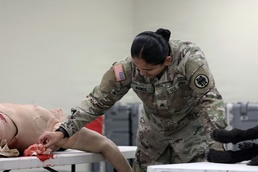
FORT HUNTER LIGGETT, Calif. — U. S. Army Reserve Soldiers are transforming medical training lanes into realistic battlefield environments by preparing high-fidelity medical "injects" that challenge healthcare providers and combat units participating in Operation Bold Eagle 26, July 14–23.
Bold Eagle is a premier multi-echelon training exercise, providing mission command for 74 units and more than 3,300 Soldiers. It combines a combat support training exercise and Global Medic, an international military medical training exercise, to prepare Army Reserve forces for large scale combat operations in a demanding multi-domain operational environment.
Behind every casualty scenario in Global Medic is a team of Army Reserve Soldiers assigned to the exercise's effects and enablers section. Their mission is to create realistic battlefield conditions that test clinical skills, decision-making, communication and unit readiness before Soldiers ever face those challenges in an operational environment.
Sgt. Mateo Leon, assigned to the 7414th Troop Medical Clinic at Fort Bliss, Texas, said his team is responsible for preparing the third phase of the exercise using advanced simulation equipment designed to closely replicate combat trauma.
"We're setting up the high-fidelity area where the mannequins can bleed, move and respond as realistically as possible," Leon said. "The goal is to create situations that look and feel like real casualties so medical providers have to react the same way they would in combat."
Unlike traditional plastic training mannequins, the high-fidelity versions simulate severe injuries, realistic vital signs and active bleeding. Some are remotely controlled by operators who can make the “patient” speak, scream or deteriorate based on the scenario and treatments.
"As we pump simulated blood through the mannequin, it creates realistic bleeding that forces providers to identify the injury, apply a tourniquet and stop the hemorrhage," Leon said. "We're trying to raise their stress level because when they experience something similar in the real world, they've already seen it before and know how to respond."
The simulation capability extends beyond human casualties.
Among the training aids are advanced canine mannequins that allow veterinary personnel and medical teams to practice treating injured military working dogs, an asset often unavailable during routine Reserve training.
"We can simulate broken limbs, wounds, internal injuries and even make the dog growl or whine while the team is treating it," Leon said. "It creates the same pressure they'd experience if an actual military working dog were injured during an operation."
Leon said introducing realistic stress is one of the most valuable aspects of the exercise because battlefield medicine rarely occurs under calm conditions.
"In a real combat environment, there's chaos, people yelling and multiple casualties happening at once," he said. "We want Soldiers to experience that pressure here, so they learn to focus, make decisions and perform under stress before it's ever real."
Preparing those training scenarios requires coordination among numerous specialties. Teams responsible for moulage create realistic wounds using special effects makeup, while simulation technicians’ program robotic mannequins, radio operators coordinate scenario execution, and drivers transport equipment throughout the training area.
"It all starts with moulage because the injuries have to look real," Leon said. "Then we prepare the mannequins, the role players and everything else needed to make the scenario as realistic as possible. There are a lot of moving pieces working together."
Leon said the exercise benefits more than medical personnel.
"We've brought together military police, combat medics and Soldiers from combat arms units," he said. "Combat Soldiers learn how to provide immediate lifesaving care before evacuating casualties, and then the medical teams take over. Everyone gains a better understanding of their role in casualty care."
As a supervisor during the exercise, Leon said he has focused on ensuring every Soldier gain experience operating the sophisticated training systems before scenarios begin.
"I've been fortunate to have a strong team," Leon said. "Some Soldiers already have experience with these systems while others are learning for the first time. Everyone gets an opportunity to train because once the exercise starts, they'll each have responsibilities supporting the scenarios."
Spc. Jalinn Rivera, a combat medic specialist assigned to the 7228th Medical Support Unit in Columbia, Missouri, said his team demonstrates the capabilities of both human and canine simulators before they are integrated into the training lanes.
"We're showing how the mannequins move, how they bleed, how we can take vital signs and create different wounds and injuries," Rivera said. "The purpose is to give medics hands-on training with equipment that closely replicates real patients."
Rivera explained that many Reserve medical Soldiers rarely have access to this level of simulation during monthly battle assemblies.
"Most of the time we're training on each other or on basic mannequins," Rivera said. "These simulators allow us to see realistic injuries, monitor vital signs and treat patients that respond to what we're doing. That makes the training much more valuable."
The canine simulators also fill an important training gap for Army Reserve medical personnel.
"Many of us never have the opportunity to work with military working dogs," Rivera said. "Being able to train on a canine mannequin gives us experience we normally wouldn't receive."
Beyond individual skills, Rivera said the medical injects allow commanders to evaluate the performance of treatment facilities throughout the exercise.
"We're able to create mass casualty scenarios to see how the hospitals and role I and role II medical facilities respond," Rivera said. "It helps us determine whether they're able to keep up with the number of casualties and continue providing effective medical care."
For Army Reserve Soldiers, whose civilian careers often differ significantly from military medical responsibilities, Rivera said the opportunity is especially important.
"Compared to active-duty units, reserve Soldiers don't always get this type of hands-on experience," Rivera said. "Many of us don't perform these kinds of procedures in our civilian jobs either, so training on these realistic simulators improves our readiness for both military missions and emergency situations."
By combining advanced simulation technology with carefully planned battlefield scenarios, Army Reserve medical teams are ensuring participating units experience the complexity, uncertainty and pressure of combat medicine in a controlled training environment. The realistic injects challenge Soldiers to make rapid decisions, strengthen teamwork and build confidence, ultimately preparing Army Reserve forces to provide lifesaving care during future large-scale combat operations.