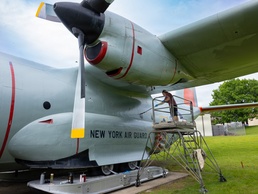
SCOTIA, New York --The first plane people see when they visit the New York Air National Guard’s 109th Airlift Wing, is one that hasn't flown in decades.
Known affectionately as "Old 490," the LC-130 has stood watch at the entrance of Stratton Air National Guard Base in Scotia since 1994.
The “skibird” -equipped with skies as well as wheels, serves as a symbol of the wing's storied Arctic legacy.
But, after more than 30 years exposed to New York's weather, the static display had begun to show its age.
Recently, a team of volunteer Airmen gave the aircraft new life, carefully restoring its distinctive gray-and-orange paint scheme while preserving an important piece of the wing's history.
Leading the restoration effort was Staff Sgt. Devin Slovak, a structural maintenance specialist assigned to the 109th Airlift Wing's Structural Maintenance Shop. Slovak volunteered for the project because of both his experience with restoration work and his appreciation for the unit's heritage.
"We have so much history with the Greenland and Antarctic missions, and that interests me a lot," Slovak said. "I like doing this kind of detailed work, and I've done a lot of historical restoration with my father in construction."
The aircraft had not been repainted since it was transported to the base after serving as a student training aircraft at the former Chanute Air Force Base in Illinois.
Before becoming a training aircraft, the LC-130 flew with the Alaskan Air Command before joining the 109th Airlift Wing's fleet from 1975 to 1985.
During its operational career, the aircraft delivered personnel and supplies throughout Greenland, supporting the Distant Early Warning Line. The DEW Line was a network of radar sites that provided the United States and Canada with early warning of potential Soviet bomber attacks across the Arctic during the Cold War.
Restoring the aircraft required some preparation before the first coat of paint could be applied. Volunteers replaced broken windows and painted them black, sanded weathered surfaces and carefully masked sections of the aircraft before repainting it.
A volunteer call was sent across the base, inviting Airmen with supervisor approval to help complete the project over several days.
"We prepped the surface, then painted the whole plane back to its original look with the glossy gray paint scheme," Slovak said. "This is one of the first planes to have the gray-and-orange paint scheme. It's important to the legacy and history of the unit."
The orange was painted on the planes so they would show up when viewed from above, in case an aircraft had to make an emergency landing on the polar ice.
The restoration is expected to be more than a one-time effort. Wing members plan to wash the aircraft annually and perform routine maintenance to help preserve its appearance for years to come.
For Slovak, maintaining "Old 490" reflects the same pride Airmen take in the aircraft that continue to fly today.
"I think it's important to have a level of professionalism to keep things looking good and running well," Slovak said. "It shows that even though the plane's not flying, we're still maintaining it."
Standing at the entrance to the installation for more than three decades, "Old 490" has welcomed generations of Airmen, families and visitors.
Thanks to the efforts of volunteers, the aircraft will continue to serve as a reminder of the 109th Airlift Wing's enduring mission in the Arctic and the legacy built by those who flew it.
The 109th Airlift Wing flies the largest airplane in the world which has the ability to land on snow and ice in polar regions. The wing flies missions in support of Air Mobility Command missions in Greenland and Antarctica.