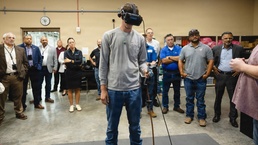
Corpus Christi Army Depot, Texas — Corpus Christi Army Depot modernization efforts have continued to transform the depot for 65 years, and this time, by hosting its inaugural Industry Day event, coinciding with the United States' 250th anniversary and the Army's 251st year. The event was organized in response to growing interest from Coastal Bend industry leaders seeking a more profound understanding of CCAD’s mission, capabilities, and potential support to the civilian sector. Industry Day featured a panel discussion, guided tours, and engagements with senior depot leadership.
The purpose of Industry Days was to provide attendees with firsthand insight into the depot’s operations, including its processes, equipment, capacity, and facilities.
Reflecting on the challenges posed by reduced workload and decreased Army sustainment funding, CCAD Commander Col. Consedine explained, “We have compensated for that over the years through direct sales partnership agreements and public‑private partnerships, primarily with defense OEMs.”
He added that even OEMs have experienced reductions in Army procurement, limiting the workload available for CCAD. As a result, the Army is exploring ways to broaden partnerships and expand agreements with entities outside the traditional defense sector.
Providing insight into the depot’s financial structure, “CCAD and other organic industrial bases function under a revolving‑fund concept called the Army Working Capital Fund, we pay ourselves with the revenue that we generate,” said Director of Production Management Mike Bonincontri.
He continued, “So we must understand what that workload is going to be, plan our rates and our costs accordingly, and then execute to our capabilities to break even.”
One question addressed during the event was whether the depot could sell unused excess capacity. The answer was yes. Under Title 10 of the United States Code, depot‑level activities and military arsenal facilities may be designated as Centers of Industrial and Technical Excellence, enabling collaboration between the armed forces and private industry.
Chief of Headquarters Operations, Israel Talamantez, highlighted the value CCAD offers local businesses, stating, “CCAD is another asset you have; another tool in your toolkit for getting work done.”
CCAD currently acts as a subcontractor for major original equipment manufacturers and maintains several public‑private partnerships under 10 U.S.C. §2474, providing an additional revenue stream.
Andrew Smith, director of manufacturing process production, explained, “We are a manufacturing source of supply when OEMs can’t provide parts. Other agencies and branches of service come to our manufacturing team to make parts for them. If we have the prints and schematics, we can produce quickly.”
Facilities and equipment belonging to a Center of Industrial and Technical Excellence may also be used by private industry to perform maintenance or produce goods, improving the efficient use of government‑owned industrial plants and supporting job creation to maintain a skilled workforce.
Col. Consedine noted the importance of sustaining CCAD’s workforce: “We are only authorized to maintain a workforce that aligns with our workload. To avoid reductions, we are seeking additional workflow opportunities that keep our workforce employed and, more importantly, proficient. So that when the nation needs them, they are trained and ready.”
CCAD continues to explore opportunities to partner with government entities and private industry, leveraging its organic industrial base facilities to develop emerging and innovative capabilities.