FORT INDIANTOWN GAP, Pa. – As the battlefield continually shifts toward unmanned aircraft systems, Fort Indiantown Gap is expanding its UAS and counter-UAS training opportunities.
Several ranges at the installation have been altered in recent months to allow for UAS and counter-UAS training so service members are prepared when they are deployed to hostile environments, said Kurt Spieles, the Gap’s range program coordinator.
“Small, unmanned aircraft systems have become a defining and complex component of the modern battlefield,” Spieles said. “Soldiers and units training at Fort Indiantown Gap need realistic, hands-on experience operating UASs for their own missions and, just as critically, detecting, tracking and defeating hostile drones before they can inflict harm upon them.
“Counter-UAS proficiency is no longer a niche skill set, but a core survivability requirement for any unit with the potential to deploy,” Spieles added.
Range 35, which is located in the training corridor between Blue and Second mountains, now includes a quadcopter and fixed-wing live-fire concept that allows users to engage drones with M249 or M240B machine guns.
The concept includes the capability to engage fixed-wing drones referred to as “wings,” fixed-wing gliders deployed by payload-capable quadcopters, and “attritable” first-person-view, or FPV, quadcopter drones.
Range 20, which is located along Range Road, has been modified to incorporate a counter-UAS team into a fire and maneuver squad. A team can bound forward on the range and engage ground targets with 5.56mm rounds and sporting clays with shotguns.
A large trench was also added that allows users to take up a defensive posture and engage clays with shotguns or ground targets with rifles. Clay throwers can be placed in various locations on the range and are thrown toward users to replicate high-speed one-way attack drones.
Together with the UAS Training and Innovation Facility, the range program is developing an inert FPV gunnery range on Range 6A, which is directly across Range Road from the UASTIF.
This range will allow pilots to fly FPV one-way attack drones directly into targets using a soft impact target backstop, constructed of large wooden frames with netting similar to that found in a batting cage. This allows multiple impacts with little to no damage to the drones.
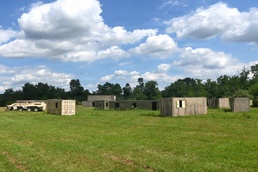
Additionally, the range program facilitated the transport and assembly of an FPV drone maneuver training facility on the UASTIF grounds. Pilots can fly around and through shipping containers that have been modified and arranged to resemble a small village.
Fort Indiantown Gap continuously updates its ranges and training areas to mirror real-world threat evolution rather than static, outdated concepts, Spieles said.
“This includes integrating small UAS operations and counter-UAS response into range and maneuver training and developing in-house sUAS capability, including 3D-printed airframes to keep pace with rapidly changing commercial and military drone technology at a fraction of traditional timelines and costs,” Spieles said. “This adaptive approach ensures soldiers train against realistic, current threat profiles rather than legacy assumptions.”
In addition to the changes at these ranges, numerous upgrades are currently underway at the UASTIF, which was selected recently to host two significant UAS training programs. Upgrades at the UASTIF include two classrooms, a simulator room, a locker room and office space.
Col. Kevin Potts, Fort Indiantown Gap’s garrison commander, said that as the threat environment on the modern battlefield continues to evolve, the integration of UAS and counter-UAS training is crucial.
“At Fort Indiantown Gap, our goal is to ensure that our service members have access to modern, realistic training through innovation and outside-the-box thinking,” Potts said. “Through this we are providing ranges for UAS and counter-UAS training in order to equip our warfighters with the critical skills they need to win on a multi-domain battlefield."