MARINE CORPS AIR STATION CHERRY POINT, N.C. -- When Marine Corps Air Station New River-based Marine Heavy Helicopter Squadron 461 (HMH-461) experienced a critical need for CH-53K King Stallion parts while conducting training in Arizona, Fleet Readiness Center East (FRCE) filled the requirement within hours, returning the aircraft to mission-capable status at breakneck speed.
HMH-461 needed support brackets for a heat exchanger unit onboard a CH-53K heavy-lift helicopter, and they needed them quickly: The squadron, supporting a high-visibility tasking, was slated to return to New River less than two weeks later. The parts were unavailable through traditional supply methods, and the initial estimate for organic manufacturing at FRCE came in with an eight- to 10-week lead time – far too long for the aircraft to be grounded and still meet the squadron’s operational requirements.
In the end, a cross-disciplinary team at FRCE was able to condense a weeks-long process into just over 37 hours, and a depot in-service repair (ISR) team was dispatched to Marine Corps Air Station Yuma, Arizona, with parts in hand only five days after FRCE received the initial request. When a second aircraft experienced the same requirement days later, FRCE was able to reduce manufacturing time on a third bracket to an unheard-of 12 hours and overnight the part to Yuma for installation by the ISR team already there on the ground.
“This successful endeavor reinforces what our customers know to be true: FRC East is here to take care of the warfighter, and we’ll go to any lengths to make that happen,” said FRCE Commanding Officer Capt. Randy J. Berti. “When called upon by the squadron, our people were able to condense a manufacturing effort from weeks into mere hours, then send a team with parts in hand to complete a much-needed repair that returned a mission-ready aircraft to the Marine Corps. It sounds incredible because it is incredible … but it’s also what our people do day-in and day-out in service to the fleet.”
FRCE Military Production Officer Cmdr. John Vincent said the effort took a tremendous, collaborative push from disciplines across the command – machinists, engineers, quality analysts, aircraft maintainers and more – but is an excellent representation of FRCE’s dedication to supporting Naval aviation.
“We understood the urgency, and when the fleet has a need that affects mission readiness, FRC East is thoroughly capably of responding,” he explained. “This was not a standard processing time – this was a Herculean effort we put together. All the pieces fell into place in a perfect scenario, but the truncated timeline wouldn’t have been possible without the expertise and commitment of the individuals pushing this project forward to make it happen so quickly. Our people do amazing things, and each one of the leaders along the way knew the importance of what we were doing.
“Demonstrating that FRC East is able to rapidly manufacture these parts will definitely help enable fleet readiness, because now the task is easy: just replace the bracket,” Vincent continued. “The ability for the enterprise to manufacture these parts removes the question of where the part can be obtained and makes it a matter of simply completing the repair rather than sourcing the materiel.”
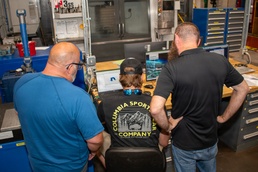
The inboard utility heat exchanger on the King Stallion is secured by four brackets; FRCE manufactured two of the brackets for the first time earlier this year, with the initial run taking about 30 days due to technical requirements. FRCE obtained technical data packages for the parts and a team in the depot’s Digital Data Center converted the data into digital models and programs that guide computer numerical control (CNC) machining equipment in cutting the brackets from blocks of solid metal. Meanwhile, the materials engineering lab verified the composition and physical properties of the metal being used to manufacture the parts. With those foundations in place, the command’s organic manufacturing team was able to complete the machining process, and the finished brackets went forward for quality assurance verification, nondestructive testing, cleaning and anodizing before being shipped to the squadron.
The successful first round of manufacturing the heat exchanger brackets set the stage for the rapid turnaround time achieved for HMH-461’s request from Yuma, said Russ Becker, the manufacturing planning supervisor in FRCE’s Centralized Coordination Department.
“The long lead times on the first run were driven by first-time manufacture requirements; what truly made this latest effort a spectacular success were the building blocks put into place the first time through,” Becker said. “Provided with an executable plan and the tools and data they needed to perform, our talented and dedicated team of artisans was able to provide the fleet with the assets needed to get the aircraft back to mission-ready status in unmatched time. The fleet had an urgent requirement and, in keeping with our ‘Service to the Fleet’ mandate, FRC East responded.”
After receiving HMH-461’s urgent request and manufacturing two heat exchanger brackets at incredible speed, cutting the process from more than 30 days to just over three, FRCE received the follow-on request for the third bracket. This time, the part reached completion in about 12 hours – reducing the previous manufacturing timeline for that part by almost two-thirds.
According to Clifton Force, head of FRCE’s Field Team and In-Service Repair Planning shops, the undertaking represented a massive win for the enterprise.
“This was a great example of our teams coming together to support the fleet,” he noted. “The incredible turnaround in manufacturing the first set of brackets allowed our in-service repair team to fly out with the parts in hand. When the need for the third bracket was identified, the manufacturing team produced it almost immediately, ensuring no momentum was lost in this expedited repair effort. The overall effort by FRC East ensured both aircraft could be returned to a mission-capable status so the squadron could return to New River on schedule – that’s a real-world operational impact.”
Maj. Clayton Cottrell, the MHM-461 maintenance officer, agreed that the support provided by FRCE made a tangible difference in the squadron’s ability to complete the mission.
“During high-tempo operations like Weapons and Tactics Instructor Course 2-26, aircraft availability is critical to achieving our training objectives and maintaining our combat readiness,” he explained. “When we faced a sudden, non-mission-capable status due to unavailable brackets, the traditional supply chain process couldn't source the required parts in an acceptable timeline.
“The speed and adaptability demonstrated by the Fleet Readiness Center East team was outstanding, directly facilitating continued advanced tactical training at WTI,” he continued. “By compressing a weeks-long manufacturing process into a much shorter timeline and deploying an In-Service Repair team directly to the flight line in Yuma, FRCE’s timely effort kept our aircraft in the fight, ensured our pilots and aircrew completed their training at WTI, and allowed the squadron to redeploy back to New River on schedule. We are incredibly grateful for FRCE’s support.”
FRCE is North Carolina's largest maintenance, repair,overhauland technical services provider, withmore than 3,600civilian,militaryand contract workers. Its annual revenue exceeds $886 million. The depot provides service to the fleet while functioning as an integral part of the greater U.S. Navy; Naval Air Systems Command; and Commander, Fleet Readiness Centers.