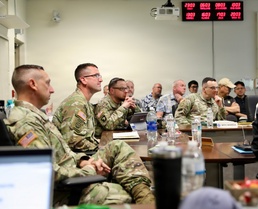
FORT LEAVENWORTH, Kan. — The U.S. Army Combined Arms Command has established the Transformation Integration Directorate, a new organization that will help the Army integrate change across the force by connecting operational experience with institutional action.
Created as part of the Army's transformation under the U.S. Army Transformation and Training Command, the directorate provides command-level integration across multiple warfighting functions and organizations. Its establishment follows the recent inactivation of the Mission Command Center of Excellence and Center for Army Lessons Learned, with many of their personnel and integration functions transitioning into the new organization as part of the command's realignment.
While each Center of Excellence maintains its own transformation integration directorate, the CAC TID serves a broader role, helping connect efforts across the Army to address challenges that extend beyond a single branch or functional area.
"The establishment of the Transformation and Training Command made it logical that there would be an integration directorate at the three-star command level to work with those two-star organizations and issues that involved multiple two-star headquarters," said Dr. Paul Reese, acting director of the Transformation Integration Directorate. "It also gave Combined Arms Command an integrating organization that works vertically with the Centers of Excellence, Transformation and Training Command headquarters and the Army staff while coordinating horizontally with Futures and Concepts Command."
According to Reese, the directorate exists to solve problems that require collaboration across multiple warfighting functions rather than within a single organization.
"Our mission is to work cross-warfighting function DOTMLPF-P problems on behalf of the commanding general," Reese said. DOTMLPF-P is the Army's framework for evaluating changes to doctrine, organization, training, materiel, leadership and education, personnel, facilities and policy. "Whether it's doctrine, training, leader development or organizational design, these are issues that a three-star command can solve."
Although the directorate supports long-term modernization initiatives, much of its work is focused on helping the Army remain ready today while ensuring current decisions continue to support tomorrow's force.
"We are primarily focused on force employment over the next zero to three years and force development over the next two to seven years," Reese said. "Our role is to ensure what we do today supports how the Army fights now while remaining on the right path to where we want to be in the future."
One of the directorate's primary responsibilities is helping the Army learn from operational experience. By bringing together organizations responsible for lessons learned and force development, the directorate can identify capability gaps, recommend solutions and assess whether implemented changes achieve the intended results.
"We now have the complete life cycle of observation, change and assessment under one organization," Reese said. "If we identify a lesson from an exercise or real-world operation, we have the ability to determine what needs to change, implement that change and then measure whether we actually closed or mitigated the gap."
Although much of the directorate’s work occurs behind the scenes, soldiers will see its effects through the doctrine they study, the training they receive, the organizations in which they serve, and the professional military education that prepares them for future assignments.
"Our role is synchronizing those changes across the Army," Reese said. "Whether we're helping implement new organizational designs or coordinating training changes, our work supports both the institutional Army and the operational force."
As the directorate continues building its processes following the achievement of full operational capability, Reese said one of its earliest measures of success will be improving how quickly it can provide informed recommendations to Army leaders.
"Changing the ENTIRE Army takes time - It may take a year or two before we fully see the results of the work we're doing today," Reese said. "But one of the first indicators of success will be how much faster we're able to recommend changes for the commanding general to implement."
The establishment of the Transformation Integration Directorate reflects Combined Arms Command's continued role in helping the Army adapt to an increasingly complex operational environment. By connecting operational insights with institutional action, the directorate provides a centralized capability to integrate change across the force and help ensure today's lessons inform tomorrow's Army.