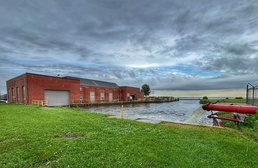
SELFRIDGE AIR NATIONAL GUARD BASE, Mich. – The U.S. Marine Corps has leveraged the unique water testing capabilities of U.S. Army DEVCOM Ground Vehicle Systems Center engineers at a one-of-a-kind facility to modernize a critical expeditionary system and advance Warfighter readiness.
After identifying the need to replace its outdated modular shower units, Portfolio Acquisitions Executive Marine Corps contacted GVSC’s Fuel and Water Equipment Branch. According to Master Sgt. Wesley Capps, a PAEMC project officer, the engineering team at the GVSC Fresh Water Treatment Test Facility—strategically located on Lake St. Clair—was the first call when the Marines obtained two potential replacement Modular Integrated Shower Systems (MISS) requiring evaluation.
“Their knowledge and expertise, especially in the engineering phase, accelerates the acquisition process for us,” Capps said. “Their testing and feedback will help ensure we go with the right system and deliver the best capability for our Marines.”
Having previously worked with the GVSC team at the Selfridge Air National Guard Base facility on the successful testing of the Marine Corps’ Lightweight Water Purification System, Capps said he knew he could rely on GVSC’s military-specific capabilities to allow for the rapid delivery of this critical new system to Warfighters. “I was able to contact them, describe the equipment, and they immediately came up with a plan,” Capps said. He noted Water Technical Specialist Dr. Benjamin Thomas played a key role in developing the test methodology and validating each MISS.
“Ben developed the test plan with the requirements that the Marine Corps set out,” Capps said. “We’ll be able to use his data to make sure we select the right product and help us determine what’s the best way to employ the system.”
Thomas, who has been providing research, development, testing, and engineering services for joint-service modernization efforts at the facility for 13 years, said the MISS testing will establish which system best reduces the logistics tail while also facilitating essential sanitation to protect the force. Because the facility has direct access to a large, natural freshwater resource, it serves as a critical Army science and technology investment and provides far-reaching support.
“This facility is a one of one,” Thomas said. “Our team serves as the sustainment engineers for all expeditionary water treatment, not just for the Army, but for other military branches.
“We are the go-to organization for water purification.”
According to Thomas, the facility is responsible for a wide variety of water-related projects that align with the Army’s warfighting strategy to ensure its research and engineering investments directly support future force readiness and operational overmatch. Thomas said the people who work at the Selfridge facility are one of the most impactful elements of that investment.
“The water community is pretty small, and most of the top field experts are right here on our team,” Thomas said. “Because everybody here has S&T and sustainment backgrounds, we’re able to cover the whole gamut of the issues we see in field systems.”
In addition to testing new systems like the MISS, Thomas said the team also makes vast contributions to overcoming obsolescence and improving the efficiency of current fielded systems, where the team’s operational experience again plays a vital role.
“We have extensive history and knowledge on our team,” Thomas said. “We have prior service members who ran those systems in the field and know exactly what refinements they need.”
Thomas explained that a core focus of their modernization efforts has been simplifying systems and resolving fielded equipment issues. He said the MISS testing and collaboration with the USMC demonstrate how GVSC helps close capability gaps by connecting operational requirements with emerging technologiesacross the military.
“The Marines are a good customer, and we want to keep working with them,” Thomas said. “They know we do good work, so they keep coming back when a need develops.”
Following completion of testing, Thomas said the team will evaluate the data and provide recommendations for which replacement will best address the shortfalls in the current system. By combining GVSC’s unique testing infrastructure with innovative products from industry partners, the team helps accelerate the transition of commercial capabilities into military service, significantly reducing acquisition timelines in support of Marine Corps Force Design 2030 initiatives.
“This capability exists in industry—we just need to modify it slightly to meet the needs of the Marines,” Thomas said. “Otherwise, it would be a five- or six-year acquisition process.”
As GVSC continues to expand its water-testing capabilities and improve expeditionary sustainment and force protection, Thomas said the team is focused on extending collaboration efforts beyond the military realm.
“We’re branching out more to academia and industry and showing that we have this capability,” Thomas said. “We have the access and the expertise available for any testing they might need—and we can test things quickly.”
By providing a faster, more transparent pathway for government, industry and academic partners to evaluate emerging technologies, GVSC continues to accelerate modernization, reduce risk in acquisition, and deliver advanced capabilities to the Warfighter.