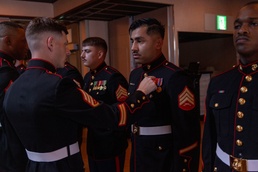
MARINE CORPS AIR STATION IWAKUNI, Japan—Last week marked the first official Sergeant’s Course held on Marine Corps Air Station Iwakuni, Japan. Every slot of the course was filled with 60 registered and qualified students stationed on MCASI and 20 on the waitlist.
Sergeants course, which is routinely held in California, Hawaii, North Carolina, Okinawa, Japan, and Virginia, is a mandated professional military education (PME) for all Sergeants to promote to Staff Sergeant. If Marines are unable to attend when they are eligible for promotion to Staff Sergeant, they will become ineligible to promote. This can negatively affect their career progression and their families.
Over the years, young sergeants in Iwakuni left their families and home units to attend one of two locations in the Indo-Pacific to attend the five-week long Sergeant’s. When the sergeants attend a course and go on temporary additional duty (TAD), they are doing so at a cost to their parent-command. Each course roughly has 60 Marines who attend. Each of these Marines must have airfare, food, and general per diem paid. This equates to over $240,000 spent on all 60 sergeants attending.
Sgt. Maj. James Gray, senior enlisted advisor, Marine Aircraft Group 12, 1st Marine Aircraft Wing, created a budget friendly solution to this problem while also protecting morale and keeping families and units intact. Marines stationed abroad already face challenges being separated by an ocean from their families, friends, pets, and homes. They work longer hours and have an increased operational demand when forward deployed
“After reviewing years of low PME completion rates in Iwakuni, it was clear we needed a different approach. Through collaboration with 1st Sgt. Caruso [the lead instructor from Marine Corps Base Hawaii] and the Hawaii team, we found an opportunity to bring the resident course to our Marines, improving access while preserving readiness and keeping our Marines with their units and families,” Gray told Capt. Mallory.
The operational tempo and geographical location when forward deployed can make it difficult for Sergeants to attend courses that are not near their assigned duty location. Gray wanted a solution for both. He proposed to the Commanding Officer of MAG-12, Col. William Millett III, to have the instructor cadre come to Iwakuni. There were many Sergeants requiring the completion of Sergeants Course. Along with maintaining mission readiness through unit cohesion, funding to send the growing number of Sergeants requiring training was not feasible. Instead of sending 60 Marines across the Indo-Pacific, he proposed that the senior noncommissioned officer instructors travel to Iwakuni and commence the course here. The total for flights, hotels, and per diem equated to less than $60,000.
The lead instructor from MCB Hawaii, 1st Sgt. Matthew Caruso stated, “Interacting with this outstanding group of professionals has been rewarding. The aviation community is known for its commitment to brilliance in the basics, so the high caliber of the noncommissioned officers here in Iwakuni comes as no surprise. This resident Sergeants School is strengthening the combat mindset and leadership skills our Corps require, preparing these NCOs to sharpen the combat lethality and discipline within their units.”
Gray and Caruso not only saved the units in Iwakuni $180,000 with this inaugural class but collectively decreased the stress that each young Marine would have faced leaving their families here in Iwakuni and increased morale as a whole.
Prospective students do not just apply; they go through a screening process that requires command endorsement from their Commanding Officer. To be competitive, Marines are encouraged to have a first-class physical fitness test and a combat fitness test. They must also have high marks from their officers in charge on their semi-annual evaluations and must be graded higher than their peers in their military occupational specialty. This process led to 20 Marines on the waitlist, showcasing the need and competitiveness of Sergeants Course.
Even when they attend the course, the physical training does not end there, they have daily 5:00 a.m. physical training sessions as a group before attending classes. In the evenings they have individual and group projects that accumulate into academic and tactical evaluations.
“The course itself can be overwhelming. It’s nice to be able to go through the day and have things run smoothly back home. Being able to go home, have dinner with my wife at the end of the day, and be home for my wife’s birthday next week relieves all that stress that would be there if I was TAD,” shared Sgt. Daniel Rogers, a student of the course and a Cryogenics Equipment Operator with Marine Aviation Logistics Squadron 12, MAG-12, 1st MAW.
After the completion of the course, the Marines will go back to their MOS’s and are expected to seamlessly integrate into the work they missed. The course is stressful and for most stationed in the previously listed locations, they have the opportunity to go home at the end of the night to be with their families. Marines stationed at MCAS Iwakuni, were never afforded that opportunity. Now, they can stay with their families while progressing their careers.
“We are in the business of developing Marines,” Gray stated matter-of-factly. “My responsibility as the senior enlisted advisor is to ensure every Marine is given the opportunity to grow as a leader while maintaining the high standards of our Corps. Investing in our Marines' education is an investment in readiness, because well-trained leaders build stronger units.”