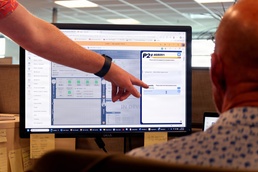
REDSTONE ARSENAL, Ala. — A new line item review app developed by the U.S. Army Engineering and Support Center, Huntsville’s Business Integration Office, is giving project managers and leaders a faster, clearer way to communicate about project status, challenges, and decisions.
“It has exponentially improved our communication. Down to our project management specialists,” beams Ryan Carman, Program Manager of the Center’s Facility Repair Renewal Program.
“We are able to see project-specific information when trying to solve and deal with P2 budgeting and scheduling – it’s all in one field instead of multiple tabs,” The Project Manager said. “PMs are able to accurately portray what's happening with the project and see executed mods at the bottom showing the award date, the new pop date; because sometimes those are not visible to the project managers when they're using different systems in the contracting world.”
The LIR app, housed within the Center’s Leader dashboard, provides project development teams with a single, consolidated location to record comments, elevate concerns, track solutions, and preserve project history. For an organization managing complex programs across multiple mission areas, that visibility can make the difference between leaders being informed and leaders being surprised.
“We're able to see confirmation of what we're told,” Carman said, expounding on the benefits of the application. “Once a mod shows up in the app, we know that it's truly been executed. It helps us confirm that actions have been taken by our PDT members. It's showing real data instead of data that someone might simply want it to show.”
Susan Armstrong, Huntsville Center’s BIO program manager, said the app was built around a simple but important need: to give project managers, program leaders and senior leadership a single place to see what is happening on a project without searching through notebooks, emails or separate files.
“The whole purpose of this is for the PMs and the leaders to go in and interact with a running log via the comments of a given project,” Armstrong said. “We wanted one consolidated place for everything.”
During a line item review, project managers and leaders can enter comments, explain project issues, document decisions, identify concerns, and record when problems are resolved. These comments become part of the project’s history, helping current and future team members understand not only where a project stands but also how it got there.
A project manager may know exactly why a schedule changed, why a budget issue arose, or how a request for equitable adjustment was handled. But if that information lives only in a notebook, an email chain, or one person’s memory, it can easily be lost when continuity is disrupted.
“[It] helps keep the whole team on the same page regarding status,” explains Nathan Smith, a Secure Facilities program manager and an early adopter of the app. “I can go in and update everyone on where we're at in the project so easily.”
“Anyone coming into the project will be able to read the project’s history,” Armstrong added.
That history is especially important for leadership. When senior leaders receive questions about a project, they need accurate information quickly. The LIR app gives them access to project comments, issues, and status information at the click of a mouse, helping them understand what is happening before they enter a meeting, answer a phone call, or make a decision.
“In my experience, I feel it definitely helps our LIR meetings. When comments are submitted in advance, meetings go more quickly because we can review and address them and take any actionable steps. Or, if the project's in good shape, we're able to move on pretty quickly. It’s a time saver,” Smith said.
Before the app, some teams tracked line item review comments in Excel files that were saved, passed around, and updated by different people. That process worked, but it also created opportunities for duplicate information, overwritten comments, or missed updates.
Kyle Rieben, a member of the BIO team who helped build the app, said the tool will improve how project information flows across the Center.
“It’s helping speed everything up,” Rieben said. “Most of the programs used to do it through an Excel file that was saved, passed around, saved, passed around.”
The LIR app streamlines that process by providing teams with a central place to enter and view comments. It also lets users group projects and flag items for different levels of leadership, from program managers and branch chiefs to division chiefs and directors.
“That lets the director see the high-vis projects they need to see,” Rieben said.
The app also provides a place for users to enter justifications and comments explaining why a project is behind schedule, over budget, tied to a claim or request for an equitable adjustment, or otherwise in need of attention. Rather than waiting for a separate briefing or relying on a side conversation, leaders can review the information directly in the dashboard.
For the Center’s project managers, the value is practical. The app is not merely another administrative step. It is a communication tool that can save time, protect institutional knowledge, and help ensure that those who need information have access to it when it matters most.
The app also exemplifies the BIO team’s broader mission. The office develops tools that improve efficiency, streamline communication, and help Huntsville Center teams work smarter across programs, projects, and mission areas.
Rieben said the app was a team effort and has continued to evolve as users provide feedback. He said that building a tool for a wide range of users means balancing specific requests with features that work across the organization.
Armstrong said the more project managers and leaders use the tool, the more valuable it becomes. Each comment adds context. Each update helps build a record. Each documented issue or solution helps the next person understand the project more quickly. Ryan Carman agrees.
“Nothing else is inputted in except for comments,” the project manager said. “Everything else is all fed from a data input linked from somewhere else. That's a requirement. So, this tool... and it should be a tool, not a burden. That's how I see it. This app has really become an essential tool. And that's the important part.”