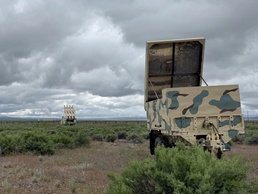
KINGSLEY FIELD, Ore. -- An innovative partnership between the 173rd Fighter Wing and Klamath Community College is strengthening F-35 pilot readiness by producing realistic threat surrogates for the Kingsley Field range while providing students with valuable hands-on fabrication experience. The collaboration connects Klamath Community College’s welding and fabrication apprenticeship programs with a Department of the Air Force requirement to build medium- and high-fidelity surrogate targets that replicate modern integrated air defense systems. The project gives students meaningful, real-world experience while expanding the training environment for the Air Force’s future premier F-35 Formal Training Unit. “This partnership demonstrates what makes the Air National Guard unique,” said Col. Adam Gaudinski, commander of the 173rd Fighter Wing. “By combining the innovation of our Airmen with the talent of our local community, we’re creating a capability that directly strengthens combat readiness. Every surrogate target built here at Kingsley Field gives our pilots a more realistic environment to train, ensuring they’re prepared to win in any theater around the world.” “Rather than building classroom exercises, students are fabricating equipment that directly supports military training,” said Capt.Jared Boyer, 173rd Fighter Wing Unit Conversion Office budget officer. “They gain practical experience using industry-standard welding and fabrication techniques while contributing to a mission that has real operational value.” In 2025, ARCWERX invested approximately $65,000 to launch the initiative, funding steel, lumber, paint, welding supplies and shop expenses required to safely manufacture the training assets. The partnership was formalized through a memorandum of agreement between the 173rd Fighter Wing and Klamath Community College. The first phase of the project produced three radar site surrogates and two SA-17 surface-to-air missile system replicas, which are being deployed across the Kingsley Field range. Pilots from the 56th Fighter Wing at Luke Air Force Base, Arizona evaluated the targets through their F-35 avionics and confirmed the surrogates produced the radar signatures required for realistic tactical training. The validated emitters replicate modern threat systems, allowing pilots to train against radar signatures that closely mirror those they could encounter during real-world operations. Training in a representative threat environment improves sensor employment, tactical decision-making, threat recognition and survivability before Airmen ever deploy into combat. As the Air Force’s F-35 Formal Training Units expands, the 173rd Fighter Wing prepares combat-ready fighter pilots for operational squadrons around the globe. Permanently integrating these surrogate targets into the Kingsley Field range ensures every student pilot trains against realistic threat emitters while mastering the aircraft’s advanced sensors and tactics in a representative combat environment. “Kingsley Field exists to produce the world’s best fighter pilots,” said Gaudinski. “As the Air Force transitions to the F-35, our responsibility is not simply teaching someone to fly an aircraft. It’s preparing combat aviators who can survive and dominate against advanced threats. These surrogate emitters allow us to replicate the challenges our pilots may face anywhere in the world, making every graduate who leaves Kingsley more capable on day one at their operational squadron.” The enhanced range also benefits far more than the 173rd Fighter Wing. Active-duty, Air National Guard and Air Force Reserve units that train at Kingsley Field will have access to increasingly realistic threat replication, improving readiness across the Total Force while maximizing the value of a permanent training capability. Beyond improving pilot training, the project has strengthened joint operations across Oregon. Soldiers from the Oregon Army National Guard’s Unit Training Equipment Site transported and emplaced the completed surrogates at the range training area, supporting both Air Force and Army training objectives. Using military transportation assets instead of commercial towing and crane services saved more than $14,000 while providing valuable training opportunities for Army transportation personnel and exercising joint logistics capabilities. The project’s success has generated continued investment. The National Guard Bureau’s A3/10 Directorate committed an additional $100,000 to expand production, enabling Klamath Community College students and 173rd Fighter Wing maintainers to fabricate approximately a dozen additional surrogate targets. Students and Airmen continue refining manufacturing processes through computer-aided design and improved fabrication techniques, incorporating features such as integrated transportation tie-downs, optimized structural angles and enhanced mobility. The initiative has become one of the Air National Guard’s most requested innovation projects, with multiple wings seeking information on how to establish similar partnerships with local educational institutions. “What makes me most proud is that this project creates lasting value on multiple fronts,” said Gaudinski. “Our students leave with valuable trade skills, our community strengthens its workforce, our joint partners gain meaningful training opportunities, and our pilots receive a more realistic combat environment. That’s innovation at its best finding a solution that makes everyone stronger while ensuring America’s Airmen remain ready to answer the nation’s call.” By combining innovation, education and operational requirements, the partnership demonstrates how community collaboration can generate strategic effects. Every surrogate target fabricated by Klamath Community College students strengthens the Kingsley Field range, expands realistic training opportunities for F-35 pilots from across the Total Force and enhances the combat readiness of Airmen who may one day employ those skills anywhere in the world.