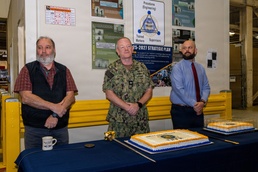
BANGOR, Wash. — Trident Refit Facility-Bangor (TRFB) is celebrating its 45th anniversary on July 1, 2026, marking nearly five decades of providing industrial maintenance, overhauling, and modernization to the nation’s west coast strategic fleet ballistic missile submarine (SSBN). For 45 years, the facility has stood as the U.S. Navy’s premier submarine facility in the pacific northwest, ensuring that the nuclear-powered submarines that patrol the world's oceans remain ready to execute their critical strategic deterrence mission at a moment's notice.
Today, a combined team of approximately 500 military personnel and 1,500 civilian workers operate together at TRFB. This workforce focuses on maintaining the current Ohio-class submarines operationally ready by incrementally overhauling and upgrading the ships to support national security objectives until the end of their service lives.
The facility’s history began on July 1, 1981, when it was officially established under the leadership of Capt. Marvin Sigsbee Greer Jr. as the primary maintenance facility for the newly introduced Trident submarine program. The command was built from the ground up to support and maintain the Navy’s submarines.
“We used to do 18 day in-port refit periods, due to the boats being new”, said Mike Carpentier, TRFB Repair Superintendent. “We’d open up things for planned maintenance, inspect, document, and put new software and put it all back together.”
At the heart of the command’s operations is the iconic Delta Pier, a massive structure named for its unique triangular configuration resembling the Greek letter, Delta. Built parallel to the shoreline, the Delta Pier houses a dry dock uniquely designed to support simultaneous maintenance on five of the Pacific Fleet’s eight assigned Trident submarines.
“When I showed up in 1989, every civilian mechanic was full performance and very experienced. Sailors came here to support the mission may not have had all the same level of experience, but we understood our job was to fix submarines,” said Carpentier.
The facility reached a major operational milestone on Aug. 12, 1982, when the USS Ohio (SSBN-726) arrived as the first Trident submarine to undergo refit at Bangor. This arrival launched a long-standing maintenance rhythm of incremental overhauls involving waterborne and drydocked maintenance periods conducted between patrols to keep the ballistic missile submarines continuously operational without long-term deployments to distant shipyards.
The command underwent significant administrative changes in the late 1990s and early 2000s, reflecting shifting priorities from the Navy. In 1998, the facility merged with Shore Intermediate Maintenance Activity Everett and its Bremerton detachment, forming the Naval Intermediate Maintenance Facility, Pacific Northwest. This was followed by further consolidation in October 2003 to become Puget Sound Naval Shipyard and Intermediate Maintenance Facility (PSNS & IMF), uniting the region's civilian maintenance workforces under a single administrative umbrella.
Despite these organizational shifts, TRFB personnel continued to achieve milestones, including the completion of the command's 500th Trident refit on the USS Pennsylvania (SSBN-735) on June 4, 2004. Furthermore, the facility gained national recognition for its workplace safety on Nov. 7, 2008, when it was designated an Occupational Safety and Health Administration Voluntary Protection Program Star Site for maintaining injury and illness rates well below the industry average.
Recognizing the growing strategic challenges posed by foreign military build-ups and the vital importance of dedicated deterrence, the Navy executed a major organizational realignment on Oct. 1, 2018. This realignment returned the civilian workforce directly to TRFB and re-established its independent identity, culminating in the official renaming of the Trident Refit Facility Bangor on Nov. 15, 2018. Having recently completed crucial seismic mitigation work on the Delta Pier dry dock in August 2023, the facility is well positioned to maintain the aging Ohio-class fleet.
As the command enters its 45th year, it continues to look to the future through major infrastructure upgrades and aggressive local recruiting. In October 2025 the last SSBN availability was completed at PSNS&IMF, making TRFB the sole provider for Pacific Fleet SSBN maintenance while preparing its workforce to welcome the next generation of strategic deterrence, the Columbia-class submarines, into the fleet.
Trident Refit Facility-Bangor supports the nation’s strategic deterrence mission by repairing, incrementally overhauling, and modernizing Pacific Fleet strategic ballistic missile submarines during refits.