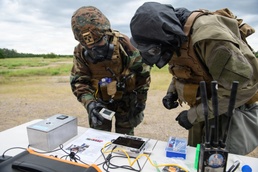
Ft. Belvoir, Va.- In a battlefield environment, the distance between deployed troops and a laboratory creates critical operational and logistical issues. To secure a strategic advantage, the Joint Science and Technology Office (JSTO) at the Defense Threat Reduction Agency (DTRA), is supporting the Department of War’s biological defense capabilities through “assays on demand,” enabling forces to identify unknown biological hazards and develop detection methods on the spot, directly in theater.
Before these on-demand tests can benefit troops, operators must map the genetics of a novel threat using systems like the newly fielded Far Forward Biological Sequencing (FFBS) program, which derived from JSTO-funded efforts. FFBS is a portable system that evaluates field samples quickly, generally within 30 minutes for DNA and 90 minutes for RNA, eliminating the dangerous wait for off-site lab results.
JSTO exploits genomic data to enable the creation of an assay — a procedure used to analyze a substance’s composition or identify specific components, functioning much like a rapid COVID-19 test that yields a positive or negative result.
“Our goal is to provide rapid biodetection solutions for the warfighter,” said Charles Hong, physical science and technology detection branch chief at the Joint Science and Technology Office. “We are actively developing biodetection technologies that have the speed and accuracy needed to inform and warn warfighters of biological threats.”
JSTO is accelerating technology development to support biodetection needs for the warfighter. One of these technologies is First Ripple, an ultra-rapid handheld device that alerts troops to biological threats in less than 15 minutes.
Processing complex clinical and environmental samples up to three times faster than current methods, First Ripple simultaneously detects more than 40 targets, including DNA, RNA, bacterial spores, viruses and protozoa. “If the sample is unknown to First Ripple, a new sample would be prepared to sequence the genetic material," said Stephen Francesconi, Ph.D., a science and technology manager at JSTO who is leading this project. “Bioinformatic software interprets the complex sequencing data into actionable threat levels designed for non-specialists to understand.”
Once the sequence is determined, it is analyzed by separate software to create a nucleic acid test that can be added to the First Ripple assays. The “primers” are created using a portable synthesizer called Kilobaser. Within hours of sequencing an unidentified threat, the Kilobaser uses the new genetic data to develop a custom assay. This specific test can then be distributed for rapid screening across a wider area, helping commanders contain potential exposures.
"The first step was to shrink a lab into a portable device," Francesconi said. "Now we are looking to find new partners with ideas, methods and capabilities to make it possible to find a threat ahead of it impacting a large number of our warfighters."
The system’s development relies on a steady collaboration among military scientists, academia and private industry. JSTO continues to solicit commercial proposals to field next-generation biological detection technologies. These ongoing partnerships directly support the Chemical and Biological Defense Program's mission to anticipate emerging threats and equip warfighters to survive and operate in hostile, contested environments.