(U.S. Army Story by Sgt. 1st Class Kevin Valentine)
WASHINGTON – The Freedom 250 Fourth of July celebration brought record‑breaking crowds, record‑breaking transit numbers, and record‑breaking heat to the National Mall – a once‑in‑a‑generation convergence of conditions that demanded an unprecedented public‑safety response. When FEMA sought partners to execute an emergency water‑distribution plan, the phone rang at the National Guard.
What followed was one of the most complex, multi‑agency operations the city has ever seen, executed by Joint Task Force‑DC (JTF‑DC) and its battalions, commanders, and interagency partners working as a unified lifesaving force. At the center of this interagency effort was Lt. Col. Christian Cannon, JTF-DC operations officer, connecting agencies and coordinating how to meet the needs of the Freedom 250 attendees.
The call came the night before the Fourth: extreme heat, massive crowds, and a no‑fail requirement to keep the public safe. FEMA and the White House needed an emergency water‑distribution plan immediately.
Within minutes, JTF‑DC’s command team, interagency partners, and Cannon began coordinating the response.
The JTF-DC commander identified water‑point locations across the Mall, and Cannon initiated the work of turning guidance into action: securing refrigerated trailers, establishing overnight routes for vehicle movement, and synchronizing with taskforce commanders who would execute the mission on the ground.
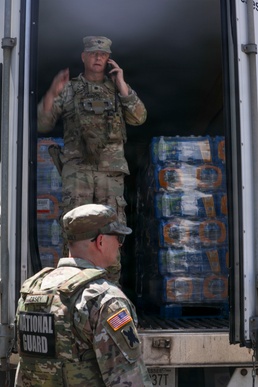
By 4 a.m., Cannon was conducting reconnaissance of water sites and confirming space for trailers. By 7 a.m., refrigerated trucks were rolling into the Mall - and Cannon was on the ground coordinating placement with the battalions responsible for distribution.
At one point, he and his soldiers restarted a failing refrigeration unit inside a 52‑foot tractor trailer holding 19 pallets of water – nearly 40,000 bottles – while the interior temperature climbed to 85 degrees.
“We were racing down Constitution Avenue in full kit [vests and other protective military gear weighing nearly 30 pounds],” Cannon recalled. “It was nonstop. But we knew people needed that water.”
The mission rapidly expanded into a full‑scale task‑force surge:
“Our unit of measurement wasn’t bottles of water – it was pallets of water,” Cannon said. “That’s how fast the water was moving.” Each pallet held about 2,000 bottles of cold water.
These battalions had never worked together before this mission. On July 4, they operated as a single, unified force.
As temperatures climbed past 100 degrees and heat indexes soared even higher, the mission intensified. Water trucks were emptying every two hours. JTF-DC medical teams were treating attendees. Hundreds of thousands pressed into narrow corridors along the Mall to get a glimpse of the Freedom 250 celebration.
Inside a tent near 14th Street, Cannon coordinated with the Washington Field Office special agent in charge, the U.S. Park Police captain, FEMA, and the JTF‑DC command team – his phone ringing nonstop as interagency partners called with urgent needs.
Outside the tent, four battalion commanders and their task forces attacked problems up and down 14th Street: water distribution, medical responses, crowd movement, and quality‑of‑life assistance. Guardsmen reinforced police officers, supported DC Fire, and helped MPD manage surging crowds.
“At one point, every key leader in the organization moved to the point of friction,” said Doane. “Hundreds of Guardsmen were out there providing water, reassurance, and lifesaving support.”
At 9 p.m., severe weather forced thousands of attendees into Smithsonian museums. Reports of heat injuries emerged inside the National Museum of African American History and Culture. Cannon coordinated the dispatch of a fully resupplied water truck from 7th Street and Constitution Avenue. MPD lifted traffic control points. Guardsmen formed a wedge through the crowd.
The task force delivered 8,000 bottles of water in 15 minutes – all consumed almost immediately.
“That one sticks with me,” Cannon said. “People were dropping out from the heat. Getting that water there mattered.”
Doane added,“This was the Guard responding exactly the way the public expects us to respond. When people are in need and looking for help, the Guard responds.”
Across the Mall, JTF‑DC, a force of 5,000 Guardsmen, provided 510,000 bottles of cold water; 353 medical assists; 108,000 wayfinding assists; 1,757 quality‑of‑life assists; and support at 69 traffic control points.
“During the Salute to America event in Washington, D.C., Lt. Col. Cannon demonstrated exceptional leadership by planning…a water distribution operation that supported record crowds in extreme heat,” said Rob Wissinger, Deputy Incident Commander for the National Park Service Incident Management Team. “Through his coordination and the tireless efforts…countless attendees remained safe and hydrated throughout the event. His foresight and decisive action helped mitigate the risk of heat-related emergencies and significantly enhanced the safety and success of our celebration of America's 250th anniversary.”
One attendee later wrote that two Guardsmen spotted him collapsing from heat, stabilized him with water, Gatorade, and ice packs, and escorted him safely to the train station.
“They definitely saved me from hospitalization,” he wrote, recommending both soldiers for Army Commendation Medals.
Throughout the day, Cannon served as the hub of interagency coordination – synchronizing FEMA, NPS, MPD, DC Fire, and federal partners while the JTF commander made force‑allocation decisions.
“Lt. Col. Cannon’s deep interagency relationships translated into a massive multi‑agency effort that delivered one of the most effective public‑safety operations this city has ever seen,” Doane said. “His coordination drove the task force’s ability to keep families safe, prevent countless heat casualties, and uphold the very spirit of service that defines Independence Day.”
Doane described one moment he will never forget:
“As the first fireworks went into the air, every set of eyes looked up – except one. I watched Lt. Col. Cannon look down at his phone and start planning how we were going to get everyone home safely.”
Record‑breaking crowds. Record‑breaking heat. Record‑breaking transit numbers. Record‑breaking demand for public assistance. The only thing that didn’t break was the Guard.
Freedom 250 was a moment of national pride – and thanks to the leadership of JTF‑DC, the surge of its battalions, and Lt. Col. Cannon at its center of interagency coordination, it became a testament to what the National Guard can accomplish when the mission is urgent, the conditions are extreme, and the stakes are measured in lives.