By Spc. William Perez, Cyber Capabilities Developer, Hardware Section, CSD-Maryland, Operations Support Element, 780th Military Intelligence Brigade (Cyber)
FORT GORDON, Ga. – Developers from the Hardware Section of CSD-Maryland (Cyber Solutions Development), 780th Military Intelligence Brigade (Cyber), recently collaborated with developers from the 11th Cyber Warfare Battalion’s CSD-Tactical on a project to increase the Army’s drone warfare capabilities.
The project, which spanned more than a year, aligns with the Army’s “Transforming in Contact” initiative, which aims to modernize the battlefield by rapidly delivering new technology into the hands of Soldiers. Drone warfare has become one of the most significant battlefield innovations in recent years, with several countries scrambling to develop increasingly advanced drone technology following the outbreak of the war in Ukraine.
This project required developers to work across several technical domains, including embedded systems, RF engineering, 3D printing, networking systems, and more. Developers from CSD-Maryland collaborated with CSD-Tactical through shared Git repositories, hundreds of remote meetings, and numerous TDY trips.
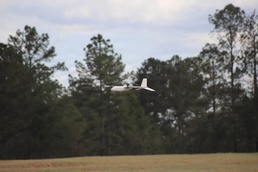
The project culminated with a visit to U.S. Army Cyber Command (ARCYBER) by the Secretary of the Army, Honorable Daniel P. Driscoll, on March 26. CSD-Maryland’s Hardware Section traveled to Fort Gordon, Georgia, to demonstrate the numerous capabilities developed over the previous year. The drone demonstration was conducted alongside the 11th CWB’s Expeditionary Cyber and Electromagnetic Activities (CEMA) Teams (ECTs) which showcased their ability to provide battlefield lethality through cyberspace operations. Developers from CSD-Maryland demonstrated to the Secretary Driscoll, Lt. Gen. Christopher L. Eubank, commanding general, ARCYBER, and other senior leaders their ability to simultaneously deploy three autonomous 3D printed VTOL (Vertical Take-Off and Landing) drone systems and corresponding software solutions developed entirely in-house.
This project, which originated at CSD-Maryland, was fully transitioned to the 11th CWB shortly after the demonstration, enabling the battalion to continue developing and employing the capability. The impact of this effort extends beyond cyber units. The project was designed not only for use by ECTs within the 11th CWB, but also for potential employment by Army Brigade Combat Teams. This demonstrates how the gap between cyber operations and more traditional combat roles continues to narrow as battlefield technology becomes increasingly advanced.
This evolving battlefield environment makes the task of building combat-ready formations more important than ever, whether through the development of new battlefield capabilities by organizations such as CSD-Maryland and CSD-Tactical or through training in cyber warfare tactics by ECTs. By remaining at the forefront of emerging wartime strategies, including drone warfare and expeditionary cyber operations, the Army’s cyber forces are helping ensure that Soldiers remain prepared to face any adversary in an increasingly complex and dynamic operational environment.