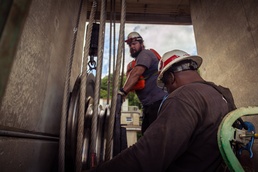
The U.S. Army Corps of Engineers Light Capacity Fleet plays an important role in maintaining critical navigation infrastructure across the Tennessee, Cumberland, and Ohio rivers. Based out of Old Hickory, Tennessee, at the Cumberland River Operations Center, the regional fleet supports locks and dams by completing repairs on culvert valves, miter gates, roller gates, and other essential components that help keep river traffic moving.
At Cannelton Lock and Dam in Cannelton, Indiana, the Light Capacity Fleet recently worked on the upper emergency gates. The work included replacing approximately 6,000 feet of lift cable, 22 sheaves measuring 52 inches in diameter, and four connecting pins. These repairs support the reliability of the emergency gate system, which is important for maintaining safe and efficient operations at the lock.
Jeff Neely, Chief of the Light Fleet, and Rodney Smith, Superintendent of the Light Fleet, discussed how the crew’s smaller size is one of its biggest strengths. The Light Capacity Fleet is part of the Regional Rivers Repair Crew, which also includes the heavy capacity fleet, medium capacity fleet, and the Marietta Repair Station in Ohio. While the heavy and medium fleets have more personnel and equipment, the Light Capacity Fleet performs much of the same work, except for major gate lifts that require heavier lifting capacity.
“The Light Capacity Fleet’s primary role is working on locks and dams on the Tennessee, Cumberland and Ohio rivers,” Jeff Neely Light Capacity Fleet Chief stated. “Our primary work is working on culvert valves, miter gates, and roller gates.”
One of the fleet’s main advantages is its cross-trained workforce. Team members are not limited to one task or trade. A crane operator may also weld or assist with electrical work, while other crew members shift between different responsibilities as needed. This flexibility allows the team to adjust quickly when conditions change on a job site.
“So what makes us special out here on the fleet is we have a group of talented guys that are multi-talented,” Rodney Smith Superintendent of Light Fleet said. “We don’t have one guy doing one task at a time. We can move through different tasks and the same guy might do three different trades that day.”
That adaptability is especially valuable during critical repairs. If the scope of work changes, a contractor may need to submit a modification request before moving forward. The Light Capacity Fleet can adjust within minutes while working with engineers from the host district. This helps reduce delays and allows the crew to continue completing mission-essential work.
The fleet’s smaller size also benefits the taxpayer. According to the team the Light Capacity Fleet can arrive with 20 to 30 workers and complete work that might normally require 50 to 60 people. Because the crew is cross-trained and able to shift roles quickly, they can reduce costs while still completing complex repairs safely and efficiently.
“We can show up and we can get after critical work at a lower cost and still be quick with it,” Jeff Neely exclaimed.
The crew refers to itself as the “Spartans,” a name connected to the idea of a small team accomplishing a large mission. The name reflects how the Light Capacity Fleet operates: with fewer people, multiple skill sets, and a strong focus on teamwork. When challenges come up, the crew works together, adapts, and continues moving the job forward.
The work performed by the Light Capacity Fleet has a direct impact on navigation, commerce, safety, and the communities connected to the river system. Locks and dams support the movement of goods and help maintain reliable river operations. When maintenance issues are addressed before they become larger problems, USACE can reduce disruptions and continue supporting industry and stakeholders.
Neely and Smith also highlighted the pride that comes with working for the Corps of Engineers. The crew understands that its work is part of a larger mission and that many men and women before them helped build and maintain the system they continue to support today. For the Light Capacity Fleet, working for the Corps is more than a job. It is a responsibility to the mission, the public, and the communities that depend on safe and reliable river infrastructure.
“It gives you purpose,” Rodney Smith leader stated. “Be proud of who we worked for at the end of the day.”
The Light Capacity Fleet’s work at Cannelton Lock and Dam shows the value of a skilled, adaptable, and mission-focused team. Through cross-training, teamwork, and efficient use of resources, the fleet continues to support critical infrastructure while providing a strong benefit to the taxpayer.
Reference
U.S. Army Corps of Engineers. (2026). *Light Capacity Fleet subtitles. *[Video transcript].