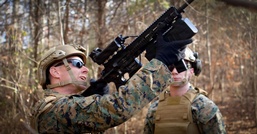
MARINE CORPS BASE QUANTICO, Va.— The Marine Corps has established theMarine Corps Robotics Integration Groupas its service-level organization responsible for integrating, standardizing, and institutionalizing training for Group 1 and Group 2 small unmanned aircraft systems and counter-small unmanned aircraft systems across the Total Force, as announced inMARADMIN 307/26.
Assigned under Marine Air Ground Task Force Training Command, Marine Corps Air Ground Combat Center, Twentynine Palms, California, MCRIG serves as the Marine Corps' focal point for unmanned systems training integration, curriculum development, and education. The organization ensures emerging drone capabilities are transformed into standardized programs of instruction, instructor certifications, and enduring training products that can be delivered consistently throughout the Marine Corps.
"The battlefield continues to demonstrate that small unmanned aircraft systems are no longer niche capabilities; they are indispensable tools for reconnaissance, precision strike, force protection and survivability," said Maj. Gen. Mark H. Clingan, commanding general, MAGTFTC, MCAGCC. "The Marine Corps Robotics Integration Group provides the institutional framework necessary to rapidly integrate validated capabilities into standardized training, ensuring Marines across the Total Force are prepared to employ and defeat these systems in future conflicts."
The establishment of MCRIG reflects the Marine Corps' continued effort to adapt to the rapidly evolving character of warfare, where inexpensive, commercially available unmanned aircraft have fundamentally changed how modern militaries detect, target, maneuver, and fight. MCRIG also establishes a deliberate process for transitioning emerging capabilities into formal Marine Corps training.
As the service-level integrator, MCRIG receives validated capability packages, including tactics, techniques and procedures, pilot courses and training requirements, from specialized organizations responsible for experimentation and operational assessment. Once validated, MCRIG develops curriculum, training support packages, and certification standards before distributing them through designated regional hubs that execute standardized instruction across the Fleet Marine Force.
Central to this process are two complementary organizations: the Marine Corps Attack Drone Team and the newly established Marine Corps Counter Drone Team.
"The Marine Corps Attack Drone Team and the Marine Corps Counter Drone Team are designed to move at the speed of technology. Through the analysis of exercises, operations, and purposely designed events we gain critical information about how systems should be employed or defeated,” said Col. Charles Anklam III, commanding officer, Weapons Training Battalion. “Our responsibility is to rigorously test ideas, validate capabilities, and rapidly transition those findings to MCRIG, where they become standardized training that benefits every Marine. This partnership allows us to remain agile to the constantly changing threat, innovate quickly, and provide the fleet with consistently reliable, credible, and operationally relevant information to increase lethality and survivability."
The Marine Corps established MCCDT to accelerate counter-drone training development in the same way MCADT has supported and advanced attack drone capability development, experimentation, research, testing, and evaluation. Together, the two organizations provide Training Command a focused capability to study both sides of the unmanned systems fight: employment and defeat.
As an organic element of Weapons Training Battalion at Marine Corps Base Quantico, Virginia, MCCDT serves as Training Command’s dedicated counter-drone training development cell. Not designed to deploy as an operational force provider, MCCDT’s role is to identify the threat, test emerging solutions, validate practical tactics, and transition those findings to MCRIG for service-wide implementation.
MCCDT integrates lessons from MCWL, MAGTFTC, MCRIG, government partners, industry, and the Fleet Marine Force to ensure counter-drone tactics and training remain operationally relevant. This approach allows the Marine Corps to rapidly assess emerging threats, evaluate available technologies, and convert battlefield lessons into practical training requirements.
Using established Marine Corps guidance and approved training standards as its baseline, MCCDT conducts operational assessments and force-on-force evaluations to refine C-sUAS best practices. Once validated, those recommendations are provided to MCRIG for incorporation into institutional doctrine, curriculum, instructor certifications, and standardized training products.
This relationship creates a disciplined innovation pathway. MCADT and MCCDT move quickly to support the experimentation, assessment, and validation of tactics against emerging unmanned systems challenges, while MCRIG ensures those lessons become consistent, repeatable, and enduring training across the Marine Corps.
Together, these organizations create a continuous cycle of innovation and institutional learning, rapidly identifying and validating lessons through operational assessment, and incorporating them into formal Marine Corps training.
Designated TECOM regional hubs will execute MCRIG-approved courses throughout the Marine Corps, providing geographically distributed training while also returning operational observations and lessons learned to support continuous improvement of curriculum and tactics. The integrated training enterprise provides the Marine Corps with a sustainable framework capable of rapidly adapting as unmanned technologies evolve, ensuring Marines receive standardized, current, and operationally relevant instruction regardless of where they train.
The Marine Corps is also seeking motivated, technically proficient, and innovative Marines to help build this emerging capability. Marines interested in serving in select C-sUAS billets within MCRIG are encouraged to reviewMARADMIN 307/26for eligibility requirements and application procedures.
The establishment of MCRIG and MCCDT represents another significant milestone in the Marine Corps' broader modernization efforts, ensuring Marines remain prepared to employ and counter rapidly evolving unmanned systems while preserving the agility, lethality, and survivability required on tomorrow's battlefield.