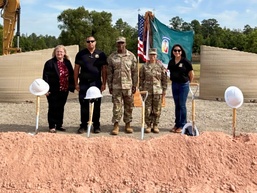
FORT POLK, La. — Contracting professionals from the Mission and Installation Contracting Command helped bring one of the Army’s most innovative military construction projects to life, marked by the June 26 groundbreaking of the new Rotational Unit Billeting Area, or RUBA, at the Joint Readiness Training Center and Fort Polk.
Brig. Gen. Freddy Adams, commanding general of the MICC, and Command Sgt. Maj. JennyAnne Bright joined Maj. Gen. Jason Curl, commanding general of the Joint Readiness Training Center and Fort Polk, Lt. Gen. Gavin Lawrence, deputy commanding general of Army Materiel Command, and other Army leaders for the ceremony celebrating the milestone.
When complete, the RUBA project will use advanced 3D-printing technology and modern construction methods to deliver new barracks that improve quality of life for rotational units at Fort Polk while reducing construction time and costs associated with traditional military construction. By partnering with industry and leveraging advanced construction techniques, the Army is accelerating delivery of critical infrastructure that strengthens readiness and supports large-scale combat operations.
Lawrence highlighted the Army’s commitment to transforming military construction through innovative acquisition strategies.
“Across the Army, we are embracing commercial construction best practices to deliver better facilities faster, more efficiently, and at lower cost to the American taxpayer,” Lawrence said.
The MICC, a subordinate command of Army Contracting Command and Army Materiel Command, played a key role in planning, developing and executing the acquisition strategy that enabled the project through Other Transaction Authority, or OTA, demonstrating how innovative contracting solutions support Army transformation and readiness.
The requirement originated with the Fort Polk Directorate of Public Works and was received by the MICC-Fort Polk office, led by Lt. Col. Brandon Wagner and Deputy Director Michael Ozols. The requirement was then executed by the MICC Theater Support Office under Director Lucy Lopez. Led by contracting professionals Charley Jackson, Stephanie Deal and Susan Denley; the team completed the OTA agreement in fewer than 29 days.
“Using these very flexible agreements helped our team better support the planning, development and execution of the acquisition strategy for such an innovative construction project as the RUBA,” Jackson said.
“Using the OTA for the RUBA project represents one of the most significant contracting achievements in the command’s recent history and marks the first military construction project award of this magnitude executed by the MICC in decades.”
The successful implementation of OTAs exemplifies how innovative acquisition authorities are expanding the MICC’s capabilities, enabling contracting professionals to execute increasingly complex requirements while delivering solutions faster for Army mission partners.
“This project demonstrates how innovative contracting can accelerate capability to the field while delivering greater value to the Army and the American taxpayer,” Adams said
The project also reinforces the command’s growing role as a force multiplier for the Army, Army Materiel Command and Army Contracting Command, applying innovative contracting strategies to accelerate modernization and strengthen readiness.
“Our team is committed to delivering decisive contracting solutions that equip Soldiers with what they need to dominate on the battlefield, sustain readiness at home and pioneer winning capabilities for the Army of tomorrow,” Adams continued.
Command Sgt. Maj. JennyAnne Bright said the project highlights the importance of the MICC’s mission and the direct impact contracting professionals have on Army readiness and the American Soldier.
“Every contract represents an investment in our Soldiers and their mission,” Bright said. “The professionals behind this project helped transform an operational requirement into a modern capability that will support warfighters for years to come.”
The new RUBA will provide a safe, organized environment where rotational units can maximize training and depart the Joint Readiness Training Center better prepared for future operations. The project includes modern billeting and motor pool facilities capable of supporting up to eight battalions and their equipment.
The project reflects the MICC commander’s vision of becoming the Army’s unrivaled contracting arsenal by delivering trusted, agile and forward-looking contracting solutions that provide a competitive advantage to Soldiers, units and installations across the force.
“The MICC Theater Support Office will continue partnering with MICC-Fort Polk, the Directorate of Public Works and industry throughout execution of the agreement, providing acquisition expertise and contract oversight as construction progresses,” Jackson said. “The RUBA project shows how an innovative workforce is expanding the MICC’s ability to execute complex requirements faster and more effectively while delivering decisive contracting solutions that support Army transformation and the future fight.”
To learn more about other MICC initiatives, visit the army.mil/micc.
About the MICC The Mission and Installation Contracting Command is a one-star subordinate command of the Army Contracting Command and the Army Materiel Command. MICC Soldiers, Civilians and contractors take pride in their mission to support Soldiers and their families across the theater of operations by delivering decisive contracting solutions across the theater of operations, equipping America’s Soldiers with what they need to dominate on the battlefield, sustaining readiness at home and pioneering the capabilities for the Army of tomorrow. Headquartered at Joint Base San Antonio-Fort Sam Houston, Texas, the MICC comprises nearly 1,500 Soldiers and Civilian employees assigned across the theater of operations. MICC contracts are vital in feeding more than 260,000 Soldiers every day, providing daily base operations support services at installations, preparing more than 100,000 conventional force members annually, facilitating training for more than 100,000 students each year, and maintaining more than 14.4 million acres of land and 170,000 structures.