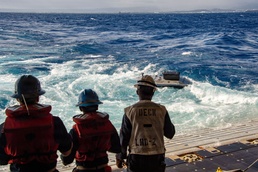
Pacific Ocean – During Rim of the Pacific (RIMPAC) 2026, Wasp-class amphibious assault ship USS Essex (LHD 2) made history by receiving supplies in its well deck from a remotely operated autonomous Digitally-Crewed Surface Vessel (DCSV), demonstrating a new at-sea logistics capability.
“This delivery is a proof of concept for unmanned vehicles,” said Gunnery Sgt. Samuel Maragini, 3D Printing Team NCOIC, Combat Logistics Battalion, 13th Marine Expeditionary Unit. “This is the first time this has been done on a ship like this.”
The DCVS delivered parts for Essex’s 3D Printing Program and sent off 3D-printed drones that were manufactured on board. This direct link between 3D printing and unmanned delivery boosts mission readiness by reducing supply times. Producing essential parts on board and quickly transporting them at sea allows crews to perform repairs and keep key systems running without relying on ports or scheduled deliveries.
Well deck operations are core to Essex’s mission, enabling the launch and recovery of landing craft, amphibious vehicles and delivery ships. Using the well deck for this delivery proved that existing amphibious ships could support new unmanned technology without new platforms.
The delivery enabled evaluation of how unmanned systems can sustain naval forces across wide maritime areas. In future operations, unmanned vessels may resupply ships, reduce crew risk and help keep ships mission-ready far from port.
“It’s showing that an unmanned vehicle could be used to supplement supply chains,” Margarini said.
For Essex, this delivery showed how amphibious ships advance the Navy and Marine Corps unmanned systems while preserving readiness.
Unmanned and remotely operated vessels extend the capability of interconnected manned platform sensors to enhance capacity across the multinational force. Twenty-nine nations, 40 surface ships, three submarines, 14 land forces, over 150 aircraft, and 25,000 personnel participate in RIMPAC around the Hawaiian Islands, June 27 to August 1. As the world’s largest international maritime exercise, RIMPAC offers unique training and cultivates relationships vital for safe sea lanes and secure oceans. RIMPAC 2026 marks the 30th exercise in the series, which began in 1971.
Throughout the exercise, partners train and operate together to strengthen collective forces and promote a free and open Indo-Pacific.
Details of RIMPAC activities and imagery are available at http://www.cpf.navy.mil/rimpac.