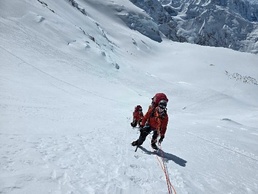
BLACK RAPIDS, Alaska — During the December 2025 Christmas block leave, Sgt. 1st Class Jared Massey was standing on the wind-scoured slopes of Mt. Chimborazo in Ecuador, sucking in the thin air at 20,000 feet. As a seasoned instructor at the Northern Warfare Training Center (NWTC)—the 11th Airborne Division’s premier cold-weather school—Massey knew that leading a team up North America’s highest and most unforgiving peak, the 20,310-foot Mt. McKinley, required exceptional physical conditioning.
Planning for the 25-day expedition began a year prior. It involved extensive route analyses, technical mountaineering courses in Colorado, and countless hours of personal time spent earning critical civilian certifications. Massey and his team of five fellow NWTC instructors spent months simulating the treacherous West Buttress route across the Alaska Range and Washington's Mt. Rainier.
"Planning and preparing for an expedition like this isn't something you do overnight," Massey said. "It takes a year of grueling technical mountaineering, constant physical training, and building the kind of trust where you’d trust a teammate with your life. Because out there, you actually are."
A Hard Choice: True Leadership Under Pressure
The team flew into the glacier on May 16, 2026. They established their initial camp at 7,800 feet and began moving methodically up the mountain. High-altitude expeditions rarely follow a linear timeline. By the time the group reached the 11,000-foot camp, two of the instructors began showing signs of what appeared to be Acute Mountain Sickness (AMS) and severe respiratory illness.
The two instructors spent several days attempting to recover at the 11,000-foot camp. But the mountain did not relent. It was soon discovered they had developed respiratory infections. Continuing upward into even thinner air with compromised lungs and rapidly dropping oxygen levels could have triggered a severe, life-threatening medical emergency.
Instead of pushing forward and risking a catastrophic medical evacuation on the mountain's high-altitude fixed lines, the two soldiers made the difficult but disciplined and tactical decision to descend.
"Choosing to turn back under those conditions is a testament to sound judgment and leadership under pressure," Maj. Davis, the NWTC Commander, noted. "That is a core military virtue."
The remaining four instructors—Sgt. 1st Class Massey, Sgt. 1st Class Cameron Daniels, Staff Sgt. Lucas Auer, and Staff Sgt. Mateo Boyd—continued the climb.
Enduring the Storms
Severe weather dominated the expedition. Out of 25 days on the mountain, intense storms pinned the team in place for 13. Heavy snowfall and high winds battered the camps, damaging tents and requiring constant maintenance at altitudes above 11,000 feet. The extreme environment proved too much for many on the mountain. During their ascent, the NWTC team encountered multiple other climbers suffering from severe frostbite and AMS, all forced to abandon their climbs and retreat to lower elevations as the weather worsened.
Despite the harsh conditions, the team remained fully operational. While at the 17,000-foot camp, the instructors assisted National Park Service Rangers in evacuating two civilian climbers suffering from severe altitude sickness down to the 14,000-foot camp. Both civilians made a full recovery.
"We train for rescues, but performing one at 17,000 feet in extreme conditions is a testament to the grit of the NWTC team," Massey noted. "It's what we do. I was very proud of how my team operated in those conditions."
The Final Push to the Summit
On June 5, 2026, the weather finally cleared. The team seized the opportunity. Leaving the 17,000-foot camp, they executed a grueling, nine-hour push, gaining over 3,000 vertical feet to stand on the summit of North America at 8:04 p.m.
It was the first successful summit by an all-NWTC team since 2022.
"I cannot express how proud I am of these Arctic warfighters," Maj. Davis said. "Twenty-five days on North America’s highest peak displays their experience, grit, and dedication to their craft. They lived the NWTC motto:'HIEMES OPPUGNAMUS ET MONTES SUPERAMUS!'—'Battle Cold and Conquer Mountains!'"
Unrivaled Arctic Integration
While four instructors stood at the summit, the achievement required seamless Arctic integration across the entire 11th Airborne Division. CH-47 Chinook helicopters from the Arctic Aviation Command executed the team's insertion and extraction, while the Arctic Sustainment Command (Provisional) provided critical logistical backing.
"The NWTC stands as the U.S. Army’s subject matter experts in Arctic warfare," Maj. Davis said. "When American soldiers summit the highest peak in North America, it shows the public that we are fully capable of operating, surviving, and winning in the absolute harshest conditions on Earth. No matter the terrain, we are ready."
About the Northern Warfare Training Center
The Northern Warfare Training Center, based in Black Rapids, Alaska, provides world-class cold-weather and mountain warfare training to U.S. military forces and designated personnel to enhance warfighting capability in extreme environments. As the Army’s premier Arctic and mountain training institution, NWTC builds individual and unit proficiency in operating across snow-covered, mountainous, and high-latitude terrain, strengthening readiness for operations in some of the most challenging conditions on Earth.
In addition to training, NWTC supports joint and coalition partners through theater security cooperation and outreach missions aligned with Indo-Pacific objectives. The center is also prepared to assist in rescue and recovery operations worldwide and conducts high-altitude rescue missions in coordination with the U.S. Department of the Interior in the vicinity of Denali National Park. Through these efforts, NWTC enhances interoperability, strengthens partnerships, and reinforces the Army’s ability to fight and win in cold-weather and mountainous environments.