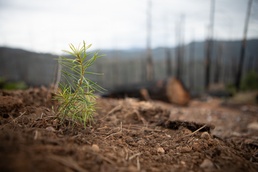
Nature will have its way, but that’s not to say land managers can’t give it a little nudge. That’s just who gathered this spring in the hills of the Mendocino National Forest above Clear Lake in north central California.
In an eight-day period, the Forest Service, https://patriotops.org/, and https://www.theclerc.org/ planted 71,000 seedlings east of the communities of Nice and Lucerne to restore areas of the 2018 Ranch Fire burn scar.
The 2018 Ranch Fire, part of the Mendocino Complex Fire, burned 459,123 acres in 53 days. In the aftermath, communities, the Forest Service, and nonprofits came together, to develop a plan to help restore the forest.
Though these large fires have become more common in recent memory, 14 million acres have burned in California in the last 10 years. And each time, the process of restoring the forest takes many hands, a solid plan, and persistence.
Since 2009, Will Evans, the executive director and cofounder of Clear Lake Environmental Center, has worked natural resource jobs in Lake County. Wildfires and their aftermath have become prominent events in his career. “In 2015, we had the Valley Fire. Every county employee was dedicated almost full-time to dealing with the aftermath of that fire. There was no business as usual anymore,” Evans said. “We were helping people rebuild their homes. We were rebuilding roads, infrastructure, sewer systems.”
And just like his previous job, his work at Clear Lake Environmental Center, a nonprofit, focuses on addressing the impact of wildfire and enhancing Lake County's wildfire resilience.
In some situations, doing one accomplishes the other. Restoring and reforesting the areas of the Ranch Fire will also make these areas more resilient when faced with future fire.
“Without active management of forested lands, brush takes over and big, healthy, mature trees do not return, which are the most resilient to fire,” Evans said. “You're going to have a 10-foot-tall brush patch that is just waiting to erupt into flames.”
Prepping to plant
Forest Service employees and locals wanted to immediately begin replanting trees. But a series of steps needed to happen first.
As a wildfire winds down, the national forest calls the nearby Forest Service nursery. There are six in the country that have been collecting, processing, and storing seeds and growing seedlings for this purpose.
Depending on the species, it takes about one year to grow a seedling that’s ready to plant. Forest Service nurseries are constantly growing these seedlings and returning them back to the forest at a rate of about 28 million seedlings a year.
But back on the Mendocino National Forest, prep for the new trees was already underway. They started with removing hazard trees, the dead and severely burnt trees that can fall without notice. Doing almost any work on a national forest requires removing hazard trees. Not only are they dangerous but they make accessing the forest impossible without a chain saw.
Many Forest Service employees have gone out on clear roads for a day of work in the forest and had to cut through a dozen or more trees that had fallen on the way back.
After the restoration area had become safer and more traversable, it was time to prepare the area for the new trees, by cutting and piling the remaining standing dead trees, cutting back brush, and using prescribed fire to consume the many dead trees that remain from the fire.
Hinda Darner, a district fuels specialist for the Mendocino National Forest, was born and raised in Lake County. She’s spent most of her 24-year career responding to and mitigating wildfire.
“This is my local community. The Mendocino National Forest has always been my backyard,” Darner said. “But most of the big fires that I went to earlier in my career were not in my backyard. And back then, a big fire was, maybe, 80,000 acres.”
For Darner, the Ranch Fire was not only close to home, it burned more than 400,000 acres — the largest in the state of California at that time. (This was later surpassed by the August Complex in 2020, also on the Mendocino National Forest.) The catastrophic wildfire was fueled by extremely dry conditions.
“That was a very big fire for us. It burned very hot and took away a lot of our forest,” Darner said. “We would love to treat and replant the whole burned area, but with limited resources we had to prioritize. The two big deciding factors were the importance of protecting our communities and protecting the forest we still have left out there.” It may seem counterintuitive, but managing wildfire risk right after a wildfire is essential to reducing future risk to nearby communities.
After a fire, dead trees of all sizes start falling and stacking up on each other. Exposed to the sun, with little or no shade, they eventually dry out. Meanwhile brush, often quite flammable, will proliferate in an area. This chain of events can lead to extreme wildfires. This is the outcome the Forest Service works to avoid through active land management like proper site preparation and reforestation.
Over the next couple years, Darner and many other Forest Service employees, partners, and municipal firefighting organizations like https://www.northshorefpd.com/services-5, got to work. They piled dead and down trees, cut back brush, pile burned and protected oak trees and other desirable species to encourage natural forest regeneration.
“We will take machines and pile large trees to be burned,” Darner said. “But we’ll also leave some standing out there for certain species of birds and a few logs on the ground for the critters. We even leave clumps of brush in strategic places for cover for the wildlife.”
For Darner, it’s all about balance and staying on schedule.
“Balance, to make sure there’s not a fuels problem. That when a fire comes through, it does not burn hot. But also, it’s about getting all this work done on time. Once the trees get ordered, once they're coming, they're coming. So getting all this work done took tremendous effort. And we're really thankful to have all of our partners and our community with us.”
Nature and other partners
Jake Barlow, a national stewardship director for Patriot Restoration Ops, has been working with the Forest Service and partners on this particular project for the past two seasons. He estimates about 30% of Patriot Restoration Ops’ work deals with postfire restoration across the country.
Last year in California, Washington and Oregon, Patriot Restoration Ops and partners planted just over a million trees.
“We cover a lot of ground fairly quickly — planting on average 9,000 trees a day — aiming for about 200 trees an acre with a 12-person crew,” Barlow said. “Each crew member puts approximately 800 trees in the ground each day.”
In California, typically spring is best for planting, when the ground is still wet and begins to warm. This time of year is also ideal, so the newly planted seedlings have a better chance of a few more spring showers before the hot summer months begin.
A typical day of planting… Wake up at 4 a.m. Load the trailer with the seedlings at 6 a.m. Start planting at 7 a.m. Plant the seedlings until about 1:30 p.m., depending on the heat index and moisture level. Repeat for about two weeks or until there are no more seedlings to plant.
Designing a landscape-scale project like the North Shore Restoration Project takes an interdisciplinary team of land managers and scientists — hydrologists, soils scientists, archaeologists, foresters, silviculturists, botanists, wildlife specialists, and fuels specialists.
Public feedback also guided the restoration work on the Mendocino National Forest. These considerations, with many others, informed the work that is now underway on about 40,000 acres.
Just like it’s important to work with partners and the community, it’s also essential to work with nature, said Barlow.
The crew plants conifer trees. But the project also encourages natural regeneration. For example, some tree species thrived after the fire, like the California black oak. On many of the burned hillsides, oak trees might be the only tall growth at about 10 feet.
“We’ve been able to encourage those species out there, to thrive and outcompete the brush species for nutrients,” Barlow said. “And we’ll be back next year.”