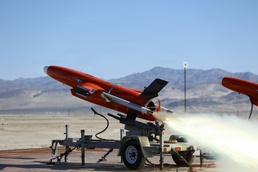
Point Mugu has been trying to sink the fleet since 1946. The fleet is better for it.
The Threat Target Systems Department continues the legacy founded eight decades ago by building, fielding and operating the targets that give the Navy’s ships and aircraft a credible enemy to train against before they face a real one.
This year, the department marks 80 years of aerial target operations at Point Mugu. The threats it builds today would be unrecognizable to the engineers who launched the first drones and pilotless aircraft in 1946.
The mission would not.
A legacy forged in war
World War II delivered two lessons the Navy could not ignore.
Germany’s V-1 buzz bombs proved unmanned weapons could strike at scale. Japan’s kamikaze attacks proved guided threats could reach ships faster than gunners could respond. The Navy needed to develop its own pilotless aircraft and guided missiles. More urgently, it needed to train crews to defeat them.
In late 1945, the Navy established a Pilotless Aircraft Unit at Naval Air Station Mojave and began operating at a makeshift range at Point Mugu. Point Mugu was selected from a survey of 26 candidate sites. Its advantages were precise: an unobstructed over-water range, reliable weather, proximity to Southern California’s aerospace industry and nearby islands for instrumentation.
On Oct. 1, 1946, the Naval Air Missile Test Center activated five miles south of Oxnard. The Pilotless Aircraft Unit consolidated there, and the mission became official: develop and test pilotless aircraft, drones and guided missiles over the open Pacific.
The first test weapon was a direct answer to the threat that prompted the program. The Republic-Ford JB-2 Loon, a derivative of Germany’s V-1 buzz bomb, launched from Point Mugu’s beach ramps throughout 1946 and 1947.
In early 1947, a Loon fired from the USS Cusk (SS-348) became the world’s first missile launched from a submarine. The technology being studied at Point Mugu had become a weapon within a year of the center’s activation.
Early target drones followed.
The KDD-1 Katydid, powered by a McDonnell pulsejet engine, gave the Navy one of its first purpose-built aerial targets at Point Mugu: a platform designed not to strike but to be struck.
The principle embedded in that first drone has driven the program ever since. To train the fleet to win, you have to give it something worth defeating.
The threat grows; so does the target
As adversary capabilities advanced, Point Mugu’s targets kept pace.
Surplus F6F Hellcat fighters, converted to remote-controlled drones, flew as test targets for early air-to-air missiles. In 1952, a Sparrow missile shot down a Hellcat drone above the sea range, marking the first recorded guided air-to-air missile intercept. The result validated the weapon. It also validated the method: give the missile a realistic target, and you learn what the missile can actually do.
The jet age raised the bar. QF-86 Sabres flew in pilot-optional mode as subsonic targets. Later, QF-4 Phantom IIs returned to Point Mugu as unmanned supersonic targets capable of No-Onboard Live Operator operations that pushed missile systems to their limits. The same aircraft that had defined a generation of fleet air combat came back to be shot at.
That is the arc of this mission.
The program also flew purpose-built supersonic targets. The AQM-37, air-launched from fighters, simulated high-speed threats at Mach 3 and altitudes above 60,000 feet. It debuted in the 1960s and flew its final launch during Gray Flag in 2025, after roughly six decades of service.
Behind each target profile are engineers, technicians, operators and range teams who turn intelligence about emerging threats into something the fleet can fly, track and engage.
Today, TTSD operates from three California locations at Point Mugu, Port Hueneme and China Lake, with teams that deploy worldwide to support fleet training and live-fire exercises. The aerial target fleet spans the full threat spectrum, from small commercially derived drones to Mach 2.7 sea-skimmers.
The Low-Speed Aerial Target Small, a DJI Phantom 4 Pro V2, supports counter-unmanned aerial system training from surface vessels, testing shipboard defenses against the class of small drone threats now common in littoral operations.
For larger low-speed presentations, TTSD received 20 former MQ-1B Predator aircraft and redesignated them as NMQ-1B aircraft, giving the Navy a more capable target that can support threat-representative test events beyond the small UAS class. The BQM-34S Firebee remains the fleet’s heavy-lift aerial workhorse. Its payload capacity supports advanced weapons development, including serving as the surrogate launch platform for China Lake’s solid-fuel ramjet missile, Chainsaw.
The BQM-177A, the newest aerial target, replaced the BQM-74 Chukar and carries advanced electronic warfare payloads and wingtip pods replicating subsonic cruise missile profiles. In a recent demonstration on the Point Mugu Sea Range, the BQM-177A flew as a test bed for the Experimental Platform for Intelligent Combat. Naval Air Systems Command’s Strike Planning and Execution Program office (PMA-281) and Aerial Targets Program office (PMA-208) sponsored the demonstration, which used the Shield AI Hivemind system to validate autonomous flight control. The BQM-177A made tactical decisions and executed maneuvers without a remote operator. That capability is in development, not yet fielded.
At the high end, the GQM-163A Coyote provides what no other U.S. target can: supersonic sea-skimming flight at Mach 2.6, with an advanced emitter signal simulator that replicates the electronic signature of an anti-ship cruise missile. The Coyote replaced the MQM-8G Vandal, a supersonic sea-skimmer built from retired Talos missiles that simulated the same threat at Mach 2.5 through the 1980s and 1990s.
That same threat-replication mindset also moved TTSD into electronic warfare, where the target is not always an aircraft, missile or boat. Sometimes, the threat is the signal itself.
When the training tool became a weapon
The Airborne Threat Simulation Organization, or ATSO, within TTSD built its reputation on one task: make U.S. systems earn every detection, track and engagement through a degraded electromagnetic spectrum. The harder ATSO made it for friendly pilots and ship crews to see through the jamming, the better the training. That was the job. Then the question changed.
In 2013, Air Force aggressor squadrons at Nellis Air Force Base needed advanced jamming pods to create realistic electronic warfare environments during training. Georgia Tech Research Institute had developed the core technology. The Air Force needed a team to package it into a flyable, maintainable system. They chose NAWCWD.
The result was the AN/ALQ-167A(V3) Angry Kitten. Its Technique Description Language architecture pairs dedicated hardware modules for speed and bandwidth with software for complex decision-making. Government programmers can update the jammer to counter new threats in days rather than waiting months for a contract modification.
“This enabled the government operators of the pods to generate a huge variety of high-performance electronic attack techniques at vastly reduced costs and development times, as compared to other systems,” said Roger Dickerson, principal research engineer at Georgia Tech Research Institute.
The early years tested the partnership as much as the technology. Antenna covers cracked during high-speed flights at Nellis, creating foreign object debris risk to aircraft engines. The Air Force grounded every pod. NAWCWD engineers worked with Georgia Tech to redesign the radome and returned the fleet to flight status within months.
The fix proved the value of the partnership. Georgia Tech develops and prototypes. NAWCWD integrates, certifies, fields and sustains.
That reprogramming speed attracted units beyond the training world. The Air National Guard Air Force Reserve Command Test Center secured an agreement to use Angry Kitten pods. Operators discovered the system’s offensive potential beyond its training role. By 2025, the pods were moving from training ranges to operational use.
“We developed this system as a training tool to test our radars, and now we’re bringing that same capability to warfighters as an offensive electronic attack jammer to protect their aircraft in real situations,” said Keith Yuen, a supervisory engineer at NAWCWD.
The dual role works because electronic warfare allows it. A threat simulator and an offensive jammer use the same physics, the same signal processing, the same hardware. What changes is the target. NAWCWD’s threat expertise made Angry Kitten realistic enough to train against. That same realism made it effective enough to fight with.
Beyond the skies: surface and electronic threats
TTSD’s mission does not stop at the water’s edge.
The High Speed Maneuverable Surface Target replicates fast attack and fast inshore attack craft. In Surface Warfare Advanced Tactical Training exercises, ships and embarked air crews use the HSMST to validate anti-surface warfare tactics, techniques and procedures against a target that moves and maneuvers like the threat. The next Mobile Ship Target, a 260-foot vessel designated MST 2301, arrived at Port Hueneme in January 2026. NAWCWD teams are outfitting it for operational use, installing a government-developed remote-control system that will allow the vessel to operate safely during live-fire events.
Its reconfigurable superstructure can be shaped to match specific adversary ship profiles, with installed emitters replicating that ship’s electromagnetic environment. MST 2301 is the primary platform for surface-to-surface and air-to-surface weapons testing.
The newest seaborne addition is the Low-Profile Surface Target. The LPST replicates the small, low-signature combatants increasingly encountered in littoral waters. One operator controls the lead vessel with up to seven others maintaining formation or weave patterns autonomously, presenting coordinated attack scenarios that mirror threats in contested maritime environments.
“The targets we build and augment serve two missions. They act as the threat representative surrogate to test and evaluate the weapons and warfighting systems designed to defeat it, and they train the crews who will track, identify and pull the trigger. A ship or aircraft that hasn’t faced a realistic threat in both contexts deploys with unanswered questions. TTSD makes sure they get the answers right,” said Tom Dowd, research and development group director and former director of NAWCWD’s Ranges/Targets Operations, Instrumentation and Labs Group.
The teams behind the threat
The targets are only as capable as the people who build, launch and operate them.
TTSD teams deploy to every major range in the U.S. and abroad. They launch GQM-163A targets from Hebrides, Scotland, during NATO’s Formidable Shield exercise, operate across Atlantic training ranges and support missions at the Reagan Test Range and ranges in Australia. During those exercises, allied navies use TTSD targets to test their own combat systems and train their crews alongside U.S. forces. At home, the Target Training and Operating Procedures Standardization Program classroom at Point Mugu trains target operators from commands across the Navy to common standards.
The collaborative framework that drives target requirements is the Target Stakeholder Requirements Action Group. Through TS-RAG, TTSD, the fleet and NAWCWD technical staff define and refine requirements together, ensuring the threats presented in training track with the evolving operational environment. The Low-Profile Surface Target emerged directly from that process: a specific answer to a gap in how the Navy trains against small-boat threats.
For the fleet, the value of that work is measured in seconds.
“This training is indispensable for exercising a ship’s layered defense, enabling personnel to achieve the technical mastery required to sense, synthesize, and decide fast enough to win in an era where the speed of decision ruthlessly punishes delay,” said Capt. Matthew W. Foster, director, Fleet Training-Pacific, Naval Surface and Mine Warfighting Development Center.
The threat that holds
Training against a realistic threat builds something that a classroom cannot. A crew that has tracked an incoming Coyote at Mach 2.6 knows where its procedures hold and where they break, before that knowledge costs lives at sea.
That is what TTSD has been building for 80 years.
The platforms changed. The Loon gave way to the Firebee, the Firebee to the Chukar. The Firebee still flies. The Chukar gave way to the BQM-177A, now making autonomous tactical decisions over the same Pacific range where the first pulsejet drones flew in 1946.
The threats changed too. Kamikaze gave way to supersonic cruise missiles, which gave way to drone swarms and electronic warfare systems designed to blind U.S. defenses before the first shot is fired.
Every generation of threat required a new generation of target. Every generation of target required the same thing: people at Point Mugu willing to build a more dangerous adversary so the fleet could learn to survive it.
“Eighty years ago this place existed for one reason: make sure we don’t lose a warfighter to something they could have learned here. That mission doesn’t change when the threat goes autonomous. It gets harder,” said Dan Carreño, executive director of NAWCWD. “And the people here have never backed down from a hard problem.”
That is the work TTSD inherited, and the work it carries forward every time the fleet asks for a harder threat.