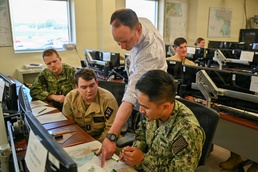
NEWPORT, R.I. — Standing on the roof of Surface Warfare Schools Command, a group of junior officers and senior enlisted peer through their sextants to take a solar noon reading, just as Sailors have done for hundreds of years.
These traditional analog baselines form the bedrock of the Surface Navigator (SURFNAV) course, the Navy's primary pipeline for training prospective surface ship Navigators and Assistant Navigators.
The program trains the fleet’s most capable Officers of the Deck and Quartermasters of the Watch, delivering the advanced foundations needed to execute the massive responsibilities of a surface ship navigation team.
"The navigators are in charge of all the voyage planning, making sure all the charts are set up, ready to go to get us from Point A to Point B," said Lt. Anthony Kennedy, a SURFNAV course lead instructor.
Beyond plotting tracks, the role of the Navigator is deeply rooted in leadership and fleet standardization. These officers and Quartermasters are directly responsible for training bridge officers, mentoring junior watchstanders, and maintaining absolute operational continuity across rotating bridge teams to prevent any dip in performance at sea, said Kennedy.
Managing those diverse responsibilities requires a bedrock foundation in surface navigation skills, which Walter O'Donnell, the SURFNAV course supervisor and an instructor with nine years of experience, defines simply as finding where a ship is and figuring out where it needs to go.
To build that deep proficiency, SWSC expanded its original curriculum from a five-week course in 2025 to a seven-week pipeline that balances traditional analog fundamentals with advanced modern systems like the Voyage Management System (VMS). The training model forces watchstanders away from blindly trusting computer displays and turns them into confident decision makers.
"We believe that competence equals confidence," O'Donnell said. "Once you start with analog and move to the systems, you start to feel like you understand what the systems are doing so that when you're on a ship and you look at VMS you can say, 'that doesn't look right.' And then you start to do some troubleshooting rather than just blindly trusting what the system is showing you."
To supplement classroom theory and build real-world proficiency, the course incorporates hands-on celestial navigation training. This training featured a trip to the Treworgy Planetarium at the Mystic Seaport Museum in Mystic, Connecticut, where students learned to identify seasonal constellations and study the real-time celestial mechanics required to cross oceans without modern technology.
Fleet Navigator’s skills in celestial and analog navigation are already being tested. Ships are routinely deployed to areas where GPS could be denied or spoofed. When electronic displays lose satellite feeds, bridge teams must seamlessly to keep the ship on mission. Furthermore, Commander, U.S. Naval Surface Forces mandated that all ships conducting open-ocean transits shall practice celestial navigation during those periods.
To replicate those high-stress conditions, the training pipeline places massive demands on the students. Chief Quartermaster Montraye Whaley, a military instructor at SURFNAV, said that students must master multitasking under stress. Students must assume multiple roles simultaneously, acting as the navigation evaluator while handling overall bridge resource management as the Officer of the Deck.
A critical pillar of this command structure is the integration of the enlisted force on the bridge. Whaley highlighted the immense tactical advantage of training senior enlisted Quartermasters to serve directly as shipboard assistant navigators. Because smaller surface platforms often feature relatively junior officers filling the primary navigator billet, having an enlisted technical expert on the bridge provides vital, forceful backup.
"Just having that force for backup from the assistant navigator is what's going to make not only that assistant navigator successful, but the whole navigation team," Whaley said. The expanded seven-week curriculum has directly triggered a 17% increase in the graduation and pass rate for fleet Quartermasters, according to Kennedy. Whether managing electronic charts in degraded environments, taking manual radar fixes, or executing tight chokepoint transits, SURFNAV graduates are returning to the Fleet with a re-engineered professional mindset that changes how they lead.
"What we've heard from the fleet is that when you complete a navigation transit, our bridge watchstanders are far more confident, not only in their systems but in themselves," O'Donnell said. "They brag about what they did at sea, navigating 3,000 miles with no GPS."
SURFNAV is offered seven times per year at SWSC, Newport, Rhode Island. SWSC’s mission is to ready sea-bound warriors to serve on surface combatants as officers, enlisted engineers, and enlisted navigation professionals in order to fulfill the Navy’s mission to maintain global maritime superiority.