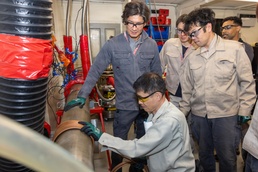
YOKOSUKA, Japan – To keep the fleet mission-ready, a specialized team from the U.S. Naval Ship Repair Facility and Japan Regional Maintenance Center (SRF-JRMC) traveled more than 7,000 miles to master a sub-zero maintenance technique.
The team, made up of one Sailor, two U.S. Navy civilians, and nine Master Labor Agreement employees, successfully executed the "freeze seal" process during a May training session at Norfolk Naval Shipyard. Traditionally reserved for nuclear vessels, this frontline method is now poised to revolutionize how conventional surface ships are repaired across the Navy.
Freeze sealing tackles a notorious maintenance headache: leaking valves that refuse to fully close. Normally, a faulty valve forces crews to shut down massive sections of a ship’s piping. That reactive process can delay critical repairs, require extensive manpower, and create conflicts between maintenance schedules and a ship's operational readiness. In the worst-case scenarios, the inability to isolate a small section of piping can lead to deferring essential maintenance, affecting the vessel's long-term reliability and crew safety.
The freeze seal method bypasses this by circulating a super-cooled medium, such as liquid nitrogen, through a specialized jacket wrapped directly around the pipe. This creates a solid, temporary ice plug that completely halts liquid flow and isolates the problem area with precision.
The hands-on training at Norfolk culminated in a major achievement for the SRF-JRMC team. They successfully created a freeze seal on an 8-inch copper-nickel pipe filled with saltwater, flowing at 8 liters per minute and pressurized to 160 psi; conditions that mirror the demanding environment aboard a naval destroyer.
"For the team to successfully establish a freeze seal in the time we did was a huge accomplishment," said Lt. Cmdr. John Langreck, deputy project superintendent for the command’s Waterfront Operations Department.
Adopting this technology provides a powerful new tool for ensuring the ships of the U.S. 7th Fleet remain mission ready for deployment. It allows maintenance teams to work around isolation challenges, saving time and resources while helping return man-hours to other priorities.
"Implementing freeze seal technology will transition our maintenance posture from reactive to proactive," said Takahito Arai, the shop head for the command's Yokosuka Pipe/Coppersmith Shop, improving how quickly we support ship availability.
The next step is to build an 8-inch waterpipe mockup in the command’s Yokosuka pipe shop, where teams can train with the liquid nitrogen freeze seal equipment on loan from Norfolk Naval Shipyard.
The long journey from Japan to Virginia underscores the Navy's deep commitment to innovation and mastery within its maintenance community. Pierce Bellaire, a process manager for SRF-JRMC’s production department, noted that the team’s dedication to mastering this "highly effective and remarkably straightforward process" embodies the SRF motto, ‘nandemo dekimasu’ - "We can do anything."
For more than 75 years, SRF-JRMC has been the linchpin of U.S. naval operations in the Indo-Pacific region, providing intermediate and depot-level repair for the ships of the U.S. Navy and the U.S. 7th Fleet.