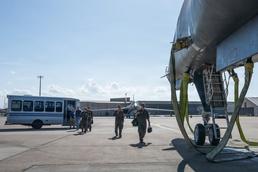
DYESS AIR FORCE BASE, Texas -- A joint team of evaluators, aircrew and maintenance personnel conducted a U.S. Air Force Long Range Anti-Ship Missile (LRASM) Event Zero at Dyess Air Force Base on June 2, marking a significant milestone in B-1B Lancer rapid weapons system integration.
The validation and verification event, led by the 7th Bomb Wing, focused on process improvement and the validation of critical pre-flight procedures for both aircraft and weapons software utilizing updated hardware. During the event, teams successfully connected a live AGM-158C LRASM to the bomber using a locally fabricated cable which increases efficiency for future verifications.
A key highlight of the event was the innovative use of the specialized cable, which was generated using U.S. Navy specifications and locally fabricated explicitly for this test by 7th BW weapons backshop Airmen.
“This event was a critical step forward in validating our procedures and proving our capability on the ground,” said the 7th BW weapons officer. “By utilizing a live AGM-158C connected via an extended cable—which was fabricated and tested entirely by our own weapons back-shop Airmen—we successfully verified rapid process integration, both new aircraft and missile software, as well as gathered invaluable data to sharpen current procedures, all while supporting future combat readiness.”
Connecting a live standoff munition to the bomber's systems without physically loading it into the weapons bay requires precise coordination across multiple squadrons. The event served to baseline data and improve process efficiencies for future weapon integration efforts, with the ultimate goal of enhancing the B-1B fleet’s maritime strike and network enabled weapon capabilities.
“USAF LRASM Event Zero marks a major milestone for Dyess and the B-1B Lancer fleet, paving the way for the rapid validation of advanced long-range standoff strike capabilities in the years to come,” said a 7th BW LRASM subject matter expert. “The ability of Dyess Airmen to fabricate this cable, which was then used to successfully connect the missile, and conduct testing locally is a huge testament to their skill and proves the adaptability of our teams.”
The LRASM is a semi-autonomous, precision-guided anti-ship standoff missile designed to penetrate sophisticated enemy air defense systems. Carrying a 1,000-pound penetrating blast fragmentation warhead, the missile uses advanced self-directed sensing and signature control to approach and defeat maritime targets from outside direct counter-fire ranges.
The B-1B Lancer has always been at the forefront of its employment, becoming the first platform to achieve early operational capability with the LRASM in 2018, and now supporting joint maritime strike missions.
The successful execution of LRASM Event Zero at Dyess underscores the continuous, close collaboration between the U.S. Air Force and the U.S. Navy's Precision Strike Weapons program office under the Program Acquisition Executive for Munitions. As both services continue to pursue next-generation standoff capabilities, tests like Event Zero ensure seamless cross-service integration.
"Our true asymmetric advantage isn't found in the B-1's steel and software, it is rooted in our skilled, innovative, and highly motivated Airmen,” said U.S. Air Force Col. Robert Sturgill, 7th BW and installation commander. “On the flightline and in our weapons shops, these professionals look past legacy blueprints to design and implement ideas that push weapon system capacity and capabilities far beyond original limits. By stepping boldly into the space of what is possible, our force ensures our Wing and Global Strike remain lethal, adaptable, and unmatched."