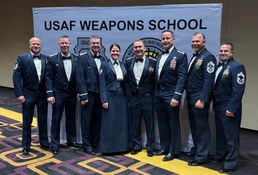
For the first time since 2019, an Airmen at the 181st Intelligence Wing graduated from the United States Air Force Weapons School. This achievement marks another upcoming Airman at the 181st IW, underscoring the rarity of completing one of the Air Force’s most demanding and selective training programs.
Graduating from the USAF Weapons School is a grueling challenge that very few Airmen attain. It can take years to meet the prerequisites needed just to apply to the course. With only two classes a year and approximately 150 graduates in each class, every Airman and Guardian goes through a competitive selection process. They are required to have a mastery level of understanding across their career field, along with a specific number of hours leading and guiding others within their area of influence.
According to their website, the USAF Weapons School consists of 20 weapons squadrons, 31 weapons instructor courses and seven advanced instructor courses at nine locations across the country. It provides an average of 400 hours of graduate-level academics and includes direct involvement in demanding combat training missions.
Staff Sgt. Abigail “HEATER” Martin is the first enlisted Airman from the 181st IW to graduate from the Intelligence Weapons Instructor Course on June 13, 2026, earning the prestigious title of weapons officer.
The course’s curriculum was adjusted in 2015, requiring both the enlisted force and commissioned officers to follow the same curriculum and achieve the same standards for graduation. Following the curriculum change, every graduate receives the title of ‘weapons officer’. In addition to the title of weapons officer, graduates are also commonly referred to as ‘tactical expert’, ‘instructor of instructors’ and ‘patches’. After the course curriculum was updated to integrate enlisted and officers, a new patch was created, displaying their equal level of operational knowledge and elevating every graduate to a rank-irrelevant platform.
“It was the most challenging thing I think I will ever do in my life and almost every graduate will say the same thing,” said Martin. “An 18-hour day is the norm there. We would work six, sometimes seven days a week. You’re being handed the most challenging tactical problems that we’re facing in the Department of War, and you’re expected to figure out these problems and instruct people how to solve them.”
Through intense daily training, the school aims to morph every service member who completes this course into an elite problem-solving tacticians that are prepared to guide the DoW at every level. The course has a reputation of forging each class through flames of unending challenges set in front of them without relent until their graduation.
“I proved to myself over and over that I could figure something out without having all the information,” said Martin. “In the operational world outside of the schoolhouse, we’re not going to have all the answers to our questions. Sometimes you’re not going to have a lot of time to figure out a problem. And in a wartime environment, you’re not going to be getting a lot of sleep.”
Returning to the 181st IW as a weapons officer, Martin will continue developing her expertise in her role as the wing’s weapons officer within the 181st Intelligence, Surveillance and Reconnaissance Group, assisting leadership in their decisions and fostering Airmen in their ongoing career progression.
“We have a person now who has been taught and has experienced tactical-level problems that are hard to solve that we maybe haven’t seen yet at the unit level,” said Chief Master Sgt. Damon “IVAN” Girton, command chief master sergeant of the 181st IW, who also graduated from weapons school and later taught as an instructor for the Joint Terminal Attack Controller Weapons Instructor Course in the 66th Weapons Squadron for three years. “[Weapons school students] are looking at real-world problems currently being addressed. HEATER saw that, and she gets to bring that back. As we’re working through our [trainings, guides, and mission operations], she gets to teach us how to solve those hard problems.”
Girton also explained that the social network established in the school is a critical tool for the students as they advance in their careers. As the students struggle through months of challenges with all the odds seeming to be stacked against them, they build a bond rooted in hard work, determination, and a deep understanding of some of the most complicated problems in the Air Force. On graduation day, students leave the weapons school to reintegrate themselves across the globe. Most, if not all, will never be stationed with each other again. However, every graduate will maintain the ability to reach out to others when they need to give and receive assistance.
Martin said she looks forward to stepping into a leadership role upon her return. With the wisdom and expertise of the noncommissioned officers who came before her, she strives to become the most effective weapons officer possible and improve the 181st ISRG along the way.
“I’m most excited about getting back and teaching our Airmen,” said Martin. “Helping expand their knowledge and be the best analyst they can be every day.”
Martin first learned about weapons school from Capt. Clint “FELON” Robinson, another graduate from the 181st IW. Becoming a weapons officer intrigued her, but she didn’t think she held the necessary capabilities sought for in a weapons officer. Martin had dismissed the idea of attempting the road to become a weapons officer, until Girton approached her shortly after he had transferred into her unit and seeing her work ethic.
“Different weapons schools go about it in different ways to select their members,” said Girton, explaining what influenced him to reach out to Martin as a potential candidate. “A lot of it is inside the units, using ‘patches’ (previous graduates) to identify people who have the skills, aptitude, capabilities and the potential to be a weapons officer.”
Girton explained how there are specific abilities patches look for in each field of expertise, but also emphasized factors that are more difficult to see or measure, such as their presence and “the ability to be that humble, approachable, credible leader.” He says those qualities are critical for a weapons officer because their purpose is not to be the most skilled operator in their unit, but to be the most capable individual of relaying information to their peers.
“They're the ones that sit back and set conditions, and help people learn and grow so the rest of the unit can go out and do [the mission],” said Girton. “You’re looking for a driven person that will never stop. Good enough is not enough; they’re always pressing for the next thing. Somebody that you know has a passion for the job and wants to teach and see the next generation succeed. We call those the intangibles; I can know it and see it and feel it, because I’ve been there. I am a patch, so when I see that person, I know.”
The Air Force is not built on luck, but rather on preparation and timing. The range of opportunities available to incoming Airmen is far too vast for many to fully comprehend. Mentors and leadership are there to equip Airmen with the tools and understanding to begin their path towards the career that will most benefit them, those around them and the mission. Martin stood out to Girton from an early point in Martin’s career, providing her the opportunity for preparation, exemplary leadership and lots of hard work to guide her where she is now. Martin will now be that leader to Airmen, helping guide their hard work into impactful leaders of the future.
“12 years ago, as Joint Terminal Attack Controllers, we had a narrow vision of what was available to help us accomplish our mission and what we could do. It really opened my aperture to all this other stuff that the Air Force is doing,” said Girton, reflecting on his experience returning to base after graduating from weapons school. “My ability, as far as joint warfare planning and execution, increased exponentially.”
Lt. Col. Christopher Good, commander of the 181st ISRG, looks forward to her added skillsets in the unit. He conveyed that her position will play a critical role in strengthening the 181st ISRG’s warfighting capabilities through her unique scope of knowledge, therefore amplifying the already existing reputation of Indiana’s distributed ground system.
“Staff Sgt. Martin is considered the commander’s ultimate tactical advisor and categorized as the top echelon of instructors, therefore coined an ‘instructor of instructors’,” said Good. “Her vast knowledge will continue advancing the 181st ISRG’s efforts, further integrating with air and joint force systems and multi-domain assets.”
According to her leaders, Martin’s presence at the 181st IW will be an ever-growing contribution of knowledge, exponentially expanding mission efficiency, accuracy and reputation through highly skilled and dedicated Airmen.