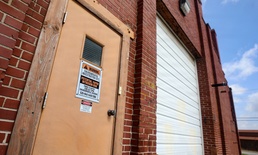
FORT KNOX, Ky. — Fort Knox officials have recently discovered unlawful entry and vandalism of some abandoned buildings since schools were dismissed for summer break in May.
The vandalism consists of rocks and chunks of concrete being thrown through windows and graffiti on walls. However, military police investigations have uncovered that some have been broken into and the insides ransacked.
Fort Knox officials said these actions pose a twofold problem for the violators. The first and most obvious is that it’s a crime.
“The abandoned buildings are still property that belongs to the United States government and because of this, if you enter the building, you can be charged in some cases with breaking and entering or trespassing, or both,” said Fort Knox Police chief Michael Doggett.
Doggett broke down the possible charges that could be levied against anyone who unlawfully enters a federal building, depending on how they got into the building, what they do to the building, and how old they are.
Anyone who breaks into a secure building would be charged with breaking and entering.
For juveniles, the case would go before the Juvenile Action Committee, made up of key law enforcement, legal and Garrison command members, which would assess the situation and rule on what punishments would be handed down.
“Mind you, they're still being charged with that crime,” said Doggett, “but only as a juvenile.”
Punishment could include community service on or off post for both the juveniles and their parents, said Doggett, or more severe charges, such as them and their parents being barred from living on post.
Even buildings that for whatever reason are not secured, there is a punishment for entering.
“If you entered the building because the door or a window was open, we might not charge you for breaking and entering, but we will charge you for trespassing,” said Doggett. “That then gets even more severe if we find damage or vandalism to the building.”
Vandalism includes tagging buildings with graffiti and damaging the building on either the outside or inside or even left-behind items in the building – such as drop ceiling tiles, mirrors, lighting, door windows, air conditioning systems and sheetrock walls.
The reason, according to Doggett, is because not all abandoned buildings are scheduled for demolition. Some are planned for future renovations, based on Directorate of Public Works assessments.
For adults, the case would be referred to the courts on or off post for federal criminal charges.
“You're going to get issued citations, and you're going to have to appear in court,” said Doggett. “We hold a monthly Magistrate Court where a judge comes from Louisville down to preside over cases. That judge has all the authority from incarceration to fines. You risk the potential of going to jail for several days.”
The details of each situation are considered, but breaking the law is still breaking the law, according to Doggett.
“There are a lot of levels where action can be taken against a person who breaks into a building or enters a building unlawfully, trespasses or causes damage to one of these structures,” said Doggett.
The law is not the only threat to those who are unauthorized to enter abandoned buildings. There are also hidden health threats that pose potentially much greater threats: from mold spores, asbestos fibers and lead to wild animal feces carrying rabies and other diseases.
Fort Knox Public Health Chief Dr. James Stephens said the empty buildings are boarded up and locked for good measure.
“There’s a reason we’re not using them anymore,” said Stephens. “It’s very rare that we leave a building fallow just because we want to leave it empty.”
Dilapidated buildings pose their own unique challenges, said Stephens, which amount to physical threats.
“The biggest thing we worry about is structural damage. So, breaking into a building is dangerous; we hope they don’t fall through a floor, we hope the stairs don’t collapse. We hope the ceiling doesn’t fall in.”
According to Stephens, over 10% of the buildings at Fort Knox date back to before the 1950s. What by today’s standards is of grave concern today was of no concern back then.
“Most of our buildings were built between 1950 and 1990,” said Stephens. “We didn’t stop using lead paint until the mid ‘70s,” said Stephens. “All our legacy buildings had asbestos tiles. The concrete had asbestos in it. So, when we go into these buildings, we have to leave them because they are unsafe.”
Asbestos becomes dangerous when it is disturbed in some way – cracked tiles, peeling paint, rotting pipe wrapping. Danger can lurk everywhere, said Stephens: “The older it gets, the more friable it gets, and it powders wherever you go; so, you touch it and it just crumbles, and then you breathe it in.”
Motorpool buildings pose their own dangers, said Stephens.
“They used solvents for paint stripping, solvents for cleaning the motorpools – leaded fuels. We have no idea what was dumped in them over the last 75 years,” said Stephens. “We also can’t say that people were 100% safe all the time back then.”
As a result, Stephens suggests that anybody who comes down with unusual symptoms, symptoms that don’t fit into typical seasonal illnesses should get checked out by a doctor. And speak honestly about entering an abandoned building.
“They should at least mention, ‘Hey, I was in an abandoned building that had a lot of dirt, dust and animal feces in there,’” said Stephens. “When people come in and say, “I have the flu,’ the medical community tends to focus on just the flu. If you come in with an illness and say, ‘Hey, I was in this type of dangerous area,’ then we’ll start expanding our testing and our thought processes.”
Tony Ritenour, Toxic Substances Control Act manager at Fort Knox, said the abandoned buildings can contain several deadly toxins that can get more toxic with time.
“They're full of invisible health hazards,” said Ritenour. “They've got mold, they've got asbestos and dust and there's lots of hazards within that dust, which include lead. Just walking through a building can stir them up.”
While nobody knows who is entering some of the abandoned buildings, Ritenour said he has a suspicion it could be youths who are out of school and looking for things to do.
“Maybe they go in there to have fun, or maybe they want to do some bad things in there,” said Ritenour. “But this could cause health hazards that they’re not aware of.”
The father of two teen boys offered some advice for anybody who might be tempted to sneak inside:
“I get it — an empty building looks like the perfect place to hang out, explore, or just do something different. But here's what you can't see; the air inside is full of asbestos fibers, lead dust and mold spores. You won't smell them. You won't feel them. You'll walk out thinking nothing happened,” said Ritenour. “The problem is what those fibers may do later; they lodge in your lungs and can cause cancer that shows up when you're in your 30s or 40s, when you've got a whole life going on. Lead can mess with your brain and memory right now, while it's still developing.
“This isn't me trying to get you in trouble; it's me trying to keep you from trading one afternoon of adventure for a diagnosis down the road that you can't take back. There's no do-over on this one. Stay out! And if your friends are talking about going in, be the one who says it's not worth it.”