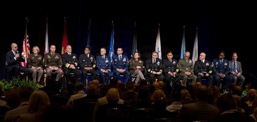
The Department of War’s top military medical leaders addressed the realities of the modern battlefield and readiness during the 2026 Military Health System Conference.
The May 28 panel at the conference in Dallas, Texas, included Army Lt. Gen. Mary Izaguirre, U.S. Army surgeon general; Army Command Sgt. Maj. John E. Dobbins, senior enlisted advisor to the U.S. Army surgeon general; Navy Vice Adm. Darin Via, director of the Defense Health Agency; Navy Force Master Chief PatrickPaul Mangaran, command senior enlisted leader for the DHA; Air Force Lt. Gen. John DeGoes, U.S. Air Force and U.S. Space Force surgeon general; Air Force Chief Master Sgt. Thomas J. Wigington, senior enlisted advisor to the Joint Staff Surgeon; and Navy Rear Adm. Matthew Case, U.S. Navy deputy surgeon general. Dr. Stephen Ferrara, the former principal deputy assistant of war for health affairs, moderated the panel.
With three wartime efforts, Operations Midnight Hammer, Absolute Resolve, and Epic Fury, taking place over the past year, the floor was opened to discuss warfighter lethality, innovating readiness, and leveraging partnerships for mission success.
The panel, with additional distinguished leaders including Navy Rear Adm. Guido Valdes, medical officer of the U.S. Marine Corps; Navy Force Master Chief Jerry Cantorna,Force Master Chief of U.S. Navy Bureau of Medicine and Surgery ; Navy Master Hospital Corpsman Alfredo Medina, senior enlisted leader of the U.S. Marine Corps Medical Forces; and Dr. Eric Elster, dean of the School of Medicine, Uniformed Services University, were poised to answer.
Unpacking readiness in a changing wartime landscape
The nature of warfare is evolving rapidly, Wigington said, stressing that past combat medical strategies will not suffice.
“How we did medicine before is not going to be how we do medicine in future wars,” he said. “Let's identify how that needs to be tailored and modified based off of the type of war fight that we know is going to come."
Leaders noted the changing environment brings a profound moral imperative: The medical system must make sure warfighters are safe and healthy to take the burden of readiness off tactical operators.
"We need to pull the risk up to the headquarters, so that the front line can focus on the mission,” noted Izaguirre. “We've got to have a health system that is not reliant on uniform members being present, because they could be called to war.”
To achieve a ready medical force, Dobbins added, training needs to take place “in the military hospitals and clinics and the operational environment, because both are important.”
Training in both areas needs “to be complementary and not competing against each other,” he said, and should be “realistic, rigorous, and build those mental calluses to prepare our medics for the front line.”
Confronting the "Walker Dip"
The "Walker Dip," — which DeGoes defined as occurring when “medics, docs, nurses, and techs lose proficiency in the interwar period” — was a focal point of senior leaders, who saw it not as just a vulnerability, but an opportunity for deliberate sustainment of skills. “We owe you better sets and reps so that we never send you down range unprepared to do the job that you need to do," he added.
“We need to be boots on the ground every day, walking our spaces reminding people what they need to do to be ready,” remarked Case.
To further bridge the gap between peacetime and wartime, the panel noted the benefits of military-civilian partnerships to retain those skills yet acknowledged the need to align these efforts under a cohesive, strategic network.
Valdes encouraged a unified plan for partnerships, calling the wide-ranging collaborations with the MHS “islands of excellence.”
“But it's not really a procurement strategy,” he said. “I think we need to get to that."
‘Brilliant at the basics’: empowering the enlisted force
The panel’s senior leaders delivered a unified, urgent message: The enlisted force must be prioritized in readiness efforts.
Cantorna said achieving this requires a culture shift, moving senior enlisted personnel away from administrative burdens and back to clinical care.
"For the Navy, the thing we have problems with is we're very administrative heavy,” he said, “I think we need our senior staff to put hands on patients — we need to change that culture."
Mangaran reinforced this philosophy, saying “If you are a provider and have enlisted medics or hospital corpsmen working in your clinic, pull them alongside and teach them how to safely conduct physical examinations. It is the enlisted warrior that is normally fighting alongside our warfighters.”
"The more you get brilliant at the basics, the more prepared you're going to be … find ways to be creative to provide that simulation training" to enlisted medics, he said.
Forging a unity of effort, a path forward
Via explained why the joint medical force cannot be compared to private sector healthcare, emphasizing that readiness must be protected as the system's primary asset.
“If you look at most insurance companies — they have a 20% reserve. Our reserve is readiness. That is our reserve,” the DHA director said, noting the significance of prioritizing and treating warfighter health as an investment in the future of the joint force.
“When we don't have the resources — there is going to be a cost to readiness, and this is the risk you're putting in the system,” he added.
To manage this risk, Via emphasized the importance of cultivating trust and working together across services: “It's not about command and control. It's about collaboration and cooperation.”
Closing the panel, leaders issued a final challenge that every level of the enterprise to prioritize the needs of all healthcare personnel — from the combat medic to the surgeon — to maintain a ready medical force.