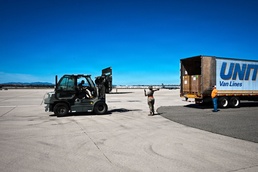
In a massive demonstration of rapid global mobility and interagency cooperation, 433rd Airlift Wing Reserve Airmen partnered with Drug Enforcement Administration personnel to execute an interagency joint mission- Operation Burnout- the largest recorded aerial transport of hazardous narcotics for destruction.
Over the course of three days, from May 18 to May 20, 2026, the 433rd AW mobilized a C-5M Super Galaxy to transport 23 pallets—approximately 50 metric tons—of seized narcotics. The payload, valued at an estimated $5 billion, was airlifted from March Air Reserve Base, Calif., to Wright-Patterson Air Force Base, Ohio, before being securely transported to an incinerator facility in Indiana for final destruction.
The joint force capability provided by the Air Force Reserve Command was a critical element in supporting the DEA’s strategic goals to protect, prevent, and support American communities by keeping illicit substances like fentanyl, cocaine, and methamphetamine permanently off the streets.
“It’s really mission essential that we utilize the Air Force to be able to transport these drugs,” said Gerald Mapp, senior foreign integration advisor to the DEA for the Department of War. Mapp explained that recent environmental closures of major incinerators in California left the DEA with growing stockpiles of seized contraband.
“We have to store this stuff once we seize it in an approved warehouse, but more stuff is always coming in,” said Mapp. “You have to look at fentanyl as a major problem—one pill can kill you. Taking these drugs off the street protects the American public, and we couldn’t do this without the Air Force’s heavy airlift capabilities.”
Moving 50 metric tons of highly valuable and hazardous contraband overland presents significant security and logistical vulnerabilities. By utilizing the C-5M Super Galaxy, the interagency team drastically reduced the risk of ambush, theft, or logistical failure while expediting the destruction process.
Rashida Weathers-Hurst, section chief of laboratory management and operations for the DEA Office of Forensic Sciences, highlighted the stark contrast between land and air transport for an operation of this magnitude.
“If we had not partnered with the Air Force, we would have had to drive it across several states, which would have taken tons of manpower and days to do,” Weathers-Hurst said. “Drug evidence is currency on the street, so it is definitely a high-security mission. The precision of military logistics and their ability to execute a mission safely makes this teamwork top tier.”
The operation required meticulous coordination. Joint Task Force North began planning the movement months in advance, navigating the complexities of hazardous cargo waivers, cross-country flight paths, and intense ground security protocols involving DEA Special Reaction Teams and Air Force security personnel.
“We were able to put a call out to the whole enterprise to see who was willing to pick up this mission, and the 433rd answered the call,” said U.S. Air Force Maj. Benjamin Sperring, air mobility chief for Joint Task Force North. “Having the C-5 gave us the capability of a larger aircraft, meaning we could fly more seized narcotics and make a bigger impact on the crime rates. The interagency collaboration to get these drugs absolutely destroyed has been fantastic.”
For the Texas-based aircrew, Operation Burnout was a unique opportunity to apply their wartime training and readiness to a critical domestic mission. Loadmasters and aerial port Airmen from the 50th and 56th Aerial Port Squadrons worked seamlessly alongside DEA personnel to meticulously package, seal, and load the 23 hazardous pallets, ensuring all flight safety regulations were met.
Maj. Ryan Becker, 733rd Training Squadron student flight commander and aircraft commander for the mission, emphasized that the Air Force’s capabilities extend far beyond traditional combat roles.
“Our assets aren’t just used for war,” said Becker. “We do humanitarian aid, disaster relief, and we carry out missions that support our partners in law enforcement. The DEA, Coast Guard, and local law enforcement do all the hard work to get this stuff off the street. We’re just the last step in helping them finish that mission.”
By successfully executing the largest known aerial shipment of hazardous narcotics for disposal, the Alamo Wing proved that its Reserve Airmen stand ready now to deliver global airlift power at a moment's notice—whether defending the nation abroad or protecting communities at home.