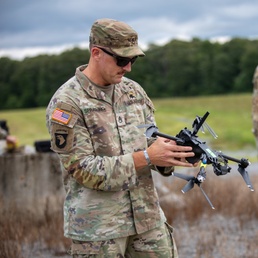
SMYRNA, Tenn. – Twelve Tennessee Army National Guard Soldiers became the first graduates of the Tennessee Army National Guard’s inaugural Small Unmanned Aircraft System (SUAS) Master Trainer Course at the Volunteer Training Site in Smyrna, June 29, establishing a new capability to expand unmanned aircraft expertise across the force.
Conducted by the 1st Battalion, 117th Military Police Regiment, the two-week pilot course prepared experienced SUAS operators to return to their units as instructors, evaluators, and program managers capable of building and sustaining unit-level unmanned aircraft programs.
“This is the most advanced training we’ve ever provided to Soldiers on these systems, and it’s just the beginning of what we are capable of,” said Jeffery Barber, chief instructor for the course.
Unlike the Army’s Basic SUAS Operator Course, which focuses on safe operation and employment of unmanned aircraft systems, the Master Trainer Course develops Soldiers to certify new operators, advise commanders on system capabilities, oversee training programs, and integrate SUAS into mission planning.
“Everybody attending the course already knows how to fly and has attended a pilot’s course or equivalent,” Barber said. “We dive deep into training methodology and understanding various platform capabilities so our graduates can train others and brief commanders on capabilities, what’s possible, and what risks they’re accepting.”
While most students previously completed the Army’s operator course, commanders could also nominate Soldiers with equivalent military or civilian experience, including those holding Federal Aviation Administration Part 107 Remote Pilot Certificate certification, allowing experienced operators to enter the advanced program.
Throughout the course, Soldiers received instruction in SUAS doctrine, advanced meteorology, crew coordination, airspace management, risk management, Army regulations, instructor methodology, training management, and flight proficiency. During the culminating field exercise at Volunteer Training Site Tullahoma, students planned missions, conducted aerial reconnaissance, analyzed terrain, collected imagery, and demonstrated their ability to safely employ unmanned aircraft systems in realistic operational scenarios.
“We ensured that all our graduates were tested and capable of flying and teaching any mission they may be called to perform in combat,” Barber said.
Students trained primarily on the Skydio RQ-28A, a lightweight quadcopter that provides infantry units with intelligence, surveillance, and reconnaissance capabilities during day and night operations. They also received familiarization training on the Skydio RQ-28C and the Neros Archer.
“The technology and systems are changing so rapidly that we designed this course to remain flexible,” Barber said. “Our Soldiers must be able to quickly incorporate new platforms into their units while using the newest doctrine and lessons learned from current conflicts. It is our responsibility to ensure they return to their units with the best training and information available.”
For Travis Robinson, commander of the Multi-Purpose Company, 3rd Battalion, 278th Cavalry Regiment, the course represented more than advanced flight instruction.
“This course is very different from the Operator Course,” Robinson said. “It teaches us how to train Soldiers, manage records, control airspace, and understand the requirements behind building a successful program. If we, as leadership and command teams, don't understand what it takes to be proficient at these systems, then it becomes a wasted asset.”
Robinson said unmanned aircraft systems provide commanders with greater situational awareness while reducing risk to Soldiers operating on the ground.
“Instead of putting eyes on, we can put eyes over,” Robinson said. “It gives us a different angle to see threats and provides us with a safer means to acquire valuable, real-time intelligence on the battlefield.”
The course directly supports the 278th Cavalry Regiment as it continues its transition from an Armored Brigade Combat Team to a Mobile Brigade Combat Team. As one of the Army National Guard’s first brigades selected for the transformation, the regiment is fielding emerging capabilities including the Infantry Squad Vehicle, advanced unmanned aircraft systems, extended-range precision fires, and electronic warfare.
“This training isn't something you learn once and walk away from,” Robinson said. “The technology changes. The battlefield changes. If you don't do this on a regular basis, you're going to be left behind. Tennessee and the 278th are at the forefront of this new technology and will remain leaders in this field.”
The Tennessee Army National Guard plans to conduct another SUAS Master Trainer Course in 2027, pending evaluation of the pilot program by the National Guard Bureau.
-30-