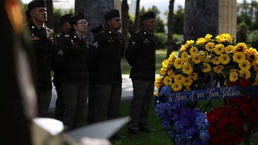
NETTUNO, Italy - More than 80 years after Iron Soldiers fought across the battlefields of Italy, a group of Soldiers from the 1st Armored Division stood on the same ground where their predecessors endured some of World War II's fiercest combat.
A battlefield study took Soldiers to the Sicily-Rome American Cemetery and Memorial, where 7,845 American service members are buried and more than 3,000 missing personnel are memorialized. Among them are 247 Soldiers from the 1st Armored Division who fought during the Italian Campaign, including Operation Shingle and the Battle of Anzio.
For Command Sgt. Maj. Carvet C. Tate, the senior enlisted advisor of the 1st Armored Division, the experience provided Soldiers an opportunity to connect with the division's legacy in a way no classroom ever could. "It's important for Soldiers from the 1st Armored Division to come to Anzio to truly learn and stand on the sacred grounds where Iron Soldiers before us fought," Tate said. "Reading about history is one thing but standing here and truly getting the essence of what our Soldiers before us endured during World War II is pretty amazing." The visit included historical briefings and a wreath-laying ceremony honoring the Americans who fought and died during the campaign to liberate Italy from Nazi occupation.
During Operation Shingle, Allied forces landed at Anzio on Jan. 22, 1944, as part of an effort to break the German defensive line south of Rome. The campaign evolved into months of brutal fighting marked by artillery barrages, difficult terrain and determined enemy resistance. Soldiers of the 1st Armored Division played a critical role in sustaining offensive operations that ultimately contributed to the liberation of Rome.
Standing among the rows of white marble headstones, Tate reflected on the sacrifices made by those who wore the Old Ironsides patch before them.
"What stood out to me most was participating in the wreath-laying ceremony and honoring the Soldiers buried here," Tate said. "When you see the names on the walls, the maps of the campaign and the history surrounding you, it reinforces what it means to be an Iron Soldier and the sacrifices made by those who came before us." For Sgt. Maj. Matthew W. Gorman, operations sergeant major for the 1st Armored Division, the visit reinforced the connection between readiness, leadership and legacy.
"When I first arrived at the cemetery, I was speechless," Gorman said. "It was a really powerful message and really captured the reality of what it means to be in a large-scale combat operation. Seeing all 247 Soldiers buried here from the 1st Armored Division was something really difficult to put into words."
Gorman said the experience provided a perspective that cannot be replicated through books or classroom instruction.
The Soldiers selected to make the journey to Italy were not chosen at random. Each earned the opportunity after distinguishing themselves during the 1st Armored Division's Iron Heroes competition, where they competed against the division's top Soldiers in physically and mentally demanding events designed to test lethality, endurance, leadership and warrior skills.
Representing the best of Old Ironsides, these Iron Heroes stood on the same ground where previous generations of Iron Soldiers fought and sacrificed for freedom during World War II. The experience connected today's highest-performing Soldiers with the legacy of those who established the division's reputation for courage, toughness and battlefield excellence more than eight decades ago.
While senior leaders reflected on the campaign's operational significance, the trip also left a lasting impression on the division's youngest Soldiers.
Pfc. Reginald Senegal said seeing the cemetery firsthand deepened his appreciation for the division's history and strengthened his connection to the Old Ironsides patch.
"It definitely makes me wear my unit crest with more passion and devotion," Senegal said. "I’ll definitely try to uphold that value and sacrifice that past soldiers before me have made.” "
Upon arriving at the cemetery, Senegal immediately noticed the reverence with which the site is maintained.
"My first thought when I arrived at the cemetery and saw the headstones was how important the cemetery seemed to be to both the culture here and American culture," Senegal said. "It was well taken care of and very symbolic.”
For Senegal, it showed how our fallen Soldiers are honored not only in the United States but also in the places where they made the ultimate sacrifice.
One of the most impactful moments came when Senegal entered the memorial chapel and saw the names of thousands of Americans whose remains were never recovered.
"The moment that impacted me the most on this trip was walking to the chapel and seeing the thousands of names written on the walls of people whose bodies were never found, and that they’re still honored today and seen as an important loss to our country," Senegal said.
Senegal plans to share the experience with fellow Soldiers who were unable to make the trip.
"It’s important for Soldiers to know the history behind their unit so they can have that pride and morale to wear the patch every single day and understand what their unit went through and what they represent when they wear that.,” he said. As the group departed the Sicily-Rome American Cemetery, they carried home more than historical knowledge. They left with a deeper understanding of the Soldiers who fought before them and a renewed commitment to uphold the legacy those heroes established.
For Tate, that legacy remains one of the division's greatest strengths.
"The Soldiers who came here are not the same Soldiers who will leave," Tate said. "When they return to Fort Bliss, they'll have a greater appreciation for what it means to be an Iron Soldier. They'll understand the sacrifices that built this division, and they'll carry that legacy forward."
More than eight decades after the guns fell silent across the battlefields of Italy, the legacy of the Iron Soldier continues to endure, not only in memorials and history books, but in the Soldiers who continue to proudly wear the Old Ironsides patch today.