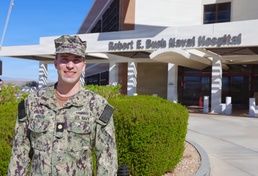
TWENTYNINE PALMS, Calif. — While most service members at the Marine Corps Air Ground Combat Center (MCAGCC) build military readiness by training on the ranges, Lt. Cmdr. Matthew Horch works behind the scenes to protect the installation from public health threats that can sideline the force before they even reach the battlefield. As Navy Medicine Readiness and Training Command (NMRTC) Twentynine Palms' Public Health Emergency Officer, Horch helps the installation prepare for, respond to and recover from public health threats that could affect the health of the force and mission readiness.
Since July 2025, Horch has served as NMRTC Twentynine Palms' Public Health Emergency Officer (PHEO) in addition to his duties as department head of the occupational health department. Working out of Naval Hospital Twentynine Palms, his duties span everything from workplace health and safety to planning for infectious disease outbreaks and other public health emergencies.
Originally from Vancouver, Washington, Horch earned a Bachelor of Arts in biology from the University of Chicago before completing both his Doctor of Medicine and Master of Public Health degrees at the Uniformed Services University.
He said his decision to pursue Navy Medicine was driven by a desire to focus on patient care while serving a greater purpose.
"I joined Navy Medicine because I knew I could have a greater impact on patients through the military," Horch said. "In military medicine, I thankfully don't have to worry much about billing, insurance, and many other administrative aspects of healthcare. I can focus entirely on what the patient needs and how to provide them the best possible care."
As the installation's PHEO, Horch serves as the commander's principal public health advisor during routine operations and public health emergencies. His responsibilities include monitoring health threats, leading outbreak investigations and recommending protective measures that safeguard public health while ensuring the installation can continue its mission.
"A PHEO is a specially trained medical professional who serves as the primary public health advisor to a military installation commander. In our case, that’s MCAGCC’s commanding general," Horch explained. "Their main role is to guide the commander on how to prepare for and respond to public health emergencies, such as disease outbreaks, pandemics or bioterrorism."
Every military installation commander is required to appoint a PHEO, ensuring each military treatment facility has immediate access to expert public health guidance when responding to health emergencies.
"The reason this is required is to ensure that every command has immediate, on-site expert guidance to protect the health of service members, their families and civilian personnel to ensure the command's operational readiness," Horch said. "Having a designated PHEO ensures a swift and effective response to any public health crisis."
In Twentynine Palms, public health planning begins with the unique challenges of the Mojave Desert. Horch said heat illness and dehydration remain the installation's most immediate and persistent threats because of the year-round operational tempo and extreme environmental conditions.
"Our installation is the largest live-fire Marine Corps installation in the world, where rigorous training occurs year-round in extreme desert conditions," Horch said. "Because of this, heat illness and dehydration are our most immediate, daily public health threats."
To reduce those risks, the public health team conducts regular workplace heat surveys using wet-bulb globe temperature measurements, establishes safe training limits, enforces work-to-rest cycles and hydration guidance based on heat flag conditions, and provides preventive education that helps leaders recognize and respond to early signs of heat illness before they become life-threatening.
Beyond environmental hazards, Horch and his team remain prepared for infectious disease outbreaks and other emerging health threats. Although the installation is geographically isolated, military personnel and their families routinely travel around the world, requiring constant vigilance and planning.
"We prepare response protocols for highly contagious outbreaks like measles by ensuring rapid isolation and contact tracing capabilities are always ready," Horch said. "Additionally, we actively monitor desert-specific vector-borne threats unique to arid environments, such as rodent-borne Hantavirus, while maintaining rigorous surveillance and triage plans for high-consequence pathogens like Ebola so our staff remains fully trained in personal protective equipment and containment long before a threat ever reaches our gates."
For Horch, public health and military readiness are inseparable.
"A healthy force is a deployable force," Horch said. "Without robust public health measures and designated advisors like PHEOs, a military command risks losing its most valuable asset, its people, to preventable diseases. By keeping the community healthy, public health directly safeguards the nation's defense capabilities."
Preparing for emergencies requires continual training, coordination and interoperability with partner organizations. For example, Horch recently participated in a joint emergency response tabletop exercise with another military installation to strengthen disaster preparedness and evaluate joint response capabilities.
"We recently conducted a joint emergency response tabletop exercise with Edwards Air Force Base," Horch said. "This provided insight into our joint capabilities, shortfalls, and how we can better prepare for disasters and public health emergencies."
Whether mitigating the dangers of extreme desert heat, preparing for infectious disease outbreaks or strengthening emergency response plans with joint partners, Horch's work helps ensure Navy Medicine remains ready to protect the health of the force. Through prevention, preparedness and expert public health leadership, he helps keep warfighters healthy, resilient and in the fight.
Navy Medicine's 44,000+ talented and ready forces optimize health readiness, deliver quality healthcare, and provide global expeditionary medical support to warfighters.