The U.S. Air Force Nurse Corps celebrated its 77th anniversary in 2026. Through its mission, “Nursing Excellence, Anytime ... Anywhere,” the nurses are dedicated to the health and safety of Airmen and Guardians.
A component of the Air Force Medical Service, the Nurse Corps was established July 1, 1949, with the transfer of 1,199 nurses from the U.S. Army Nurse Corps, two years after the creation of an independent https://www.airforce.com/.
U.S. Air Force General Order No. 35, established the AFMS and its six original corps components. Air Force Maj. Gen. Malcolm Grow, who would become the first U.S. Air Force surgeon general, convinced the U.S. Army and President Harry S. Truman, the U.S. Air Force needed its own specialized medical service.
Battlefield evolution needed specialized nurse corps
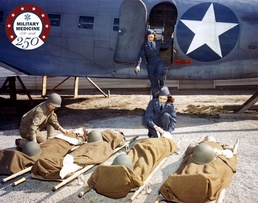
During World War II, U.S. Army Air Force nurses proved aircraft could move sick and injured troops safely over long distances. In January 1943, a specialized aeromedical nurse corps identity took shape as nurses and technicians began deploying overseas in medical air evacuation transport squadrons. Meanwhile, Army 2nd Lt. Elsie Ott, a nurse with no formal air evacuation training, escorted five seriously ill patients from Karachi, then part of India, to Walter Reed General Hospital in Washington, D.C, according to Judith Taylor, Air Force Medical Service senior historian. This first strategic evacuation mission demonstrated the need for trained flight nurses and validated the viability of long-distance aeromedical evacuation.
The U.S. Army Nurse Corps’ first formal class of trained flight nurses graduated Feb. 18, 1943, at Bowman Field, Kentucky. The honor graduate, Army 2nd Lt. Geraldine Dishroon received the first wings presented to a flight nurse and served on the first air evacuation team to land on Omaha Beach after the D-Day invasion in 1944.
The U.S. Army continued to support the medical needs of the U.S. Air Force after its creation on Sept. 18, 1947, until the establishment of the AFMS and the Nurse Corps in 1949.
Air Force Col. Verena Zeller, named the first chief of the Nurse Corps in 1949, had served in the U.S. Army Nurse Corps since 1936 and completed the flight nurse course in 1946. She was promoted to lieutenant colonel in 1950 and colonel in 1951.
Zeller led the corps through its first major test, the Korean War. At the time, only 181 of the corps’ 1,170 nurses were designated as flight nurses. Within a few weeks of the outbreak of hostilities, however, 200 Air Force nurses were actively engaged in the aeromedical evacuation of patients in the Zone of the Interior and overseas. With few fixed U.S. Air Force hospitals on the Korean Peninsula, nurses served mainly in aeromedical evacuation roles or in hospitals offshore in Japan. At the peak of the Korean War, almost 3,000 U.S. Air Force nurses served on active duty.
During the Vietnam War, more than 4,000 U.S. Air Force nurses served. U.S. Air Force nurses were instrumental in evacuating large numbers of those injured from Southeast Asia — including March 7, 1969, when 711 patients were evacuated from Vietnam on 12 missions. In 1973, flight nurses repatriated 591 American prisoners of war.
In support of the wars in Iraq and Afghanistan, the Nurse Corps played a pivotal role including at the peak of the Iraqi invasion between March and May 2003 with more than 2,000 aeromedical evacuations.
In 2026, nurses now serve in military hospitals and clinics, operational units, and mobility missions, including aeromedical evacuation and other settings where care must move with the force. They work across general medicine and numerous specialties, including clinical nursing, critical care, emergency and trauma nursing, flight nursing, mental health, obstetrics, and operating room nursing.
Landmark moments and historical figures of the Nurse Corps include:
More than seven decades after its creation, the Nurse Corps provides vital support to the Airman and Guardian with its vision: “The World’s Premier Nursing Service, Answering the Call ... Always is our beacon.”
Spotlight page recommendations: Military Medicine 250
Recommended Content: