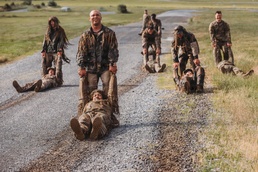
FORT INDIANTOWN GAP, Pa - U.S. Army Soldiers with the Recon Section of the Multi-Purpose Company, 1st Battalion, 112th Infantry Regiment, 56th Mobile Brigade Combat Team, 28th Infantry Division conducted a ghillie wash training event here June 25, 2026.
Using Fort Indiantown Gap’s mire pit training site as the location, the Soldiers were put through a period of intense physical training in their ghillie suits, crawling through water, sand, mud, rocks and grass.
A ghillie suit is a camouflage garment often worn by snipers that is designed to resemble heavy foliage, grass or terrain.
This physically intensive event builds camaraderie and promotes teamwork, but also has a very practical purpose, said Sgt. 1st Class Kyle Benich, acting first sergeant for the MPC.
“It weathers their ghillie suits from being shiny and new, testing the durability of the suit and the mental fortitude of the Soldier in the suit,” Benich said. ”I’m very proud of the work these Soldiers have put into their suits and learning the craft during this training period.”
Benich added that a ghillie wash is also used as an initiation process for would-be sniper candidates.
Spc. Collin Hoch, who has been in the Recon section for about three years, tested his newly constructed ghillie suit during this event. He explained that the ghillie wash highlighted the need to be very physically fit to handle the physical requirements of the job.
“That event was a smoker,” Hoch said. “You need to put a lot of thought and preparation into the suit you make so you can trust it – my pants ripped during the event. Preparation and planning are really important.”
As the battalion shifts from a Stryker brigade combat team to a mobile brigade combat team, emphasis is being placed on ensuring knowledge continues to get passed on to younger, newer Soldiers.
Sgt. Dakota Williamson, who has more than a decade of experience in the Sniper Section and has placed in the Pennsylvania state sniper competition, explained that the training conducted during this year’s Annual Training was intended to build a base of knowledge within the Recon section. It was also designed to make all members of the Recon section proficient in sniper operations to give them the best chance possible at passing Sniper School when they attend, Williamson said.
During training a variety of sniper weapon systems were used, including the MK22 Advanced Sniper Rifle, the M2010 Enhanced Sniper Rifle and the M110A1 Squad Designated Marksman Rifle. Members of Recon were given classes on different types of range estimation unassisted and all optics assigned to them.
Classes on ballistics, environmental factors, and spotter responsibilities were included to effectively engage targets out to 1,000 meters from various different shooting positions.
Members of Recon practiced and were tested on unknown distance engagements, ability to give a shooter corrections to their data to make an accurate second round engagement, and marksmanship fundamentals including a “grouping” exercise which highlights any deficiencies in fundamentals and is a requirement to attend sniper school.
“What we went over highlighted a lot of the little things to think about, like spin drift and the Coriolis effect and how those things affect firing at stationary and moving targets,” Hoch said. “These classes helped me really dial in. I built a lot of confidence over AT; we did a lot of practical events after the classes. I definitely feel more prepared for when I get a slot for Sniper School.”