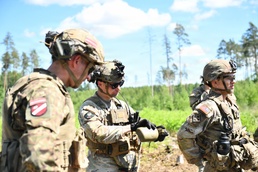
A mosquito lands on the back of a 107th Engineer Battalion Soldier’s neck. Their calloused hand swats at the pest before returning to the excavator’s controls and the mission’s work—digging trenches in the warm summer ground. Hot-rolled steel formed into a bulldozer’s blade cuts, piles, and builds soil for the defense of tomorrow. Sweat beads between brow and safety glasses, stinging the eyes of the operator as the sun hangs high. Tonnage and tracks move deliberately across endless shadows of pine, driving forward over clay, rock, and loam. The modern plow tills the land, cultivating a field of security. A Latvian soldier fells trees into intricate abatis, tied together with wire. These formidable fortifications point east. Bunkers are buried and earthworks raised—a final bastion of freedom against a history that rhymes. Barriers are filled, uniforms stained, and engagement areas develop into a shared burden.
This is the Eastern Flank Deterrence Initiative.This is the line to be held.This is Latvia.
The Partnership
Shortly after regaining independence from the Soviet Union in 1991, the Armed Forces of Latvia entered the initial cohort of the National Guard Bureau’s State Partnership Program (SPP) in 1993. Latvia joined forces with the Michigan National Guard in the SPP, starting a training relationship that has endured for three decades. The program enabled military-to-military engagements to flourish between the two partners, permitted the Michigan National Guard to formalize security cooperation activities with Latvia, and introduced other Michigan resources to the Baltic state through a whole-of-government approach.
Soldiers of the 107th Engineer Battalion, headquartered in Ishpeming, Michigan, have trained with Latvian soldiers since the beginning of this partnership. For more than 30 years, Soldiers from the partner nations have developed friendships that span distance and time. During each recurring training engagement, new ties are forged through mutual trust and interoperability. These bonds helped enable the successes of this summer’s multinational engineer effort.
Boots-on-the-ground engineer operations between Latvia and Michigan occurred throughout June 2026, though planning efforts for the mission have been ongoing. According to Sgt. 1st Class Timothy Corrigan, operations noncommissioned officer for the 1431st Combat Engineer Company, “The overall mission took tireless hours of planning and coordination with units of several nations, to include the Latvians, Danes, and the NATO Multinational Division–North.”
Working together, tactical-level echelons from each nation built collective mission readiness. “The Soldiers gained experience developing and building a layered countermobility obstacle, which started from a drawing on paper and finished with the completion of a complex obstacle group,” Corrigan said.
The Ground Game
Soldiers from Headquarters and Headquarters Company, 107th Engineer Battalion; the 1431st Combat Engineer Company; and the 1432nd Engineer Support Company combined efforts with the Zemessardze (National Guard) of the Latvian Armed Forces and the Danish Army’s 3rd Construction Battalion to continue the years-long development of training areas at the Selija Military Training Ground in Latvia. The focal point of the site is an integrated obstacle belt and intermediate staging area. These defensive fortifications provide a critical foundation for the Latvian Armed Forces and NATO partners to train formations on terrain that mirrors Latvia’s eastern defensive positions.
This training area is modeled after a similar obstacle belt being constructed by the Baltic nations of Latvia, Estonia, and Lithuania in an area of operations known as the Baltic Defensive Line (BDL). This countermobility corridor is being built in part to deter enemy action. Should an adversary contest the sovereignty of these nations along the BDL, the conflict would likely incur a far larger fight on NATO’s doorstep. Creating a hard target is a measured step toward proactive survivability and self-determination. A training area built for the conflicts of tomorrow must be constructed with the sweat equity of today.
“Along with developing the BDL training area, the 1431st emplaced a complex trench and bunker system designed using Latvia’s lessons learned from the Ukrainian Army in their current conflict with Russia,” Corrigan said.
Trench warfare has become a central feature of the past four years of the Russo-Ukrainian War. Just as shrapnel and airburst artillery drove armies into trenches and dugouts during World War I, drones and sustained indirect fire barrages have produced similar effects along Ukraine’s eastern, southern, and northern borders.
By working with Latvian forces to develop a trench warfare training area, the 1431st is providing a proving ground for Baltic states to practice deliberate defense reflective of modern conflict. While it may appear simple to transition from squad maneuver in wooded terrain to Soldiers occupying extended trench networks, modern lessons learned indicate otherwise. Shooting, moving, and communicating in trenches presents unique challenges—shortened lines of sight, fortified strongpoints, and angles of fire that must be carefully understood.
“In the surrounding area, individual and vehicle fighting positions were also created and tied into the terrain for training on engagement area development,” Corrigan said.
The 1431st Combat Engineer Company, headquartered in Calumet, Michigan, worked shoulder to shoulder with Latvian 1st Brigade Zemessardze Soldiers, sharing techniques for preparing defensive positions. While a fighting position may begin with a backhoe or bulldozer blade, the effectiveness of the position comes from NCOs compiling sector sketches and Soldiers using available resources to improve their foxholes.
“The fighting positions were constructed using HESCO barriers and concrete ‘Lego’-style blocks,” said 1st Lt. Austin Schondel, battalion training officer for the 107th Engineer Battalion. “The Soldiers also worked side by side with engineers from the Danish Army’s 3rd Construction Battalion. American equipment operators learned valuable skills from the experienced Danes on how to best employ NATO-provided equipment,” he added.
Getting to the Fight
The essence of countermobility is creating conditions that disrupt, fix, turn, or block enemy forces to achieve a commander’s desired effects on both enemy and terrain. While the ultimate destruction of an adversary may come through counterattack, countermobility sets the conditions for success. If countermobility begins with an obstacle, a counterattack begins with an Intermediate Staging Base (ISB).
Enter the 1432nd Engineer Support Company.
The 1432nd, based in Kingsford and Gladstone, Michigan, is tasked with providing general engineering support for division-level and higher echelons. While the 1431st focuses on combat engineering, the 1432nd delivers light, expedient construction capabilities through rapidly deployable, modular platoons. In short, the unit is built to build on short notice.
An Intermediate Staging Base transforms potential energy into kinetic energy. It's where commanders finalize plans, top off fuel tanks, rack ammunition, and unleash combat power. ISBs are positioned close enough to the forward line of troops for rapid deployment, yet far enough back to support logistics operations beyond bare essentials. This strategic positioning enables units to integrate seamlessly with their follow-on headquarters.
“Interoperability with our NATO partners is a must,” said Schondel, who also serves as executive officer of the 1432nd Engineer Support Company. “The involvement of Danish engineers was imperative to the mission. The lessons learned from our Latvian and Danish partners are invaluable and will be considered for years to come.”
Importantly, an ISB must provide layered protection against indirect fires to ensure survivability of critical assets. The 1432nd Engineer Support Company cleared the area by removing stumps and debris, filling low spots, and grading and compacting the staging area. They also improved mobility corridors for equipment movement. A unique aspect of this training was the multinational use of engineering equipment on the same worksite—American, Latvian, and Danish engineers operating side by side.
“Working alongside our NATO partners, namely Latvia, and using their equipment, the different operating environment proved invaluable to our training,” said 1st Lt. Collin Metzker, 1st Platoon Leader, 1432nd Engineer Support Company.
“Latvia was an incredible opportunity to advance our operational and tactical proficiencies while strengthening partnerships and enhancing our readiness,” said Spc. Jacob Foster, an equipment operator in the 1432nd Engineer Support Company. “Working with our allies, we feel like we contributed to global security.”
The Effect
The lasting impacts of the operation extend beyond earthworks and obstacles. The training infrastructure will serve Latvian forces and allied partners for years to come, reinforcing defense-in-depth principles and multinational interoperability. For the Michigan National Guard, the mission reinforces three decades of partnership through the State Partnership Program and sets conditions for future cooperation.
The Eastern Flank Deterrence Initiative remains strong, built on shared sacrifice, trust, and the enduring commitment of allied nations prepared to face the challenges of tomorrow.