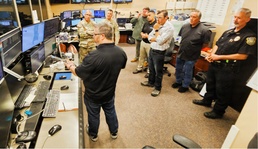
Fort McCoy is taking another significant step to strengthen installation safety and emergency response by implementing a Next Generation 911 (NG911) System, providing emergency dispatchers with faster, more accurate, and more resilient communications capabilities to support the thousands of service members, civilian employees, family members, contractors, and visitors who live, work, and train on the installation.
The modernization replaces the installation’s traditional analog-based 911 system with an Internet Protocol (IP)-based emergency communications network that delivers more detailed information to dispatchers and enhances coordination among first responders.
The upgrade supports the Fort McCoy Directorate of Emergency Services (DES), whose police officers, firefighters, emergency dispatchers, and emergency management personnel respond to incidents across the installation’s approximately 60,000 acres. Their responsibilities include law enforcement, structural and wildland firefighting, emergency medical response, hazardous-material incidents, traffic accidents, severe weather emergencies, training accidents, and mutual aid support with surrounding communities when needed.
“Every second matters during an emergency,” DES officials said. “Next Generation 911 provides dispatchers with more accurate information sooner, helping first responders arrive faster and better prepared.”
Modernizing emergency communications
Traditional 911 systems have relied primarily on voice calls transmitted over analog telephone networks. While dependable for decades, those systems offer limited information beyond the caller's phone number and approximate location.
NG911 transforms emergency communications by using secure broadband and IP-based technology to deliver voice, text, and enhanced location information through a modern digital network.
The new system provides several important capabilities:
— Text-to-911: Individuals who cannot safely make a voice call, or who have hearing or speech disabilities, can communicate directly with emergency dispatchers through text messaging.
— Improved location accuracy: Enhanced geolocation technology helps dispatchers identify the location of mobile callers much more quickly and precisely than legacy systems that relied primarily on cellular tower triangulation.
— Greater system reliability: If a dispatch center experiences technical issues or becomes overwhelmed during a major emergency, calls can be automatically rerouted to alternate communications centers, ensuring emergency calls continue to be answered without interruption. These capabilities allow dispatchers to provide responding police officers, firefighters, and emergency medical personnel with more complete situational awareness before they arrive on scene.
Supporting Fort McCoy’s readiness mission
As one of the Army’s premier Total Force training centers, Fort McCoy supports year-round training for active-duty, National Guard, Army Reserve, and other Department of Defense units from across the nation. The installation also serves as a Mobilization Force Generation Installation and Strategic Support Area, annually supporting tens of thousands of military personnel during exercises, mobilizations, and specialized training events.
That mission depends on a highly capable emergency response system.
Whether responding to training incidents on maneuver areas, structural fires, medical emergencies in cantonment facilities, hazardous-material incidents, or severe weather events, DES personnel play a critical role in maintaining a safe training environment and ensuring operational readiness.
The implementation of NG911 further strengthens that mission by improving communication between emergency callers, dispatchers, and first responders while supporting interoperability with local, state, and federal emergency communications partners.
A tradition of service
Fort McCoy has served the nation since its establishment in 1909 as Camp McCoy. Over more than a century, the installation has supported training and mobilization for every major U.S. conflict from World War I through today's global operations.
Throughout that history, emergency responders have remained an essential part of the installation's infrastructure, protecting soldiers, civilian employees, families, and critical facilities while enabling uninterrupted training and mission support.
Today's Directorate of Emergency Services continues that tradition by combining law enforcement, fire protection, emergency communications, physical security, and emergency management into an integrated public safety organization dedicated to protecting Fort McCoy's people and resources.
The adoption of the Next Generation 911 system represents another milestone in that continuing commitment, ensuring Fort McCoy's emergency responders have the modern technology needed to respond quickly, coordinate effectively, and help safeguard the installation for years to come.
Learn more about Fort McCoy online athttps://home.army.mil/mccoy, on Facebook by searching “ftmccoy,” on Flickr at https://www.flickr.com/photos/fortmccoywi, and on X (formerly Twitter) by searching “usagmccoy.” Also try downloading the My Army Post app to your smartphone and set “Fort McCoy” or another installation as your preferred base.
Fort McCoy is also part of Army’s Installation Management Command where “We Are The Army’s Home.”
(Article submitted by the Fort McCoy Directorate of Emergency Services.)