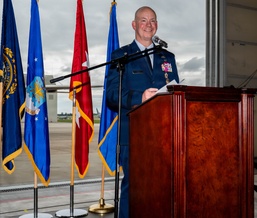
PEASE AIR NATIONAL GUARD BASE, N.H. – "Life happens when you’re busy making other plans," said the retiring New Hampshire Air National Guard commander, Brig. Gen. William Davis, reflecting on a military journey that was never supposed to be a lifelong career.
After paying his own way through Boston University, he enlisted as a private first class in the Army National Guard as an airborne infantryman. Eventually, he commissioned as an officer, and in 1998, transferred to the Air National Guard as a traditional guardsman in public affairs.
Davis’ original plan was to serve 20 years and retire as a part-time guardsman with the rank of major. However, a succession of tours and activations revealed the profound value of military membership and prompted a decision to make the military a full-time career.
Interestingly, the path to success was paved with early rejection. When trying to transfer to Pease Air National Guard Base, he was rejected for four consecutive jobs. Nine months of disappointment ended when the selected candidate for a public affairs role backed out, leaving him as the runner-up. Two years later, 9/11 thrust public affairs into the spotlight, providing experiences that shaped his entire career trajectory.
"I have learned not to take setbacks so seriously because frequently what subsequently happened ended up fine or better," said Davis.
With the lows, come highs.
Of all the assignments and missions, one of the most monumental highlights was the acquisition of the KC-46A Pegasus. While assigned to work the legislative component of the acquisition, Davis recalls being the first person in New Hampshire to know Pease had been selected to receive the aircraft. He remembered the moment happened on the back patio of the Presidential Inn at Joint Base Andrews, Maryland. A congressional military legislative assistant called with the news. Bound by operational security protocols, he could only share the information with the adjutant general and assistant adjutant general until the public announcement.
"It was an incredible feeling because it was a monumental effort on the part of dozens of people and by extension, the reputation of the unit," said Davis. "It’s one of the highlights of my military career."
According to Davis, while his career was largely positive, it was marked by one profound difficulty: the tragic loss of Brig. Gen. John "Pogo" Pogorek. The devastating event unexpectedly thrust him into the commanding role.
With tears in his eyes, Davis recalls how Pogorek left a lasting impact on his leadership style, particularly through his philosophy that the world is divided into owners and renters. He adapted this concept into his own mantra: wagon pullers and wagon riders.
"If you're a puller, you pull the wagon," Davis explained. "Wagon riders are people who are takers, not givers."
On his desk sits an unusual memento: a dirty, broken metal plow stake. It reminded him of a noncommissioned officer who took the initiative to remove it as a safety hazard when nobody else was looking. To him, that stake represents the ultimate wagon-puller spirit, doing the right thing and going above and beyond, even when out of the spotlight.
A cornerstone of his leadership has been the Citizen-Airman concept and the deep integration between the military and the local community. The profound support from the Seacoast community, from employers to families, was a critical factor in securing the KC-46 and ensuring mission readiness.
According to Master Sgt. Frank Perry, a senior noncommissioned officer with the 157th Air Refueling Wing, Davis has command presence beyond wearing the rank. Perry, who performed as the master of ceremonies for Davis’ retirement ceremony, also mentioned his style, approachability, and even blunt candor as some of the things that define his leadership and what makes him appreciated.
A guiding principle throughout Davis’ tenure has been a quote from a seminar: "Trust can’t be surged." He recalls how that quote proved vital during the COVID-19 pandemic. When the Guard was activated to run testing and vaccination sites, there was no time to build new relationships; they had to rely on the trust already established.
“He is the kind of leader who could say ‘take that hill’ and I guarantee the wagon pullers and riders would all move mountains to make it happen,” said Perry. “That’s simply the type of leader and mentor he is.”
Before hanging up his uniform, he sent a targeted email to the wing's junior enlisted Airmen and NCOs, the future of the force, sharing decades of observations. His parting advice focuses on seizing opportunities and embracing leadership.
For new Airmen, he advises actively seeking opportunities. Most importantly, he considers deployment the best professional military education. Getting out of a comfort zone and focusing on a singular mission builds unparalleled Airmanship.
For mid-level NCOs and company-grade officers, he recommends making preparedness, what he refers to as 360 degrees, by learning from those above rank, below rank, and outside the military. He also urges them to step up to lead. While command is a complex experience, acting as coach, disciplinarian, mentor and judge, there are very few things in life that compare to its rewards.
When asked about the future of the wing, he states he is deeply impressed by the current generation of service members, noting a rising sense of energy and initiative. As he prepares to leave, his confidence in the wing is absolute, forged by watching the team perform flawlessly during recent deployments. In retirement, he plans to pursue a master’s degree in history, spend time on his sailboat, ride motorcycles and volunteer with animals.
"I consider service in the National Guard a vocation ... it's more than a job, it's a way of life," said Davis.
When Airmen look back on his tenure, he hopes they remember him as one thing: a wagon puller.