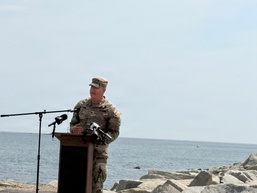
SACO, Maine — Construction has officially begun on a U.S. Army Corps of Engineers priority project to lessen destructive wave energy at Camp Ellis Beach in Saco, Maine.
Col. Justin R. Pabis, New England District commander, joined Assistant Secretary of the Army for Civil Works Adam R. Telle, Sens. Susan Collins and Angus King, Rep. Chellie Pingree, and Saco Mayor Jodi MacPhail at the construction site June 30 to mark the kickoff of the highly anticipated project.
Addressing the audience, Sen. Collins expressed her great pleasure that the project was underway.
“They say that good things come to those who wait and this project certainly proves that old saying,” said Sen. Collins. “But I would say that the vital project that we’re watching today proves that good things come to those who join together who persevere, who never give up.”
Built in 1867 to assist commercial shipping at the Saco River mouth, the original jetty intensified severe erosion on a beach already deeply affected by the dynamic coastal forces of Saco Bay. Financial hurdles that limited federal expenditures for the project stalled potential solutions from becoming a reality. However, persistent advocacy from Collins and King secured a $45 million federal authorization through the Water Resources Development Act, finally allowing the project to advance.
"The specific objective of the project is to directly mitigate the wave energy and impacts associated with the existing jetty," Pabis said. “Currently, waves hit the jetty, roll down its side, and accumulate in both height and energy before battering a shoreline already heavily impacted by the complex hydrodynamics of Saco Bay.”
To combat this, the project—authorized under Section 111 of the River and Harbor Act—will be accomplished in two phases. Phase 1, currently underway, involves constructing a 750-foot stone spur jetty engineered to intercept the waves that follow the existing structure and impact Camp Ellis Beach. Once the spur is complete, Phase 2 will deliver 73,170 cubic yards of sand—enough to fill more than 22 Olympic-size swimming pools—to nourish Camp Ellis Beach. Subsequent renourishments may occur up to the authorized $45 million cost limit.
Once funding was secured, again thanks to support from the congressional delegation, the New England District team compressed schedules, mitigated risks, and worked through months of intense modeling and design. This efficient approach allowed the contract to be awarded years ahead of the typical timeline for such a complex project, aligning perfectly with the USACE "Build Infrastructure, Not Paperwork" (BINP) initiative.
“This project also demonstrates a principle that guides our work at the Army Corps of Engineers: Building Infrastructure, Not Paperwork,” said Telle. “That means reducing unnecessary delays, empowering decision-makers, and focusing our energy on delivering real projects that provide real benefits. The goal is simple. Less time spent navigating process. More time spent delivering results.”
During the event, Pabis thanked the congressional delegation for its relentless efforts to secure funding and extended his appreciation to MacPhail and the residents of Saco for their patience. He also recognized the local advocacy group Save Our Shores Saco Bay, affectionately acknowledging them as the district’s loudest critic.
“Thanks for keeping us honest,” Pabis said.
The Camp Ellis area holds personal meaning for the USACE team. Pabis spent many childhood summers in nearby Biddeford, while Project Manager and Chief of Navigation Jenifer Thalhauser is a Maine native and University of New England alumna with close ties to the region.
“As the commander, I made this work our district’s priority,” Pabis said. “Jen and her team made it a reality.”
Mohawk Northeast LLC is the project’s contractor. Phase 1 is expected to cost $24.4 million and be completed by August 2027. The beach nourishment phase is tentatively scheduled for 2028, contingent upon environmental coordination and temporary work area easements.
“Today is not the end of a long journey,” said Telle. “It is the beginning of a new chapter. In the months ahead, crews will build this critical infrastructure, and the community will begin to see the benefits of years of planning and partnership take shape. The American people expect government to deliver. Today, standing here at Camp Ellis, that is exactly what we are doing.”