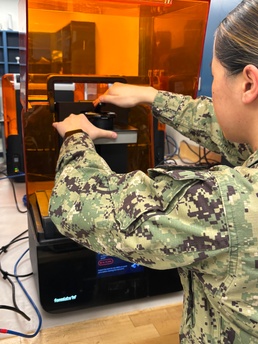
To get submarines built faster and keep them at sea longer, Naval Supply Systems Command Weapon Systems Support (NAVSUP WSS) is leading the expansion of 3D-printed parts used by the Navy’s undersea fleet.
The urgency of the initiative aligns with the US Navy’s strategic goal to produce three submarines per year, specifically, one Columbia-class ballistic missile submarine and two Virginia-class fast-attack submarines. This marks the first time in decades the Navy is building two different submarine classes simultaneously. This has stretched traditional casting and forging processes to their limits, compounding existing workforce shortages and supply chain delays.
To keep up, supply chain leaders are turning to advanced manufacturing, a more accurate term for 3D printing or additive manufacturing, said Lt. Cmdr. Elisabeth Staab, NAVSUP WSS director of platforms, programs, and suppliers for submarines. Staab is leading the command’s efforts to leverage the emerging capability to overcome long-standing submarine supply chain bottlenecks in coordination with Defense Logistics Agency (DLA), Naval Sea Systems Command (NAVSEA) and key defense industrial base partners.
“By streamlining advanced manufacturing policies and breaking down traditional manufacturing barriers, NAVSUP WSS continues to lead the charge in unlocking AM production capabilities, modernizing the industrial base, and accelerating material delivery to the fleet,” Staab said.
While the technology isn’t new, recent advances have unlocked the ability to create parts that meet Navy’s strict requirements for submarine parts.
“I earnestly believe that metallic additive manufacturing is the path to the capability and capacity you need for critical materials in the submarine industrial base,” said Matt Sermon, then-executive director of the Program Executive Office, Strategic Submarines, to the American Society of Naval Engineers in 2023. “And that same holds true for surface ships, and its systems, and for sustainment as well.”
By 3D printing parts, he said, the Navy can reduce lead times, address obsolescence and strengthen the industrial base by increasing speed, capacity, resilience, flexibility and often quality. To this end, the Navy established the Additive Manufacturing Center of Excellence to prototype new materials, provide rapid-response 3D printing for urgent fleet maintenance, and demonstrate advanced manufacturing systems to defense contractors and naval engineers.
The shift has already produced measurable logistical benefits. For example, NAVSEA found the adoption of advanced manufacturing had slashed lead times for some critical components by up to 70%, allowing the naval enterprise to bypass traditional manufacturing bottlenecks.
For the NAVSUP WSS workforce, the shift represents a modernization of how readiness is generated and sustained. Advanced manufacturing enables the construction of complex structures and customized replacement parts, often in a fraction of the time required by legacy methods.
Chief of Naval Operations Adm. Daryl Caudle recently addressed the rapid deployment of 3D-printed components across the fleet and the operational impact of the technology.
“Over the last year, we placed nearly 120 additive manufacturing parts into development, installed 20 of those parts, and eliminated more than 1,400 cumulative days of delay,” Caudle told the Surface Navy Association earlier this year. “That is not a science project. That is combat credibility gained back from the jaws of inefficiency.”
Industry partners are also invested in the transition. According to an executive vice president of America’s largest shipbuilder, the slow production of large, traditional castings has historically gated progress and throughput for both the Columbia and Virginia submarine programs. Corporate officials across the defense industrial base have noted that scaling up heavy-industrial 3D printing capacity can alleviate this by saving critical time and strengthening the broader submarine supply chain.
By unifying stakeholders from DLA, NAVSEA and private industry, NAVSUP WSS remains at the forefront of this supply chain innovation. As the Navy continues to integrate advanced manufacturing into its standard sustainment architecture, the command's proactive coordination will be vital to keeping America’s submarine fleet lethal, resilient and ready for the future fight.
NAVSUP WSS provides the U.S. Navy, Marine Corps, and allied forces the program and supply support for the weapon systems that keep naval forces mission ready. With locations in Norfolk, Philadelphia, Mechanicsburg, and Tucson, NAVSUP WSS manages operational readiness for almost 300 deployable ships, 92 submarines, and 3,700 aircraft worldwide.