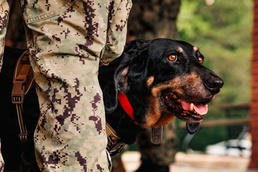
MARINE CORPS BASE QUANTICO, Va. — Head low and scanning through potential targets, she narrowed her focus and tactically approached her first target. An opening opportunity was revealed, and she engaged—wagging her tail.
Bristol is not an ordinary operator, though; she is an 11-year-old Labrador retriever-coonhound mix therapy dog, and those “targets” were the service members and officer candidates she met while on mission to provide therapeutic support.
“Seeing Bristol here literally makes my entire day, and makes my energy shift from being like, 'Oh, I miss home, I miss my family, I want to go home,' to ‘I can do this,'” said U.S. Navy Petty Officer 3rd Class Cailin Northcutt, a hospital corpsman with the John H. Bradley branch of Naval Health Clinic Quantico attached to Officer Candidates School.
For Northcutt and other service members across the globe, therapy dogs offer a sense of community and comfort. For Bristol, she’s volunteered the majority of her time on MCB Quantico since 2019.
On June 11, Bristol patrolled for friendlies at The Basic School and OCS. The first stop was the David R. Ray Clinic at TBS.
As she made her way through the dental lobby, she visited Marines and sailors awaiting assistance and appointments, greeting them with her warm presence. One Marine, though, seemed unsure about being near Bristol. Her handler, Sabrina Hundley, the command secretary of NHCQ, noticed and approached the Marine.
Hundley asked him if he liked dogs, and the Marine replied that he “was never a big fan of dogs.”
With this information, Hundley escorted Bristol to the other Marines, and she let go of the leash to allow her to move freely among the group.
Minutes later, Bristol noticed the one Marine who rejected her previously. In one last attempt, she inched her way calmly towards him; this time, the Marine petted Bristol without hesitation and was grinning ear-to-ear as he did.
“For corpsmen, I would say to see a therapy dog in our clinic is more of a sign of, 'Oh, there's someone there for us,'” said U.S. Navy Petty Officer 3rd Class Jonathan Tu, a hospital corpsman with the David R. Ray branch of NHCQ.
Tu admitted that corpsman experience a demanding job under high stress situations and may not receive the amount of relief, especially after working in the heat for 12 hours a day.
“Bristol is a sense of relief,” he said. “It’s like, 'Oh, there's someone you can relate to.’”
While therapy dogs are sometimes confused with service animals, their roles differ. Service dogs assist individuals with specific physical needs, whereas therapy dogs are trained to provide comfort and affection to people other than their handlers. This includes visiting environments such as hospitals, schools, nursing homes and military installations.
In Bristol’s case, she’s made 460 visits and dedicated more than 700 volunteer hours to support personnel, landing her the silver and bronze Presidential Volunteer Service Award medals for her significant contribution to community service. In April 2020, she earned the Canine Good Citizen title.
Since military service can be wrought with hardships, therapy dogs are uniquely fitted to provide a common point of connection and a familiar comfort for unit members. For those on Quantico, a lot of those hardships are separations of family, friends and even pets due to the various schools and training that occurs across base.
“Who doesn't love dogs? Dogs make literally everything better,” said Northcutt, a dog owner separated from them due to training. “When Bristol showed up, it was like everyone’s mood shifted here. I was excited to start the day, and everyone crowded around. Bristol is a huge morale booster.”
Northcutt added that the presence of Bristol and other therapy dogs in the medical bay can positively impact candidates awaiting care for illness or injuries, offering brief moments of relief when needed.
“They could absolutely say no at OCS during the cycle,” Northcutt confirmed. “They could technically say, 'We don't think that's a good idea,' but genuinely everyone agreed on, 'Hey, this could make someone's day.'”
After the day’s visit, Bristol returned home with her handler, Hundley.
Hundley explained that Bristol is nearing retirement from her six years of service at 11 years old but also recalled how she ended up becoming a therapy dog.
“People noticed how calm she was,” Hundley said.
One day, while out on her leisure time, she explained, “Somebody walked up to me when we were at the National Museum of the Marine Corps, and they recommended having her tested to become a therapy dog.”
Originally a rescue dog for Hundley, Bristol was then on the way to becoming a therapy dog. In 2019, after Bristol passed the tests, Hundley decided to take her around base while she was off working hours to support the personnel. Hundley and Bristol have been doing this ever since.
The military relies on mutual support during demanding operations. While that support usually comes from fellow service members and medical personnel, therapy dogs offer an additional layer to boost morale.
For units interested in welcoming Bristol for a visit, Sabrina can be contacted at [Sabrina90@aol.com](mailto:Sabrina90@aol.com) to discuss scheduling and available visitation dates.