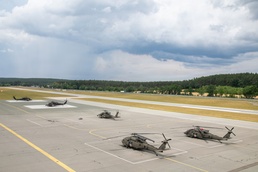
GRAFENWOEHR, Germany—U.S. Army Sgt. Ashton Schübel and Spc. Adrian China sit inside the air traffic control tower at Grafenwoehr Army Airfield, monitoring the steady flow of rotary-wing aircraft operating in and out of the Grafenwoehr Training Area. From the elevated vantage point above the runway, the two Soldiers track movement across controlled airspace, coordinating with multiple facilities, to ensure every aircraft maintains safe separation while supporting daily aviation operations.
Behind the glass and radios, their work is constant and deliberate. Each transmission carries purpose, and each instruction directly contributes to the safe and efficient movement of aircraft supporting training and readiness throughout the region. For Schübel, an air traffic control operator with U.S. Army Europe and Africa, the job is defined by precision and accountability. He described the mission of air traffic control in simple but uncompromising terms. “Our mission, our motto, is safe, orderly and expeditious,” said Schübel. “That is something that we implement into our everyday life when we’re controlling aircraft. What’s going to be the safest, most orderly and expeditious plan of action for each individual aircraft.”
Inside the tower, Schübel works alongside a team responsible for managing both airborne and ground movement across the airfield. The operation is divided into specialized positions that each carry distinct responsibilities but require constant coordination. Ground control oversees aircraft, vehicles and personnel movement on taxiways, parking areas and ramps. Flight data maintains communication between facilities, tracks aircraft movement and ensures information is properly relayed across the installation. The local controller manages aircraft in flight within controlled airspace, sequencing arrivals and departures while maintaining separation standards. Together, the team functions as a single integrated system, relying on discipline, communication and timing to keep operations moving safely.
A typical shift begins with equipment checks, facility inspections and turnover briefs from the outgoing controller. Because the tower is not a 24-hour facility, personnel also conduct opening and closing procedures that include broadcast announcements over radio frequencies to advise inbound and outbound aircraft when services begin or end. Schübel emphasized that even routine operations require full attention, especially when coordinating aircraft entering or exiting restricted training areas within the 7th Army Training Command’s Grafenwoehr Training Area. “Ground is in charge of all movement on the apron, parking areas, vehicles, personnel and aircraft,” said Schübel. “Flight data relays information between the tower, radar room and base operations, and the local controller is in charge of all aircraft in the air.”
Within that structure, controllers routinely manage aircraft transitioning through controlled and restricted airspace, including medical evacuation flights that move through the region to support urgent real-world missions. Schübel explained that while controllers are physically separated from aircraft, their decisions directly affect the timing, the routing and the mission execution. “All aircraft have to contact us that are going through our airspace,” said Schübel. “We have to make sure that when they call up, we are promptly responding and giving them what they need. That can be a huge factor when it comes to people’s lives or what they are doing, especially in an emergency.”
Radar systems provide another layer of awareness for controllers inside the tower. While not used to directly control aircraft, radar allows the team to verify aircraft identification, monitor movement beyond visual range and issue safety alerts when potential conflicts arise. “If an aircraft that is not under control is headed in the same direction or toward an aircraft that is under control, then we need to give those safety alerts,” said Schübel. “We are directly responsible for all of that.”
Every transmission is recorded, adding a level of accountability that reinforces the importance of accuracy and professionalism in every instruction. In the event of an incident, controllers may be required to review recorded communications to determine whether proper procedures were followed. The responsibility, Schübel said, is significant, but it is one that comes with the profession. “It can be a very stressful job,” said Schübel. “We have to make sure aircraft are separated, safe, and landing and departing within regulations. Not everybody can do this job.”
That pressure is compounded by the need to maintain technical proficiency and procedural accuracy. Controllers must master standardized phraseology, airspace regulations and operational procedures established through strict guidance. Much of that knowledge is reinforced through continuous study and certification requirements, even after Soldiers begin working in the tower.
Schübel is currently progressing through qualification training, working under supervision as he builds proficiency across multiple positions within the tower environment. Even in training, he said, the expectations remain high. “You have to be able to recall the right information in certain situations and say the right thing,” said Schübel. “We have to train hard and study constantly, but that preparation is what allows us to perform when it matters.”
While Schübel brings experience and mentorship to the tower, Spc. Adrian China represents the next generation of air traffic controllers learning the profession firsthand. Assigned to flight data, China supports coordination between the tower, radar facility and base operations while building familiarity with the complexity of airfield operations. China arrived at Grafenwoehr following training at Fort Rucker, Alabama, the home of Army aviation, and described the transition as both challenging and rewarding. “Working here has been pretty good,” said China. “The work hours are balanced. It can be stressful sometimes depending on traffic, but overall it’s a good environment.”
In his role, China assists with processing flight plans, coordinating with multiple facilities and ensuring information flows correctly across the airfield. The position requires attention to detail and the ability to manage multiple communication channels simultaneously. “It’s a lot of coordination that goes into air traffic control,” said China. “You’re working with different facilities, collecting flight plans, and making sure everything is where it needs to be.”
When asked what drew him to the profession, China pointed to a long-standing interest in aviation and how aircraft are safely controlled from the ground. “I love aviation,” said China. “I wanted to understand how aircraft are kept safe in the air and how they arrive safely to the ground during different phases of flight.”
For China, the learning curve has emphasized the importance of multitasking and composure under pressure, particularly when multiple tasks compete for attention during active operations. “You have to prioritize what needs to be handled first,” said China. “Especially if there is an emergency, like a medevac aircraft, that becomes the priority.”
Despite the challenges, both Soldiers share a common understanding of the mission: ensuring safe and efficient air operations that directly support training readiness at Grafenwoehr Army Airfield. For Schübel, that responsibility is rooted in preparation, discipline and leadership. For China, it is built on curiosity and developing skill in a demanding profession. Together, they represent the layered expertise required to keep Army aviation moving safely across one of Europe’s busiest training environments.
As aircraft continue to cycle through the airfield, controllers remain focused on radios, screens and runway movement. Each instruction issued from the tower contributes to a larger system of coordination that allows aviation units to train, operate and sustain readiness across the 7th Army Training Command’s Grafenwoehr Training Area.
While most Soldiers and aviators may only see aircraft in motion, the work inside the tower ensures every movement begins and ends safely, guided by the steady presence of the air traffic control team above the runway.