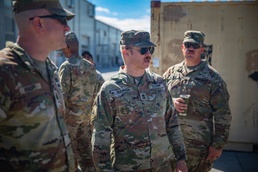
There are no normal days. There are just days.
That is how Master Sgt. Peter Nuoffer describes the work, and once you understand the work, you understand why he refuses the word "normal." Normal implies a pattern, a thing you can prepare for. What Nuoffer does instead is absorb whatever the day hands him: a dead power outlet, a broken-down tow vehicle, a soldier who cannot be found. He responds to issues before most people realize there was ever a problem at all.
Nuoffer, a military police sergeant by trade, is the mayor of Pabradė Training Area, a forward operating site in eastern Lithuania, roughly an hour from the nearest city of any size. He is, by his own description and the Army's, the only noncommissioned officer serving as a mayor anywhere in the Baltics; a job that, almost everywhere else, belongs to a commissioned officer. It is not a glamorous assignment. It does not come with a parade or a patch that people would recognize. It comes with a phone that rings at two in the morning and a base of people that depend on him, whether they know his name or not.
"It's very similar to a mayor in any metropolitan city," he says. "My job is to make sure that the power and water run, to make sure that there are beds and food, to make sure that there is coordination between the various entities that live within our city, and to make sure that we are good stewards of the United States Army, in partnership with our Lithuanian partners."
Strip away the camouflage, and that is, word for word, the job of a mayor anywhere. The difference is that when the lights go out in an American town, somebody calls the power company. Out here, Nuoffer is the call.
His day starts the way every soldier does. Physical fitness is around six in the morning. But it is the next ninety minutes that tell you who he is. By 7:30 a.m., he walks around the entire site, a slow loop that runs about an hour and a half. He checks on the dining facilities. He looks at the buildings. Mostly, he looks for the Soldiers.
"I like to interact with people face-to-face," he says, "so that they get a chance to actually see the people who are responsible for the sustainment of the installation that they're on."
The walk puts a face on a function that is otherwise invisible. It lets other Soldiers on the installation see that the food in the dining facility did not arrive by magic. Someone is responsible, and that person is out walking the ground at half past seven, looking for problems of the day before they become emergencies of the night.
What falls under his care is staggering in its ordinariness and its scope: every facility on the installation, every acre of the cantonment, the motor pool, the maintenance bays, the dining halls, the storage, the fuel yards. The entire physical apparatus that lets a soldier live and train, and all of it runs through the mayor cell. He cannot say how many, for security reasons, but several battalions have rotated through the forward operating site.
"I have had the opportunity to work with elements that I would not normally work with as an MP," he says. "Through this job, I have made some lifelong contacts. And it is an absolute honor to be the person who is responsible for making sure that their experience here is tolerable."
He chooses that word carefully. Not comfortable. Not easy. Tolerable. It is an honest word from a man who knows exactly what he can and cannot give the people in his care.
Ask him what breaks most, what call he dreads, and the joking stops.
"A missing soldier," he says. "We've had two. Both have been located within an hour. But that is the call that I dread getting the most."
It is, he makes clear, about more than logistics. "We do everything we can to ensure that safety is paramount while we're out here," he says, "but not to the point of impeding training."
That is the arithmetic of his job. Safety against readiness. Caution against the mission. He will not stifle a unit's training; he will not smother a soldier's hard-earned downtime. But the responsibility for the people on that installation, their well-being, their safe return home, sits underneath every decision he makes. There is a lighter dread, too, and he offers it almost as relief: the Friday-evening call that someone's power has gone out because a soldier plugged a 110-volt appliance into a 220-volt outlet, and the electricians do not return until Monday. "I get to hear about it over and over and over," he says, "until Monday, when they show up." He laughs, but even in the comedy of the blown outlet, the Soldier's problem becomes his problem. That is the whole shape of the man. Everything that goes wrong on that installation eventually lands on his desk.
You could run this job on maintenance alone. Keep the status quo, make sure things proceed as they always have, and collect no complaints. Nuoffer does the opposite. He is restless about making the place better, and when you ask him why, he reaches backward into his own career.
"I go back to Pfc. Nuoffer, and Spec. Nuoffer, and Sgt. Nuoffer," he says. Referring to versions of himself at posts across the United States, in Korea, in Germany and on the way to Iraq. "I think about my deployments, and what I would have liked to have had if I had been the one in charge of morale, recreation, and welfare. What I wanted to see in the chow hall. Where I wanted to have my downtime. How I wanted my downtime to be spent."
He is building, for these soldiers, the installation he wishes someone had built for the younger versions of himself. He checks his work against the only metric that counts. He asks them.
"I poll the soldiers pretty regularly. 'Is there something you'd like to see, or that you feel you need, to make your stay here better?' Sometimes it's as simple as putting water in a refrigerator. Sometimes it's as complicated as establishing a music concert," which, in fact, the mayor cell is putting on in September.
When he was deputy mayor, the Soldiers lived in containerized housing units. Now they have hardstand barracks. The dining facility was once a tent; now it is a real kitchen with storage. Maintenance happened under canvas; now there is a full facility with a gantry crane and proper tools. Step by step, an austere outpost became something close to a garrison. And the reward for all of it? He struggles to name it because it cannot be counted.
"It's not measurable in smiles, or thumbs up, or metrics," he says. "It's not measurable in morale. You have to see it in person to understand it."
Then he finds the words. "They stand a little taller. They walk a little lighter. They're more motivated."
That is the reward of the mayor's position. Not medals. Not recognition. The almost invisible straightening of a Soldier's spine, the slight lift in a tired person's step, the difference between merely enduring a deployment and excelling on one. Nuoffer trades his every waking hour for that, and considers it a fair trade.
There is no school for this. No course, no manual, no certification that turns a military police sergeant into the mayor of a town.
"You learn through baptism by fire," he says. "Every day you get presented with a new problem. And hopefully, the new problem has some reference to an older problem you've already solved. If it hasn't, good luck. You'll figure it out."
The skill he says matters most is not one you would put on a promotion packet. It is patience, which he insists is a skill, and the interpersonal sense to go with it. "You have to recognize that every individual's problem, in that moment, is important to them," he says. "That doesn't make it more important in the grand scheme. But to that individual, it's the most important problem they've got right now."
And the problems do not wait for their turn. While he solves problem A, problem B arrives. And the people who have problem B want it solved now. If he cannot, they may feel a certain way about that. The job is the constant management of that gap, the promise kept, that we will get to you. He also wants to correct a misconception about what kind of mind the work demands.
"It's not a position for someone who struggles with only analytical thought," he says. "You need to be very creative in this role; to find the opportunities to improve this position and this location."
And when it does go wrong at two in the morning, who fixes it? He swats away the easy, heroic answer. It is not him alone.
"No one person solves a problem," he says. "There's a network of people working together: United States service members, Lithuanian service members, Lithuanian contractors, U.S. contractors. All coming together to resolve whatever issue is presented."
The mayor's real talent is not fixing things with his own hands; he is rarely hands-on at all. It is knowing exactly whose hands to put a problem into. That knowledge was earned the slow way, starting in November when his team first arrived and began asking what felt like redundant questions to the people already on the ground: Who are you? What do you do? What do you know?
"Through that explorative environment," he says, "we discover which individuals I need to go to in order to resolve what problem to achieve the result that benefits both U.S. and Lithuanian forces."
An American master sergeant and a Lithuanian contractor, working different duty hours in different languages, were brought together at 2 a.m. because Nuoffer had, months earlier, taken the time to learn that this particular person was the one who could help. The partnership between two nations, so often described in the language of treaties and summits, lives here too, in a phone call, in the dark, between two people who trust each other because one of them did the work of learning who the other was.
You will not find Pabradė Training Area on a tourist map. Most Americans will never hear its name. The Soldiers who pass through it will remember the training, the cold, the long days in the field, and they may never quite register the reasons why their bed was there and the water was running, and why the power stayed on. It's because the mayor decided their experience was worth his every waking hour.
That is the nature of the work. It is, by design, invisible. When the mayor cell does its job perfectly, nothing happens. No crisis, no outage, no missing Soldier. Just an installation, quietly running, full of people who are free to do their own jobs because someone else is doing this one.
“There are no normal days,” Master Sergeant Nuoffer says. “There are just days.” And on each of them, he gets up before the sun, walks his FOS, and goes looking for the problems, so that the Soldiers in his care can stand a little taller, walk a little lighter, and never once have to think about why.