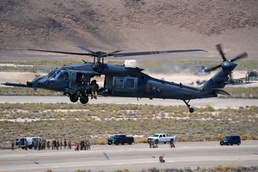
An integration exercise designed to develop new tactics, techniques and procedures, combined support from five wings, seven groups and 17 squadrons across maintenance, logistics, operations, medical, security, safety, fuels, fire emergency services, airfield operations and host-base support June 17, 2026, on Creech Air Force Base, Nevada.
Dubbed VENOM FORGE, this exercise implemented lessons derived from the 57th Maintenance Group’s inaugural Agile Maintenance Leadership Course to develop tactical-level maintenance leaders who can build mission-type orders, manage risk, communicate under friction, generate aircraft and create the conditions for combat airpower to happen.
In preparation for the event, mission partners completed a multi-platform hot-pit refueling site certification at Creech Air Force Base, helping enable contingency hot-pit and Integrated Combat Turn (ICT) training for multiple fighter platforms. The effort also supported the spin-up of four crews on contingency hot-pit and integrated combat turn procedures, creating a foundation for future Agile Combat Employment training iterations.
“Creech’s support was critical because it gave the capstone an unfamiliar environment and helped turn the course concept into executable training,” said Maj. Yoarmerby Gomez, 57th Maintenance Group maintenance tactics officer. “This exercise required more than ramp space. It required access, support equipment, airfield operations, fuels support, fire emergency services, safety, security, medical response planning, host-base coordination and leadership buy-in.”
To execute VENOM FORGE, organizations from the 57th Wing, 99th Air Base Wing, 53rd Wing, 355th Wing and 432d Wing came together to give students a realistic stage to experience how maintenance decisions affect logistics. The students learned how movement timelines affect aircraft generation, how medical and emergency-response planning affects mission risk, and how host-base constraints shape execution.
Creech AFB provided further support with equipment required for execution, facilitation of access across the installation and aided aircraft integration and operations not part of normal day-to-day mission operations.
“Creech provided the right balance of proximity, realism and operational value,” said Gomez. “It is close enough to Nellis to support a controlled hub-to-spoke training model but separate enough to force students to coordinate with a real host base instead of relying on home-station assumptions.”
To further test units involved, an inject involving members suffering from simulated heat stroke was enacted, allowing medical teams on HH-60W Jolly Green II to integrate Critical Care Air Transport while aggressor units conducted hot-pit ICTs on F-35A Lightning IIs and F-16C Fighting Falcons.
“What made VENOM FORGE unique was that every organization had its own reason to be there,” Gomez said. “One of the clearest examples of the training value was the level of deconfliction required on the airfield. At one point, F-35s and F-16s were being refueled and rearmed while two HH-60s were entering the airspace. These elements of controlled chaos were exactly what we wanted the students to experience. It forced multiple agencies to communicate, deconflict and execute safely in a dynamic environment.”
The certification and partnership conducted at Creech has enabled a repeatable foundation for future iterations of the exercise. These next events could include more students from Creech, additional mission partners, different aircraft and more deliberate deconfliction across multiple simultaneous operations.
“For the students, VENOM FORGE showed that aircraft generation is not just a maintenance action,” Gomez said. “Thanks to this exercise, we now have a scalable course model, a stronger relationship with Creech, a multi-agency training framework and a better understanding of what it takes to generate combat airpower from a spoke location.”