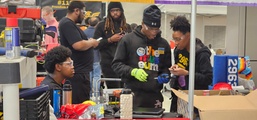
At Portfolio Acquisition Executive (PAE) Strategic Systems Programs (SSP), a unique commitment is placed on developing the command’s future workforce, especially from the ground level. The volunteers of PAE SSP’s science, technology, engineering, and mathematics (STEM) team take that commitment to the next level, supporting the future generation of engineers in the local metropolitan community.
Ishmael Kamara, a general engineer working in PAE SSP’s Missile Branch, is one of those volunteers. Kamara returned for his second year working with the Anacostia High School (AHS) For Inspiration and Recognition of Science and Technology (FIRST) Robotics team, named the AnaDroids, preparing them to compete at this year’s FIRST Robotics Competition in Severn, Maryland. Kamara donated his time several days a week to guide the school’s young engineers through the competition’s engineering design challenge.
“It’s very important for us to do outreach in the communities we exist in,” Kamara said. “Being able to help those students is crucial.”
FIRST is a global nonprofit organization that provides elementary, middle, and high school students with the opportunity to participate in robotics programs, with the long-term goal of promoting STEM education and preparing K-12 students for future careers in STEM fields.
This is the second competition the team participated in under PAE SSP’s mentorship this year, and they were just one of thirty-five different robotics teams from the FIRST Chesapeake District taking part in the contest.
“Each year, there are different goals set for the robots. The competition this year required robots to team up with other schools and involved intaking and shooting balls into a hub,” Kamara said.
The competition, consisting of rotating teams, required students to come up with new and clever approaches to win.
“Each match consists of six robots. The robots are split into two teams red and blue with three robots on each team. In total our team competed in twelve matches with different robots and alternating between red and blue each time,” Kamara said. “This means that in addition to fixing their own robot between matches, the students have to constantly coordinate with their new teammates to develop a strategy for each round.”
Throughout their rounds, the AnaDroids’ robot helped their teams throw nearly nine-hundred balls through the hub. During the competition, judges also walk around and speak to the students directly.
“They would ask them about how they designed the robot, how it works, how long they worked on it, and what they were doing in the competition,” Kamara said.
The potential for judges to give teams awards based on these conversations means that the students have to be able to move beyond designing robots and strategies and actually communicate those designs – and the engineering design process – effectively.
Beyond volunteering, PAE SSP donated supplies and materials that supported Anacostia High School in this year’s robotics competition.
“For this particular robot, PAE SSP purchased a brand-new swerve-wheel drivetrain,” Kamara said. “With more capabilities than the basic tank-wheel drivetrain, such as being able to do a 360 or drive at an angle, we opened up new possibilities for the students. Overall, PAE SSP contributes approximately seventy to eighty percent of the robot. Additionally, the high school participates in other STEM programs that we don’t work with directly, but that are still indirectly supported by some of the materials we provide. For example, we donated a cart that was used to lift up their robot for the FIRST competition, but it worked just as well to lift up their battery-powered electric vehicle that they constructed to race in DC’s annual Electric Vehicle Grand Prix which better prepares them for careers in science and engineering.”
The support that PAE SSP provides to schools in the local community is critical to enhancing PAE SSP’s talent pipeline, which has sparked curiosity and awareness of civilian careers supporting the Department of War. In some cases, these STEM competitions can provide internship opportunities for students entering college, cultivating a network of STEM talent that is ready to tackle tomorrow’s naval engineering challenges.
“We’re currently looking at potentially bringing on an intern who was a senior on the FIRST team last year and is now a freshman in college pursuing engineering,” Kamara said. “We’re constantly looking for more opportunities to better connect to the school and are always looking for more volunteers to provide greater support to the students.”
PAE SSP is responsible for sustaining the strategic weapon system (SWS) on the Ohio-class ballistic missile submarines (SSBN) and supporting the integration of the D5LE weapon system on the new Columbia-class SSBNs. Looking to the future, PAE SSP is actively modernizing the sea-based leg of the nuclear triad through the development of the D5LE2 SWS and pioneering regional strike capabilities of the future through development of the nuclear-armed sea launched cruise missile (SLCM-N) and the non-nuclear hypersonic conventional prompt strike system (CPS).