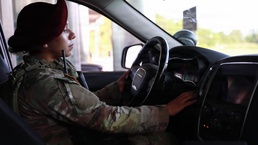
FORT BRAGG, N.C. — For Pvt. 1st Class Katie Ramon, a military police soldier assigned to the 108th Military Police Company (Airborne/Air Assault) ‘Double Stack’, 503rd Military Police Battalion, 16th Military Police Brigade, the role of a military police soldier extends beyond securing installation access points. It requires being ready to respond when lives are on the line.
On May 13, 2026, while serving as the chase vehicle operator at Fort Bragg's All American Access Control Point, Ramon responded when a civilian arrived at the gate experiencing a heart attack. Drawing on recently completed medical training, she immediately began life-saving measures and rotated CPR duties with a gate guard for approximately seven minutes until emergency medical services arrived. The individual survived.
For Ramon, a Houston, Texas native, the response reflected the reason she joined the Army.
"I joined the Army as an MP because I wanted a life of purpose," Ramon said. "Protecting people isn't just a job. It's a responsibility. If I can make someone's worst day a little better, then I've done what I set out to do."
According to Sgt. 1st Class Andrew Veith, platoon sergeant, 108th Military Police Company (Airborne/Air Assault) ‘Double Stack’, 503rd Military Police Battalion, 16th Military Police Brigade, Ramon's actions demonstrated the value of military police medical training and the importance of being prepared to respond under pressure.
"Pfc. Ramon received updated medical training, including how to properly perform chest compressions," Veith said. "It also shows MPs that training isn't just there to check a box. It's there for a reason. It affects people's lives."
Veith said the impact of Ramon's actions extended far beyond the individual she helped that day.
"Ramon's actions saved a life," he said. "Not only did they affect that person, they affected that person's family, friends and the community. Her willingness to act without being told had a ripple effect on everyone involved."
After emergency medical personnel transported the civilian, Ramon returned to her duties at the access control point. She notified her first-line supervisor, gathered information from those involved and completed the required reports before continuing her shift.
For Ramon, responding to the emergency was simply part of the responsibility that comes with serving as a military police soldier.