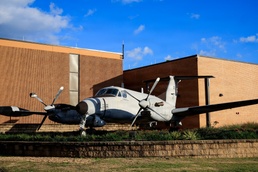
FORT GORDON, Ga. – The U.S. Army Intelligence and Security Command (INSCOM) has announced the strategic relocation of the 116th Military Intelligence Brigade (MIB) from Fort Gordon, Georgia, to Fort Hood, Texas. The move, authorized on March 3, 2026, by then-Chief of Staff of the Army General Randy George, positions the brigade to lead the deployment of the Army’s High Accuracy Detection and Exploitation System (HADES) marking a pivotal step in the modernization of the nation's global aerial intelligence, reconnaissance, and surveillance (AISR) capabilities. This relocation consolidates and redesigns the Army’s only fixed-wing AISR brigade to better support multi-domain and large-scale combat operations globally.
“For over 25 years, the 116th Military Intelligence Brigade has been a cornerstone of excellence at Fort Gordon, providing unmatched aerial intelligence capabilities that have safeguarded our nation and strengthened global security,” said Fort Gordon and Cyber Center of Excellence Commanding General Maj. Gen. Ryan Janovic. “Their departure marks an evolution in their mission and Army transformation. We are proud of the impact they have had on our community and our profession."
Pioneering the Future of Aerial Intelligence
The U.S. Army activated the 116th MIB (AI) at Fort Gordon in 2000, and in 2014 the brigade reorganized to provide the Service a single integrator and headquarters command for disparate AISR platforms deployed around the globe. Unlike other Services, the brigade has both aviation and military intelligence capacities located in a single command structure, enabling rapid generation of combat power and flexibility across land, sea, and air domains.
The move to Fort Hood comes as a result of a 2018 operational gap analysis that identified the Army's legacy AISR fleet as having insufficient reach and outdated sensors to be effective in the aerial-layer domain. To bridge this gap, the Army initiated a rapid transformation strategy, leveraging technology demonstrators to shape the future HADES program. The new facilities at Fort Hood will provide the necessary hangar space for the larger HADES jet aircraft.
“The 116th represents the United States Army's commitment to the global warfighter through our ability to bring the aerial layer to bear to meet Combatant Command and Army Senior Service Commander Priority Intelligence requirements,” said 116th MIB (AI) Commander Col. Matthew McGraw. “We provide deep sensing and intelligence that enables commanders to maintain decision advantage in a complex environment.”
The HADES Program: A Leap in Technology
HADES, a Soldier-crewed aerial intelligence system, uses artificial intelligence and machine learning for rapid data processing, enabling deeper sensing and faster operations, giving commanders a decisive advantage in multi-domain conflicts and shortening the kill chain in high-intensity scenarios. As the first capability fielded under the Army Intelligence and Security Enterprise’s Multidomain Sensing System program, HADES provides a groundbreaking multidomain solution to collection gaps.
Lessons learned from recent demonstrator aircraft fundamentally shaped the HADES program through testing new sensors, expanding a federated analysis and exploitation (A&E) architecture across the Army, Joint, and national agency partners, and completing a basing study to streamline AISR integration, training and operations. Army aviators and onboard sensor operators also received exposure necessary to transition from the legacy aircraft to jet aircraft so they can deploy HADES once fielded.
This initiative revolutionizes the Army’s approach to AISR and demonstrates the Army’s commitment to embracing transformation in contact (TiC), while divesting from legacy systems to invest in rapid, iterative development that delivers next-generation capabilities to the warfighter while remaining engaged in the global AISR mission. On track for delivery in Fiscal Year 2026, the first HADES prototype marks a rapid progression of just five years from the first experiment to an operational system.
“HADES will enable the Army and Joint Force to conduct long-range sensing to enable the execution of long-range precision fires,” said INSCOM Commanding General Maj. Gen. Timothy Brown. "The key to the future of Aerial ISR is the consolidation at Fort Hood of the mighty 116th!"
The restructure will also establish the Army's first operational Unmanned Aircraft System (UAS) Battalion at Fort Hood, Texas. The companies merging to form the UAS Battalion are currently engaged in global operations, and their consolidation will enhance the brigade's agility, deployability, and lethality. The 116th MIB (AI) remains the Army's sole unit deploying small, tailored forward elements to launch UAS remotely operated from home station, significantly reducing sustainment and mobility costs.
The Way Ahead
Beginning in FY2027, the 116th MIB will relocate its headquarters to Fort Hood, Texas, along with two of its battalions. The remaining battalion and companies will relocate starting in FY2028. The move results in 1,228 additional personnel to Fort Hood, Texas, and decreases personnel at Fort Bliss, Texas by 242, Fort Gordon, Georgia by 638, Fort Stewart, Georgia by 186, and Hunter Army Airfield, Georgia by 162.
Fore more information, please contact the INSCOM Public Affairs Office at 703-428-4965 or mailto:army-inscom-pao@army.mil.